In this post, we are comparing Samsung’s ISOCELL Plus vs EXMOR-RS CMOS sensor by Sony semiconductor. Both imaging sensors are built for entirely different camera form factors. The Sony sensors are for their flagship range of mirrorless cameras, whereas ISOCELL+ is for smartphones.
ISOCELL Plus and EXMOR-RS CMOS sensors improve image quality in the latest camera models. Let’s go through the details of each of them:
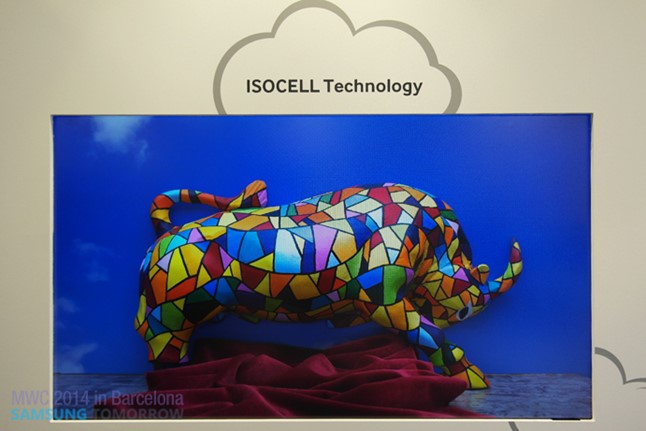
The latest ISOCELL Plus sensor technology from Samsung powers the top-notch cameras seen on the brand’s flagship devices. Samsung tackled the engineering challenges of smartphone cameras and built the ISOCELL Plus technology, which pushes the boundaries of the image sensor to convey color-accurate, crystal-clear photos even in challenging lighting conditions.
ISOCELL technology enables a broader chief ray angle (CRA) by capturing more diagonal light. This eventually allows a brighter lens with a wider aperture that produces clear and more luminous pictures even in low light conditions.
Because of their design, ISOCELL image sensors can also decrease the height of the camera module irrespective of the resolution. Hence, these sensors adopt the sleek form factor of contemporary smartphones.
Five years after the inception of ISOCELL, Samsung has elevated the image sensing technology further with the ISOCELL Plus.
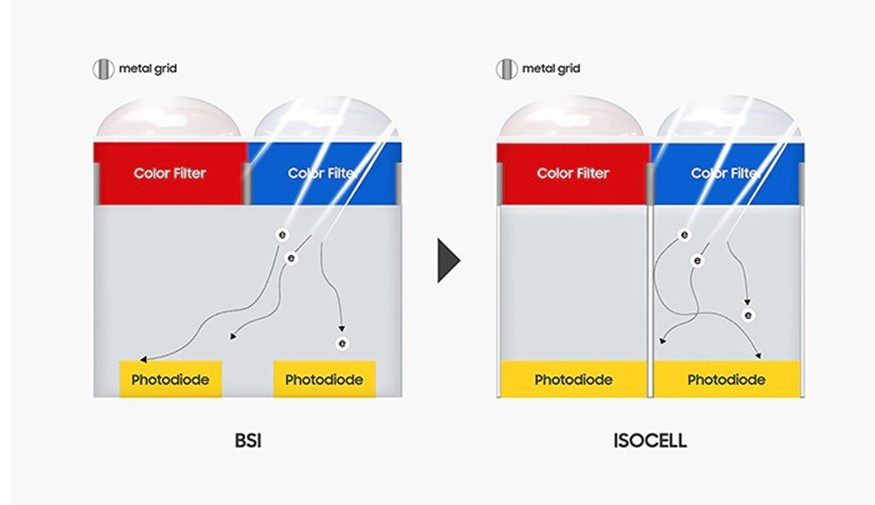
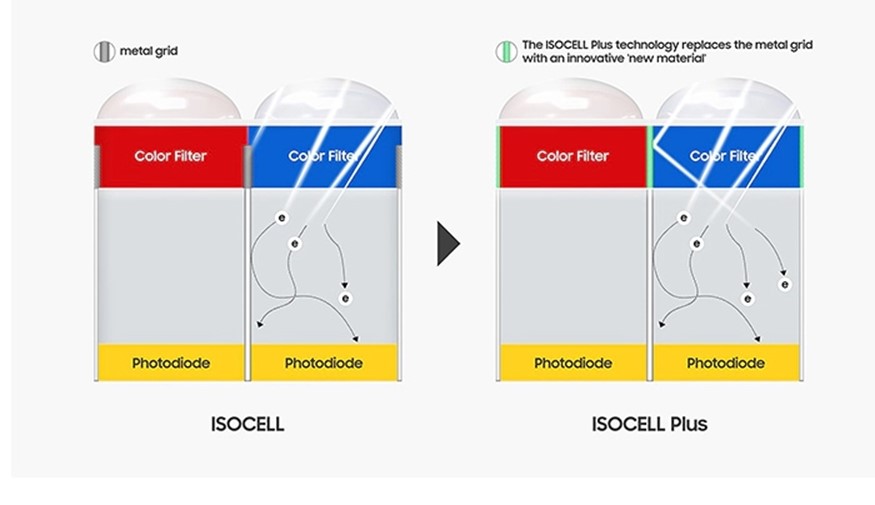
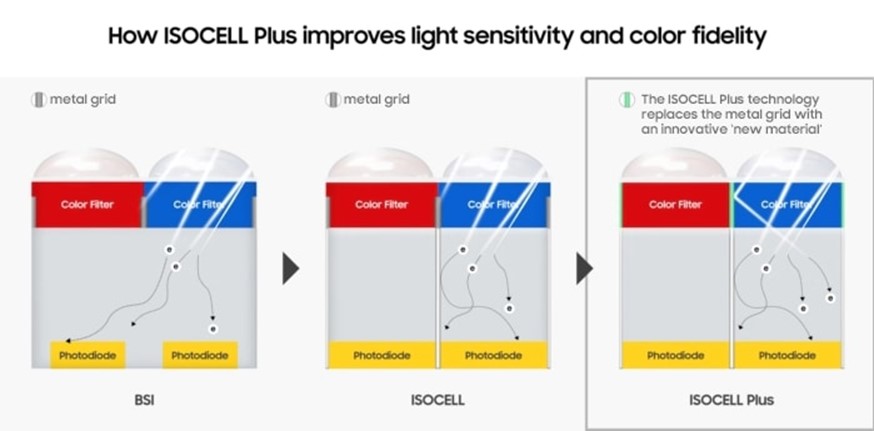
In the traditional ISOCELL technology, the metal grids that isolate the color filter decreases interference between pixels. Also, they lead to some optical loss because they absorb reflected light or incoming light from the neighboring pixels.
On the other hand, the ISOCELL Plus sensor substitutes that metal barrier with an advanced new material developed by Fujifilm. So, it minimizes light reflection and optical loss. The latest ISOCELL Plus technology indicates more accurate and sharper photos, although challenging light environments exist.
The ISOCELL Plus sensor features higher color fidelity and 15% more light sensitivity. Moreover, this sensor is compatible with super-resolution cameras with more than 20 MP resolutions. The technology also allows the image sensor to equip pixel-sized 0.8 µm or smaller without any performance loss. Hence, this sensor is an optimal solution for high-resolution cameras.
ISOCELL Plus sensor not only facilitates the development of ultra-high-resolution sensors with its small pixels but will also provide a performance boost for sensors with more significant pixel designs. The pixels are separated through a unique coating material, leading to a rise in density by 30%.
Samsung launched ISOCELL Plus in July 2018, and since then, it has progressively extended its image sensor lineup built on the technology.
Exmor-RS CMOS sensor:
Sony developed Exmor-RS, the world’s foremost stacked CMOS image sensor that conveys superior picture quality in a compact size. It is designed for use in tablets and smartphones. It includes a unique, advanced ‘stacked structure.’
Sony built this 35 mm full-frame stacked CMOS image sensor with the built-in memory for the high-performance α9. It leads to a lighter and smaller professional camera.
In addition to offering outstanding imaging performance, it entails multiple functions that help reduce components to trim the weight and size of the α9. The idea behind the development is to use natural resources. The structure layers the pixel section that shows results of back-illuminated pixels on the chip attached with mounted circuits for signal processing.
This α9 sensor significantly boosts image quality and performance through powerful AF; vibration-free, silent, constant shooting up to 20 fps, and a blackout-free viewfinder. Note that this sensor packs all the features of a conventional digital SLR mirror, AF sensor, mechanical shutter, and optical finder.
Along with these, it reduces the physical size and weight of the camera. Compared to a conventional full-frame DSLR, for example, Sony’s first full-frame model α900, the α9 is approx. 20% smaller. So, it is easier to carry anywhere. Moreover, this sensor offers performance and speeds beyond the capabilities of other sensor models while using fewer resources.
Sony will also unveil three corresponding imaging modules equipped with these sensors. Of these three modules, two Exmor-RS models that Sony will launch are IMX135 (type 1/3.06 model with 13.13 effective megapixels) and IMX1344 (type 1/4 model with 8.08 effective megapixels). They feature the ‘HDR (High Dynamic Range) movie’ function and the ‘RGBW coding’ function.
HDR movie function allows the configuration of two unique exposure conditions on a single screen when shooting. It flawlessly performs image processing to produce optimal images with brilliant colors and a broad dynamic range, irrespective of the light conditions.
RGBW coding function can capture clear, sharp images even when captured in low light conditions. This function features W (white) pixels in addition to the conventional RGB (red-green-blue) pixel. It leverages Sony’s proprietary device technology and signal processing to enhance sensitivity without negotiating its high resolution.
The third Exmor RS imaging module is the ISX014 (type 1/4 model with 8.08 effective megapixels). It has an in-built camera signal processing function.
Critical features of Exmor RS stacked CMOS image sensor:
Commercializing the latest, independently developed Exmor-RS, equipped with the world’s first unique stacked structure.
The corresponding stacked structure offers superior image quality and a more compact size.
Implemented with ‘HDR movie’ and ‘RGBW coding’ functions (“IMX135” and “IMX134”)
It is implemented with a built-in camera signal processing function that provides compatibility with picture adjustment, automatic controls, and multiple image output formats (like YUV) (“ISX014”).
ISOCELL Plus vs. EXMOR-RS CMOS sensor:
ISOCELL Plus sensor
Exmor-RS CMOS sensor
Compatible with cameras with a resolution of more than 20 MP
Compatible with cameras with resolution up to 13.3 MP
Equip pixels of size 0.8 µm or smaller without any performance loss
The corresponding camera models are 20% smaller than full-frame DSLR cameras
Improves the image quality using higher color fidelity and 15% more light sensitivity
Improves the image quality and performance using powerful AF; constant shooting up to 20 fps, and a blackout-free viewfinder
The output minimizes optical loss and light reflection
The optimal image output shows brilliant colors, sharpness, clarity, and a broad dynamic range, irrespective of the light conditions
When a network camera captures an image, the light passes across the lens and impinges on the image sensor. In addition, the image sensor also contains picture elements known as pixels which record the amount of light that falls on them.
These pixels transform the received light into a relevant number of electrons. The intensity of the light is proportional to the number of electrons generated. These electrons are converted into voltage and subsequently transformed into numbers through an A/D-converter. Consequently, the signal created by the numbers is processed through electronic circuits within the camera.
The original argument a decade ago for the renewal of CMOS image sensors as a competitor to CCD technology was generally based on several ideas:
1- Lithography and operation control in CMOS fabrication had reached tiers that soon would allow CMOS sensor image quality to rival CCDs.
2 – Integration of companion functions on the same die as the image sensor, creating camera-on-a-chip or SoC (system-on-a-chip) capabilities.
3 – Reduced power consumption.
4 – Decreased imaging system size because of integration and reduced power consumption.
5 – Using the identical CMOS production lines as mainstream logic and memory device fabrication, delivering economies of scale for CMOS imager manufacturing.
Currently, two key technologies are prevalent for the image sensor in a camera. They are CMOS (Complementary Metal-oxide Semiconductor) and CCD (Charge-coupled Device). The following sections explain their design and varied strengths and weaknesses.
Initial Prediction for CMOS
Twist
Outcome CMOS vs. CCD
Equivalence to CCD in image performance
Required much greater process adaptation and deeper submicron lithography than initially thought
High performance is available in both technologies today, but with higher development costs in most CMOS than CCD technologies.
On-chip circuit integration
Longer development cycles, increased cost, trade-offs with noise, flexibility during operation
Greater integration in CMOS than CCD, but companion ICs still often required with both
Economies of scale from using mainstream logic and memory foundries
Extensive process development and optimization required
Legacy logic and memory production lines are commonly
used for CMOS imager
production today, but with highly adapted processes
akin to CCD fabrication
Reduced power consumption
Steady progress for CCDs diminished the margin of improvement for CMOS
CMOS ahead of CCDs
Reduced imaging subsystem size
Optics, companion chips, and packaging are often the dominant factors in imaging subsystem size.
Comparable
Color filtering:
Image sensors record the amount of light from the bright to the dark region with no color information. Because CCD and CMOS image sensors are ‘color blind,’ a filter at the front of the sensor enables the sensor to allocate color tones to every pixel.
In this context, two widespread color registration techniques are CMYG (Cyan, Magenta, Yellow, and Green) and RGB (Red, Green, and Blue). Red, green, and blue are the primary colors, which, when combined in varied combinations, can generate the majority of the colors visible to the human eye.
The Bayer array represents the alternating rows of green-blue and red-green filters. It is the ubiquitous RGB color filter. Because the human eye is more sensitive to green color compared to the other two colors, the Bayer array features twice as many green color filters. It implies that when using the Bayer array, the human eye can sense more detail than when all the three colors were used in identical measures in the filter.
An alternate method to filter or record color is to use complementary colors, i.e., cyan, magenta, and yellow. Frequently, the complementary color filters on sensors are merged with green filters to create a CMYG color array. Generally, the CMYG system provides higher pixel signals owing to its broader spectral bandpass.
But, the signals should be subsequently transformed into RGB because this is used in the final image. The conversion indicates added noise and more processing. The outcome is that the initial gain in the signal-to-noise is decreased. Note that the CMYG system is not so efficient at accurately presenting colors.
Usually, the CMYG color array is used in interlaced CCD image sensors. On the other hand, the RGB system is prominently used in progressive scan image sensors.
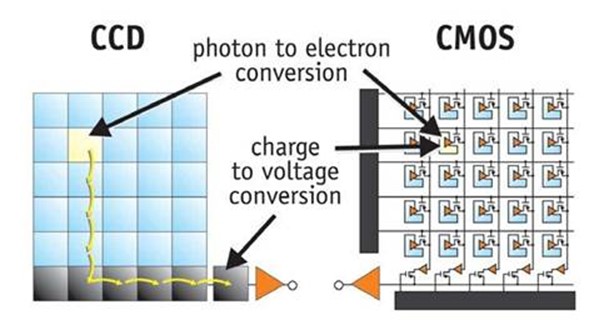
In a CCD sensor, the light impinges on the sensor’s pixels and is conveyed from the chip via one output node or merely a few output nodes. These charges are then transformed into voltage levels, buffered, and delivered as an analog signal. The particular signal is finally amplified and converted to numbers through an A/D-converter exterior to the sensor.
Specifically, the CCD technology was developed to be used in cameras. For over 30 years, the CCD sensors have been utilized. Conventionally, these sensors offered some benefits compared to the CMOS sensors, including less noise and improved light sensitivity. However, these differences have vanished in recent years.
The limitations of CCD sensors are that analog components need more electronic circuitry exterior to the sensor. Also, their production is costly and can consume up to 100 times more power than CMOS sensors. Due to the increased power consumption, there can be heat concerns in the camera. This not only influences image quality negatively but also raises the cost and environmental effect of the product.
Also, CCD sensors need a higher data rate because everything has to pass through only one output amplifier or some output amplifiers.
CMOS technology:
In the beginning, ordinary CMOS chips were deployed for imaging purposes. But the output showed poor image quality because of their inferior light sensitivity. The contemporary CMOS sensors implement a more dedicated technology. Moreover, the light sensitivity and quality of the sensors have quickly augmented in recent years.
CMOS chips provide various advantages. Contrasting the CCD sensor, the CMOS chip includes A/D-converters and amplifiers, reducing the camera expense because it comprises all the logic required to generate an image. All CMOS pixel comprises conversion electronics.
Compared to CCD sensors, CMOS sensors feature better integration possibilities and more functionality. But, this inclusion of circuitry within the chip poses a risk of more structured noise like stripes and other patterns. Moreover, CMOS sensors come with higher noise immunity, lower power consumption, a faster readout, and a smaller system size.
Calibrating a CMOS sensor in production (if needed) can be more challenging than calibrating a CCD sensor. However, technological advancement has made CMOS sensors easier to calibrate. Some of them are currently self-calibrating too.
It is allowed to read individual pixels from a CMOS sensor. This enables ‘windowing,’ which suggests that it is possible to read out the parts of the sensor area rather than the whole sensor area at once.
Consequently, a higher frame rate can be conveyed from a restricted part of the sensor; digital PTZ (pan/tilt/zoom) functionalities can also be used. With a CMOS sensor, it is also possible to obtain multi-view streaming that enables various cropped view areas to be simultaneously streamed from the sensor, ultimately simulating some ‘virtual cameras.’
HDTV and megapixel sensors:
HDTV and Megapixel technology allows network cameras to deliver higher resolution video images compared to analog CCTV cameras. This aspect implies that they expand the possibility of observing details and recognizing objects and people. This is a major consideration in video surveillance applications.
An HDTV or megapixel network camera provides a minimum of twice as high a resolution as a conventional, analog CCTV camera. Megapixel sensors are fundamental components in HDTV, megapixel, and multi-megapixel cameras. They can be used to present very detailed images as well as multi-view streaming.
Megapixel CMOS sensors are extensively available and usually less expensive compared to megapixel CCD sensors. However, there are myriad examples of costly CMOS sensors.
It is tough to create a fast-megapixel CCD sensor. It is a disadvantage and increases the complexity of developing a multi-megapixel camera through CCD technology.
Many megapixel camera sensors are usually identical in size to the VGA sensors, with a resolution of 640×480 pixels. A megapixel sensor includes more pixels than a VGA sensor. Therefore, the size of every pixel in a megapixel sensor converts smaller than that in a VGA sensor.
Consequently, a megapixel sensor is usually less light sensitive per pixel than a VGA sensor. The reason is the pixel size is smaller, and the light reflected from an object spreads to more pixels. But, this technology is swiftly enhancing megapixel sensors. Furthermore, the performance in context to light sensitivity is continuously improving.
Key differences:
A CMOS sensor includes A/D-converters, amplifiers, and circuitry for extra processing. On the other hand, in a camera equipped with a CCD sensor, several signal processing functions are carried out exterior to the sensor.
A CMOS sensor permits multi-view streaming and windowing, which can’t be accomplished with a CCD sensor. Generally, a CCD sensor has one charge-to-voltage converter in each sensor. On the other hand, a CMOS sensor has one charge-to-voltage converter in each pixel. Due to the faster readout, a CMOS sensor is more suitable for use in multi-megapixel cameras.
The latest technology advancements have eliminated the difference in light sensitivity between a CMOS and CCD sensor at a specified price point.
Detailed Comparison of CCD and CMOS sensors:
i. System Integration:
Being an old technology with a CCD sensor, it is impossible to integrate peripheral components like ADC and timers into the primary sensor. Hence, additional circuitry is required, increasing the CCD sensors’ overall size. Furthermore, specialized fabrication techniques are used in making CCD sensors, so it is expensive technology.
The camera can be incorporated into the chip or system in CMOS sensors. Hence, the CMOS sensors are very compact.
ii. Power Consumption:
CCD sensors feature higher power consumption compared to CMOS sensors due to the capacitive architecture. Various types of power supplies are required for the varied timing clocks. The typical voltage for the CCD sensors falls in the range of 7 V to 10 V.
CMOS sensors offer low power consumption compared to CCD sensors because it needs a single power supply. The range of typical voltage is usually 3.3 V to 5 V. So, for the application wherein power consumption is the key criterion, the CMOS sensor is preferable to the CCD sensor.
Since CMOS sensors feature a lower power consumption compared to CCD image sensors, the temperature within the camera can be maintained lower. Moreover, heat issues with CCD sensors can enhance interference. On the other hand, CMOS sensors can have higher structured noise.
iii. Processing Speed:
CCD sensor always needs to read out the entire image, resulting in less processing speed. It is possible to increase it using the multiple shift registers. However, this will demand additional hardware.
In the CMOS sensor, the readout for the particular area of an image is possible; therefore, its speed is higher than the CCD sensor. This speed can be further increased by utilizing the multiple column select lines. Note that the dynamic range of the CCD sensor is considerably higher than the CMOS sensor.
iv. Image distortion:
A blooming effect is visible when a CCD sensor is exposed for an extended period. With the anti-blooming technique, this blooming effect can be reduced.
In a CCD sensor, all the pixels are exposed at once. Hence, if you intend to eliminate the rolling shutter effect, all the pixels must be exposed at the same time. This is called the global shutter effect. So, these days, the CMOS sensors are equipped with global sensors. Since the entire frame is captured at once, there are no wobble, skew, smear, or partial exposure effects.
The most common kind of distortion in CMOS sensors is the rolling shutter. This is because, in the CMOS sensor, the pixels are read line by line. Hence, whenever any quickly moving object gets captured by this CMOS sensor, the rolling shutter effect becomes significantly noticeable.
All portions of a frame are not captured at a time but separately. Subsequently, all parts are showcased at once. As a result, it may add a time lag in frames. So, the images may wobble or undergo a skew effect. But, the high-end CMOS cameras contain more efficient sensors.
v. Noise and Sensitivity:
CMOS sensors have more noise owing to the higher dark currents. The reason is the charge to voltage converter circuit and amplification circuit is incorporated into the same pixel. Hence, the overall fill factor of the CMOS sensor is lesser than the CCD sensor. Consequently, the sensitivity of the CMOS sensor will be lesser than that of the CCD sensor.
In the CMOS sensor, the amplifiers used in every pixel are different. Due to that, we will notice the non-uniform amplification, which would behave as additional noise. However, the technology of this CMOS sensor has progressed so much that the sensitivity and noise of this CMOS sensor are identical to the CCD sensor.
vi. Construction:
CCD chips register the pixels (whenever light strikes) on the chip and subsequently send these pixels one by one. Hence, the time required for transmitting the pixels for one image increases. Because of continuous fetching and sending activities, the chip consumes a lot of power.
In CMOS sensor chips, the sensors themselves have plenty of inbuilt circuitry. This allows reading the pixels at the photo sensor level itself. The detailed data is sent all at once. Hence, there is no time lag, and less energy will be consumed due to this activity.
vii. Vertical Streaking:
When the CCD sensor-based cameras are used in video or live mode, they demonstrate vertical streaking. In these images, a bright vertical line is formed. Because plenty of analog sensors exist in a row, the current that overflows one of the sensors will leak to the entire row. Hence, it creates a vertical line. But, in other modes, CCD sensors don’t exhibit such characteristics.
There are no such concerns in CMOS sensors because every circuit is completely isolated from the remaining circuits on the chip.
viii. Image quality:
CCD sensors boast lower noise levels since their layout enables more pixels to be recorded over their surface. Therefore, the colors of the captured images are more vibrant. As a result, it enhances the image quality.
Conversely, due to their layout, CMOS sensors can’t accommodate more pixels over their surface. Hence, images will have low resolution, which negatively influences image quality.
Because the CCD technology is more advanced than the CMOS technology, the image quality is better. But the drawback of the technology is its higher power consumption and streaking issues.
ix. Application:
CCD sensors are widely used in DSLR cameras. Conversely, due to lower cost and longer battery life, CMOS sensors are extensively used in mobile phones, tablets, digital cameras, etc.
CCD vs CMOS Sensor:
Parameters
CCD Sensor
CMOS Sensor
Resolution
Up to 100+ MP
Sensor elements’ size restricts resolution
More than 100 MP supported
Frame rate
Best for lower frame rates
Best for higher frame rates
Color depth
Higher (16+ bits is standard for expensive CCDs)
Lower (12-16 bits is standard)
Responsivity and linearity
Lower responsivity, wider linear range
Higher responsivity, lower linear range (will saturate early)
Limit of detection
Low (more sensitive at low intensity)
High (less sensitive at low intensity)
Noise figure
Lower noise floor leads to higher image quality
Higher noise floor leads to lower image quality
Conclusion:
CCD and CMOS sensors feature unique benefits. Both these technologies are rapidly evolving. The best suitable strategy for a camera manufacturer is to assess and test sensors for every camera being developed constantly. Subsequently, whether a selected sensor is based on CMOS or CCD becomes irrelevant. So, the only focus is the sensor that can be utilized to build a network camera that conveys the expected image quality and meets the customers’ video surveillance needs.
You can use a CCD sensor to benefit from better image quality and lower cost. You can use a CMOS sensor to help from faster readout speed, low power consumption, lower noise, longer battery life, and no time lag.
The latest ISOCELL Plus camera sensors from Samsung are all set to convey enhanced color accuracy, light sensitivity, and added light gathering capacity in smartphone camera technology. These improvements result from replacing the metal barriers among pixels with walls prepared from a new material.
Smartphone consumers can expect even more precise and clearer photos in dim light environments. CMOS image sensors will be implemented with the optimized pixel isolation technology to fetch these improvements.
In this context, Samsung states that the latest technology will lead to enhanced super-resolution mobile cameras. Although Samsung’s ISOCELL technology is a standard installation in smartphone sensors, it has announced the launch of its latest ISOCELL Plus technology. This technology guarantees enhanced color accuracy and light sensitivity from forthcoming smartphone cameras.
In the existing ISOCELL camera sensors, there is a physical metal barrier between pixels. The purpose of including this barrier is to decrease color cross-talk. However, the metal barrier poses a side-effect of reflecting or absorbing incoming light, which leads to reduced photo quality.
In the prevailing pixel structure, metal grids are created over the photodiodes to decrease interference between the pixels. This can also cause some optical loss as metals reflect and/or absorb the entering light. With the launch of the ISOCELL Plus, Samsung elevates the pixel isolation technology to a new level via optimized pixel architecture.
Image Source: Samsung
Essentially, the ISOCELL Plus technology substitutes that metal barrier with a fresh material developed by Fujifilm. This improves the photo quality by decreasing absorption/reflection and optical loss. Explicitly, Samsung claims a 15%improvement in light sensitivity and a boost in color fidelity.
To capture high-quality photographs, CMOS image sensors must hold maximum light as possible and then transmit the accurate color information to the photodiode. These requirements were solved by the launch of Samsung’s ISOCELL technology in 2013.
Image Source: Samsung
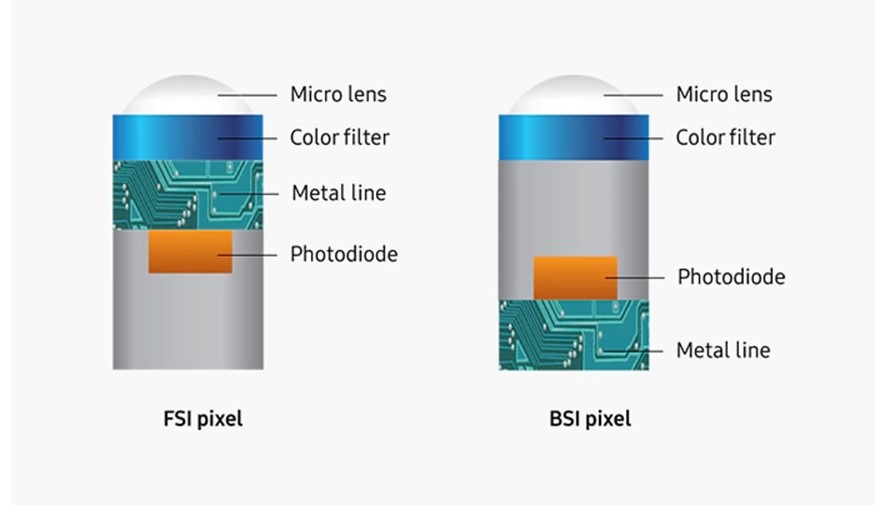
The formation of the physical barrier between adjacent pixels enables every pixel to absorb and retain more light than the traditional backside-illuminated (BSI) image sensor design for outstanding image quality.
The latest ISOCELL Plus Technology will benefit from higher resolution cameras:
Image Source: Samsung
ISOCELL Plus sensors will also be beneficial for higher resolution cameras. The company stated that the technology would permit 0.8 micron and smaller pixels. Therefore, it makes it perfect for super-resolution cameras with a resolution of more than 20 MP.
Most high-resolution smartphone cameras usually excel during the day but show poor performance at night. A large image sensor facilitates better night-time snaps (raising the phone’s thickness), pixel-binning (presenting brighter but lower-resolution snaps), or a dual-camera setup. But the Samsung’s latest ISOCELL Plus technology unlocks the door for another solution without compromising resolution or size.
This light-boosting technology can also benefit telephoto cameras, which usually depict poor performance in low light owing to their smaller apertures. Perhaps, it won’t present an extraordinary improvement in output quality at night. However, it can still be considered an improvement over existing telephoto zoom cameras.
In the context of this technology, Yanagihara, corporate vice president of Fujifilm, stated that they value their strategic relationship with Samsung. He added that this development is a noteworthy milestone for them because it records the first commercialization of their new material. He also stated that through constant cooperation with Samsung, Fujifilm expects to present more significant innovations to mobile cameras.
Ben K. Hur, the vice president of System LSI marketing at Samsung Electronics, said that with this collaboration with Fujifilm, an industry frontrunner in imaging and information technology, Samsung had elevated the boundaries of CMOS image sensor technology.
He added that the ISOCELL Plus technology would facilitate the development of ultra-high-resolution sensors with extraordinarily small pixel dimensions and convey performance advancements for the sensors with more significant pixel designs.
Samsung is exhibiting the tech at Mobile World Congress Shanghai (scheduled to conduct from June 27 to June 29). However, it hasn’t been declared when the first phones with ISOCELL Plus sensors will release. It is expected that we will soon have phones with this technology.
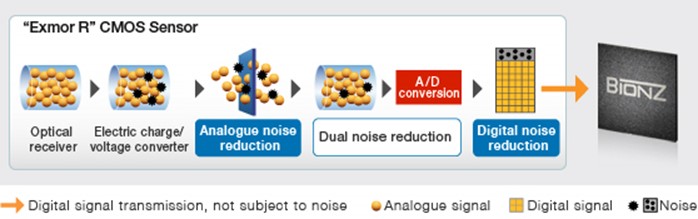
Exmor is the technology name that Sony employed on a few of their CMOS image sensors. Exmor carries out on-chip analog/digital signal conversion and two-step noise reduction in parallel on every column of the CMOS sensor.
It was October 2015 when Sony Semiconductor Solutions was recognized as a solely owned group company to strengthen the CMOS image sensor business and incorporate the semiconductor-related business procedures of Sony Group. After this incorporation, every Exmor sensor is designed and produced by the company.
It was May 14, 2020, when the Intelligent Vision Sensor was publicized with an intro. This preface stated that the Exmor is the first image sensor in the world to be implemented with AI processing functionality.
The latest new sensor differentiates itself from the earlier Exmor RS sensors through an AI processor and a memory that stores the AI models. This memory and processor are in a stacked logic layer for real-time image analysis and immediate metadata extraction from any raw image.
In that release, only model numbers were acknowledged; it was not verified whether the sensor holds a different name.
Exmor R is a back-illuminated version of the Sony CMOS image sensor. On June 11, 2008, Sony announced Exmor R. It was the world’s foremost machine-made implementation of back-illuminated sensor technology.
Furthermore, Sony claims that Exmor R is almost twice as sensitive as a standard front-illuminated sensor.
This active pixel sensor is found in many Sony cameras, mobile phones, and Apple’s iPhone 4s and 5. Formerly, Exmor R was restricted to smaller sensors for compact cameras, camcorders, and mobile phones.
However, on June 10, 2015, Sony ILCE-7RM2 full-frame camera was released. It, too, contains an Exmor R sensor.
Exmor RS is the first stacked CMOS image sensor in the world. Sony announced it on 20 August 2012. Successively, Sony proclaimed the foremost 3-layer stacked CMOS sensor and the same incorporated DRAM cell array in the center.
List of Sony Exmor R, RS Sensors:
Model number
pixels/resolution
Sensor size (diagonal)
Pixel size
Maximum fps
Sensitivity
Saturation signal
Output
Sub-pixel layout
Release date & Utilizing devices
IMX300
–
–
–
–
–
–
Release date:-
Utilizing devices:
IMX315
–
–
–
–
–
–
–
–
Release date:
Utilizing devices: –
IMX318
5488 x 4112 (22.5 Mp))
1/2.6″
1 μm
60-240
–
–
–
RGB
Release date:-
Utilizing devices: –
IMX319
–
–
–
–
–
–
–
–
Release date:-
Utilizing devices: –
IMX320
–
–
–
–
–
–
–
–
Release date:
Utilizing devices:
IMX324
3849 x 1929 (7.42 Mp)
1/1.7″
2.25 μm
40
784 to 2666 mV
800 mV
MIPI CSI-2 serial output (4 lane / 2 lane)
–
Release date:-
Utilizing devices: –
IMX333
–
–
–
–
–
–
–
–
Release date:-
Utilizing devices: –
IMX338
–
–
–
–
–
–
–
–
Release date:-
Utilizing devices: –
IMX345
–
–
–
–
—
–
–
–
Release date:
Utilizing devices: –
IMX350
–
–
–
–
–
–
– –
–
Release date: –
Utilizing devices: –
IMX351
4688 x 3512 (16 Mp)
5.82 mm (1/3.09″)
1 μm
30 to 240 fps
–
–
–
RGB
Release date:
Utilizing devices: –
IMX356
–
–
–
–
–
–
–
–
Release date:
Utilizing devices: –
IMX362
–
–
–
–
–
–
–
–
–
IMX363
4032 x 3024 (12.2 Mp)
7.06 m (1/2.55″)
1.4 μm
30 -240 fps
RGB
IMX371
–
–
–
–
–
–
–
–
Release date: –
Utilizing devices: –
IMX372
–
–
–
–
–
–
–
–
Release date:-
Utilizing devices: –
IMX374
–
–
–
–
–
–
–
–
Release date:-
Utilizing devices: –
IMX376
–
–
–
–
–
–
–
–
Release date:-
Utilizing devices: –
IMX378
–
–
–
–
–
–
–
–
Release date:-
Utilizing devices: –
IMX379
–
–
–
–
–
–
–
–
Release date:-
Utilizing devices: –
IMX380
–
–
–
15
–
–
–
–
Release date:
Utilizing devices:
IMX382
–
–
–
–
–
–
–
–
Release date:-
Utilizing devices: –
IMX383
5544 x 3694 20 MP
–
2.40 μm
32.73 to 575.26
sub LVDS 2 ch
MIPI
RGB
Release date:
Utilizing devices: –
IMX386
3968 x 2976 (12 Mp)
6.2 mm (1/2.9″)
1.25 μm
–
–
–
–
RGB
Release date: Jul, 2016
Utilizing devices: Xiaomi Mi Mix 2, Motorola Moto Z2 Force,
Xiaomi Mi Max 2,
Huawei Honor 6X,
Huawei Nova
IMX390
–
–
–
–
–
–
–
–
Release date:-
Utilizing devices:
IMX398
–
–
–
–
–
–
–
–
Release date:-
Utilizing devices: –
IMX400
–
–
–
–
–
–
–
–
Release date:
Utilizing devices: –
IMX408
1944 x 1104
(16 Mp)
1/3.61″
2.24 μm
100
–
–
RGB
Release date:
Utilizing devices:
IMX409
–
–
–
–
–
–
–
–
Release date:
Utilizing devices: –
IMX412
4056 x 3040 (12.3 Mp)
(1/2.3″)
1.55 μm
60
–
–
MIPI CSI-2MIPI 2 lane
RGB
Release date:
Utilizing devices: –
IMX415
3864 x 2192 (8.46 Mp)
1/2.8″
1.45μm
60 fps@12 Bits, 90 fps@10 Bits
–
–
MIPI
RGB, Color, Bayer Color
Release date:
Utilizing devices: –
IMX435
7764 x 4964 (38.54 Mp)
1/2.7″
4.88μm
–
–
–
Sub- LVDS 16ch and SLVS-EC 16 lane
RGB
Release date:-
Utilizing devices: –
IMX445
–
–
–
–
–
–
–
–
Release date:-
Utilizing devices:
IMX451
–
–
–
10
–
–
–
–
Release date:-
Utilizin devices:
IMX458
4224H × 3192V (13.48 Mp)
5.867 mm (Type 1/3.06)
1.12 μm
30 fps-90 fps
–
1023 LSB
CSI-2 serial data output (MIPI 2 lane/4 lane, max 1.3 Gbps/lane, D-PHY spec. ver 1.1 compliant)
RGB
Release date:-
Utilizing devices:
IMX464
Approx. pixels 2712 × 1538 (4.2Mp)
1/1.8 inch
2.9 μm
–
–
–
MIPI CSI-2
RGB
Release date:-
Utilizing devices:
IMX471
–
–
–
–
–
–
–
–
Release date: –
Utilizing devices: –
IMX476
–
–
–
–
–
–
–
–
Release date:-
Utilizing devices: –
IMX477
4056 x 3040 (12.33 Mp)
–
1.55 μm
15-240
–
–
CSI-2
RGB
Release date:-
Utilizing devices: –
IMX481
–
–
–
–
–
–
–
–
Release date:
Utilizing devices:
–
IMX486
4000 x 3000 (12 Mp)
–
1.25μm
–
–
–
–
RGB Monochrome
Release date: Feb 2018
Utilizing devices: –
IMX498
4608 x 3456 (15.93 Mp)
–
–
–
–
–
CMOS BSI
RGB
Release date:
Utilizing devices:
IMX499
4608 x 3456 (16 Mp)
6.4 mm ( 1 /2.8″)
1.12 μm
–
–
–
–
RGB
Release date:
Utilizing devices: –
IMX503
–
–
–
–
–
–
–
–
Release date:-
Utilizing devices: –
IMX519
–
–
–
–
–
–
–
–
Release date:-
Utilizing devices: –
IMX520
–
–
–
–
–
–
–
–
Release date:-
Utilizing devices: –
IMX555
–
–
–
–
–
–
–
–
Release date: 01/04/2014
Utilizing devices: –
IMX557
–
–
–
–
–
–
–
–
Release date: –
Utilizing devices:
IMX563
–
–
–
–
–
–
–
–
Release date:-
Utilizing devices:
IMX571
6280H × 4264V (26.78 Mp)
(1/1.8″)
3.76 μm
–
–
–
8-lane SLVS-EC output
RGB
Release date:-
Utilizing devices:
IMX576
5760 x 4312 (15.93 Mp)
–
0.9 μm
–
–
–
–
–
Release date:-
Utilizing devices:
IMX577
4056 x 3040 (12.33 Mp)
–
1.55 μm
15-241
–
–
CSI-2
RGB
Release date:
Utilizing devices: –
IMX582
–
–
–
–
–
–
–
–
Release date: –
Utilizing devices: –
IMX586
8000 x 6000 (48Mp)
13.4 mm (1/1.2″)
0.8 μm
30-480
–
–
MIPI
Bayer Color
Release date:
Utilizing devices: –
IMX598
–
–
–
–
–
–
–
–
Release date: 2013
Utilizing devices: –
IMX600/y
–
–
–
–
–
–
–
–
Release date:
Utilizing devices:
IMX603
–
–
–
–
–
–
–
Release date: –
Utilizing devices:
IMX608
–
–
–
–
–
–
–
–
Release date: 05/12/2017
Utilizing devices: –
IMX616
6528 x 4896 (31 Mp)
–
0.8 μm
–
–
–
CMOS BSI
RGB
Release date: –
Utilizing devices: –
IMX663
4032 x 3024 (12 Mp)
–
1.22 μm
–
–
–
CMOS
RGB
Release date:-
Utilizing devices: –
IMX682
9280 x 6920 (64 Mp)
6.10 mm (1/3″)
0.8 μm
–
–
–
CMOS BSI
RGB
Release date:-
Utilizing devices:-
IMX686
–
–
–
–
–
–
–
Release date:
Utilizing devices:
IMX689
–
–
–
–
–
–
–
–
Release date: –
Utilizing devices: –
IMX700
–
–
–
–
–
–
—
–
Release date: –
Utilizing devices: –
IMX703
–
–
–
–
–
–
–
–
Release date: –
IMX707
–
–
–
–
–
–
–
-)
Release date: –
Utilizing devices: –
IMX708
–
–
–
–
–
–
–
–
Release date: –
Utilizing devices: –
IMX766
–
–
–
–
–
–
–
–
Release date: –
Utilizing devices: –
IMX789
–
–
–
–
–
–
–
–
Release date: –
Utilizing devices: –
Other Specifications of Exmor sensors:
Model number
Other specifications
IMX300
–
IMX315
–
IMX318
Image size:
Diagonal 6.858 mm (Type 1/2.6)
Sensor type: 22.5MP CMOS active pixel type stacked image sensor with a square pixel array
The number of active pixels: Approx. 22.5MP (5488(H) x 4112(V))
Unit cell size: 1 µm (H) × 1 µm (V)
Interface: 2-wire
Controller: ARM7
Optical format:
1/2.6″
Applications:
Tablets, PC Cameras, Mobile Phones
IMX319
–
IMX320
–
IMX324
Image size:
Diagonal 9.69 mm (Type 1/1.7)
Sensor type: Area Scan Sensor
Number of effective pixels: Approx 7.42M pixels (3849H × 1929V)
Total number of pixels: Approx 6.60M pixels (2984H × 2212V)
Unit cell size: 2.25 µm (H) × 2.25 µm (V)
Pins: 108
Application: Automotive Camera
IMX333
–
IMX338
–
IMX345
–
IMX350
IMX351
Image size:
Diagonal 5.822 mm (Type 1/3.09)
Sensor Type: Area Image Sensor, Back-Illuminated Sensor
Number of total pixels: Approx 16M pixels (
4688(H) x 3512(V))
Number of effective pixels: Approx 16M pixels (
4656(H) x 3496(V))
Unit cell size: 1 µm (H) × 1 µm (V)
Pins: 72
Shutter type: Electronic Shutter
Optical format:
1/3.09″
ADC resolution: 10 bits
Application:
Tablets, PC Cameras, Mobile Phones
IMX356
–
IMX362
–
IMX363
Image size:
Diagonal 5.822 mm (Type 1/2.55)
Number of effective pixels: Approx 12.2M pixels (
4032(H) x 3024(V))
Unit cell size: 1.4 µm (H) × 1.4 µm (V)
IMX371
–
IMX372
–
IMX374
–
IMX376
–
IMX378
–
IMX379
–
IMX380
–
IMX382
–
IMX383
Number of effective pixels: Approx. 20.48M pixels (5496H × 3672V)
Total number of pixels: Approx 20.48M pixels (5544H × 3694V)
Pixel type: Back-Illuminated Sensor
Unit cell size: 2.4 µm (H) × 2.4 µm (V)
Aspect Ratio: 16:9, 3:2
Clock frequency: 72 MHz
Pins: 258
PGA: 141 dB (Max.)
Shutter type: Electronic
ADC resolution: 10-bit, 12 bit
IMX386
Image size:
Diagonal 6.2 mm (Type 1/2.9)
The number of effective pixels: Approx. 12M pixels (3968 × 2976)
Unit cell size: 1.25 µm (H) × 1.25µm (V)
IMX390
–
IMX398
–
IMX400
–
IMX408
Image size: Diagonal 4.983 mm (Type 1/3.61)
Sensor type: 2 MP CMOS active pixel type stacked image sensor with a square pixel array, black-illuminated sensor
Number of effective pixels: Approx. 2M pixels (1936H × 1096V)
Total number of pixels: Approx. 2M pixels (194H × 1104V)
Optical diagonal: 4.983 mm
Optical format: 1/3.61″
Interface: 2-wire serial
Unit cell size: 2.24 µm (H) × 2.24µm (V)
ADC resolution: 10 bit
Application: PC Camera, Tablet PC Camera, Mobile Phone
IMX409
–
IMX412
Image size: Type 1/2.3
Total number of pixels: Approx. 12.3M pixels (4056H × 3040V)
Unit cell size: 1.55 µm (H) × 1.55 µm (V)
Image output format: Digital 10-bit, 12-bit
Interface connector: Hirose DF40C-60DP-0.4V(51)
Shutter type: Rolling
PGA: Analog: 18 dB (Max.)
Digital: 24 dB (Max.)
IMX415
Image size: Type 1/2.8
Sensor type: 4K-Resolution CMOS Image Sensor for Security Cameras
Total number of pixels: Approx. 8.46M pixels (3864H × 2192V)
Other features: shuttered and shutter-less operation, available in both color and monochrome, 8-channel LVDS output interface for fast image data transition
Applications: Aerial imaging, Flat panel inspection, and Surveillance
IMX222LQJ
Image size: Diagonal 6.23 mm (Type 1/2.9) (Full HD mode) Diagonal 6.40 mm (Type 1/2.8) (WUXGA mode)
The number of effective pixels: 1984H × 1105V, approx. 2.43M pixels
Other features: Global Shutter, Chroma: Color, Monochrome, calculates the direction of polarization and the degree of polarization(DoP) based on the intensity of each directional polarization in realtime, built-in analog memory inside each pixel offers high-speed imaging of up to 163.4
Other features: Global Shutter with variable charge integration time, Built-in timing adjustment circuit, H/V driver and serial communication circuit, low dark current, low PLS characteristic
Applications: FA Cameras, ITS Cameras
IMX421 (Pregius)
Image size: Diagonal 11.0 mm (Type 2/3) approx. 2.86M
Total number of pixels:
1944 (H) x 1496 (V)approx. 2.90M pixels
Number of effective pixels:
1944 (H) x 1472 (V)approx. 2.86M pixels
Other features: Global Shutter with variable charge integration time, Built-in timing adjustment circuit, H/V driver and serial communication circuit, low dark current, low PLS characteristic
PGA: Analog: 24 dB max.
Digital: 48 dB max.
Applications: FA Cameras, ITS Cameras
IMX422 (Pregius)
Image size: Diagonal 9.2 mm (Type 1/1.7) approx. 2.03M
Total number of pixels:
1632 (H) x 1272 (V)approx. 2.07M pixels
Number of effective pixels:
1632 (H) x 1248 (V)approx. 2.03M pixels
Unit cell size: 4.5 µm (H) × 4.5 µm (V)
Interface: SLVS 4 ch/8 ch
Pins: 226
ADC resolution: 8-bit, 10-bit, 12-bit
Other features: Global Shutter, Built-in timing adjustment circuit, low dark current, low PLS characteristic
Applications: FA Cameras, ITS Cameras
IMX425 (Pregius)
Image size: Diagonal 17.6 mm (Type 1.1) approx. 1.78M
Total number of pixels:
1608 (H) x 1136 (V)approx. 1.83M pixels
Number of effective pixels:
1608 (H) x 1104 (V)approx. 1.78M pixels
Unit cell size: 9.0 µm (H) × 9.0 µm (V)
Interface: SLVS 8 ch
Pins: 226
ADC resolution: 8-bit, 10-bit, 12-bit
PGA: Analog: 24 dB max.
Digital: 48 dB max.
Input frequency: 37.125 MHz/74.25 MHz/54 MHz
Other features: Global Shutter with variable charge-integration time, Built-in timing adjustment circuit, H/V driver and serial communication circuit, low dark current, low PLS characteristic
Applications: FA Cameras, ITS Cameras
Recommended lens F number: 2.8 or more (Close side)
Recommended exit pupil distance: –100 mm to –∞
IMX426 (Pregius)
Image size: Diagonal 9.2 mm (Type1/ 1.7) approx. 0.51M
Total number of pixels:
816 (H) x 656 (V)approx. 0.54M pixels
Number of effective pixels:
816 (H) x 624 (V)approx. 0.51M pixels
Unit cell size: 9.0 µm (H) × 9.0 µm (V)
Interface: SLVS (2ch/4 ch/8 ch switching)
Pins: 226
ADC resolution: 8-bit, 10-bit, 12-bit
PGA: Analog: 24 dB max.
Digital: 48 dB max.
Input frequency: 37.125 MHz/74.25 MHz/54 MHz
Other features: Global Shutter with variable charge-integration time, Built-in timing adjustment circuit, H/V driver and serial communication circuit, low dark current, low PLS characteristic
Applications: FA Cameras, ITS Cameras
Recommended lens F number: 2.8 or more (Close side)
Recommended exit pupil distance: –100 mm to –∞
IMX428 (Pregius)
Image size: Diagonal 17.6 mm (Type 1.1) approx. 7.10M
Total number of pixels:
3216 (H) x 2224 (V)approx. 7.15M pixels
Number of effective pixels:
3216 (H) x 2208 (V)approx. 7.10M pixels
Unit cell size: 4.5 µm (H) × 4.5 µm (V)
Interface: SLVS (4 ch/8 ch switching)
Pins: 226
ADC resolution: 12-bit
PGA: Analog: 24 dB max.
Digital: 48 dB max.
Input frequency: 37.125 MHz/74.25 MHz/54 MHz
Other features: Global Shutter with variable charge-integration time, Built-in timing adjustment circuit, H/V driver and serial communication circuit, low dark current, low PLS characteristic
Applications: FA Cameras, ITS Cameras
Recommended lens F number: 2.8 or more (Close side)
Recommended exit pupil distance: –100 mm to –∞
IMX429 (Pregius)
Image size: Diagonal 11.0 mm (Type 2/3) approx. 2.86M
Total number of pixels:
1944 (H) x 1488 (V)approx. 2.89M pixels
Number of effective pixels:
1944 (H) x 1472 (V)approx. 2.86M pixels
Unit cell size: 4.5 µm (H) × 4.5 µm (V)
Interface: SLVS (2 ch/4 ch switching)
Pins: 226
ADC resolution: 12-bit
PGA: Analog: 24 dB max.
Digital: 48 dB max.
Input frequency: 37.125 MHz/74.25 MHz/54 MHz
Other features: Global Shutter with variable charge-integration time, Built-in timing adjustment circuit, H/V driver and serial communication circuit, low dark current, low PLS characteristic
Applications: FA Cameras, ITS Cameras
Recommended lens F number: 2.8 or more (Close side)
Recommended exit pupil distance: –100 mm to –∞
IMX430 (Pregius)
Image size: Diagonal 9.2 mm (Type 1/1.7) approx. 2.03M
Total number of pixels:
1632 (H) x 1264 (V)approx. 2.06M pixels
Number of effective pixels:
1632 (H) x 1248 (V)approx. 2.03M pixels
Unit cell size: 4.5 µm (H) × 4.5 µm (V)
Interface: SLVS (2 ch/4 ch switching)
Pins: 226
ADC resolution: 12-bit
PGA: Analog: 24 dB max.
Digital: 48 dB max.
Input frequency: 37.125 MHz/74.25 MHz/54 MHz
Other features: Global Shutter with variable charge-integration time, Built-in timing adjustment circuit, H/V driver and serial communication circuit, low dark current, low PLS characteristic
Applications: FA Cameras, ITS Cameras
Recommended lens F number: 2.8 or more (Close side)
Recommended exit pupil distance: –100 mm to –∞
IMX432 (Pregius)
Image size: Diagonal 17.6 mm (Type 1.1) approx. 1.78M
Total number of pixels:
1608 (H) x 1136 (V)approx. 1.83M pixels
Number of effective pixels:
1608 (H) x 1104 (V)approx. 1.78M pixels
Unit cell size: 9.0 µm (H) × 9.0 µm (V)
Interface: SLVS (2 ch/4 ch switching)
Pins: 226
ADC resolution: 12-bit
PGA: Analog: 24 dB max.
Digital: 48 dB max.
Input frequency: 37.125 MHz/74.25 MHz/54 MHz
Other features: Global Shutter with variable charge-integration time, Built-in timing adjustment circuit, H/V driver and serial communication circuit, low dark current, low PLS characteristic
Applications: FA Cameras, ITS Cameras
Recommended lens F number: 2.8 or more (Close side)
Recommended exit pupil distance: –100 mm to –∞
IMX433 (Pregius)
Image size: Diagonal 9.2 mm (Type 1/1.7) approx. 0.51M
Total number of pixels:
816 (H) x 656 (V)approx. 0.54M pixels
Number of effective pixels:
816 (H) x 624 (V)approx. 0.51M pixels
Unit cell size: 9.0 µm (H) × 9.0 µm (V)
Interface: SLVS (2 ch switching)
Pins: 226
ADC resolution: 12-bit
PGA: Analog: 24 dB max.
Digital: 48 dB max.
Input frequency: 37.125 MHz/74.25 MHz/54 MHz
Other features: Global Shutter with variable charge-integration time, Built-in timing adjustment circuit, H/V driver and serial communication circuit, low dark current, low PLS characteristic
Applications: FA Cameras, ITS Cameras
Recommended lens F number: 2.8 or more (Close side)
Recommended exit pupil distance: –100 mm to –∞
IMX437LQJ (Pregius)
Image size: Diagonal 11 mm approx. 2.86M
Total number of pixels:
1944(H) x 1496(V) approx. 2.9M pixels
Unit cell size: 4.5 µm (H) × 4.5 µm (V)
Interface: SLVS 8 ch, SLVS – EC 8 Lane
Pins: 226
ADC resolution: 12-bit
Input frequency: 37.125 MHz to 54 MHz
Other features: Global Shutter, Square Pixel Array
The launch of the new Sony 800 series sensors has ushered in a new range of flagship devices. The new 50 MP sensor from Sony, the IMX866, has been considered a game-changer in more ways than one. In today’s post, we will check the differences and similarities between the Sony IMX866 and Sony IMX766 image sensors.
A few recent leaks have indicated that the new IMX 800 series image sensors are bound to grace the new-age flagship devices. The next generation 50 MP sensor should provide you access to one of the unique experiences in getting access to a great experience par excellence.
It is the upgraded version of the IMX766 sensor and provides access to an RGBW pixel-matrix instead of RGGB as in the 766. The sensor comes with a 50-megapixel RGBW large bottom primary camera. The native format offered by the sensor is 16:11, and the sensor size reads 1/1.49-inches.
The best point or factor in its favor would be it offers you a dual-frame sensor functionality. You would get a 16:11 format with a sensor size of 1/1.49-inch, while a 4:3 crop is 1/1.56-inch. It is an RGBW sensor, and thus the intake of light would be much more significant. That should make it a massive upgrade by several counts.
The Sony IMX766 sensor – An Overview
The Sony IMX766 sensor has been one of the excellent options for providing you with one of the incredible experiences on the OnePlus Nord 2. The sensor was one of the unique options for enjoying a genuinely formidable photography experience on the flagship devices.
The camera sensor from Sony is expected to capture the light to up to 56 percent. This can go a long way in helping you improve the colors, sharpness, and shooting in low light conditions. The sensor is equipped with a 50 MP sensor which is optically stabilized. The sensor size reads 1 / 1.56 inches large and comes with 1.0 μm pixels.
The phones equipped with Sony IMX866
The Sony IMX866 is the newest sensor from the Japanese manufacturer and is set to provide you access to a great degree of experience on flagship devices. However, you would not find many devices equipped with the sensor.
As things stand now, the Sony IMX866 will only be available on the Vivo X80. The sensor on the Vivo smartphone can be efficient and helpful in helping you capture more light and is supported by a custom image processing algorithm on the V1+ chip. The manufacturer has gone on record that the smartphone will be a great option for one of the excellent experiences in terms of advanced technological advancements in the camera department.
The Phones with Sony IMX766
The Sony IMX766 predates the IMX866 sensors. That would mean you would find that the sensor is available on a wide range of devices.
Some of the smartphones that come equipped with the sensor would include
Oppo Reno5 Pro+
OnePlus Nord 2
Realme GT Neo 3
OnePlus 10R
Oppo K10 Pro
OnePlus Ace
Realme GT 2 Pro
Xiaomi 12X
Xiaomi 12
Vivo X70t
Oppo Find N
OnePlus 9RT
Oppo Reno 7 Pro
Huawei Nova 9
Huawei Nova 9 Pro
Vivo X70 Pro
Vivo X70
Oppo Reno 6 Pro
Honor Magic 3
Vivo iQOO 8 Pro
Realme GT Flash
OnePlus Nord 2
Realme GT Master Explorer Edition
Oppo Find X3 Pro
Oppo Reno 6 Pro+
Oppo Find X3
Oppo Find X3 Neo
Honor V40
The specifications for the Sony IMX866 and Sony IMX766 image sensors
Having checked out the best options available on the Sony IMX866 and Sony IMX766 sensors, let us now have a comparison table for the two sensors so that you can get a fair idea of what you will likely get.
Features
Sony IMX866
Sony IMX766
Manufacturer
Sony
Sony
Technology
CMOS BSI
RGGB
CMOS BSI
RGBW filter
Resolution
50 MP
50 x 6144, 50 Mega-pixels
Matrix size
NA
8.19 mm x 6.14 mm, Diagonal: 45.51 inch
Pixel size
1 micron, 2 microns after pixel binning
1 micron, 2 microns after pixel binning
Sensor size
1/1.49 (Video with 16:11 aspect ratio )
1/1.56 inches for 4:3 crop (Photos)
1/1.56 inches (all circumstances)
Format
16:11
The Concluding Thoughts
The Sony IMX766 and IMX866 image sensors come with their plus points. The IMX866 is one of the excellent options with the latest developments and enhancements. You would find it gracing the new flagships you would come up with in the coming days.
Of course, as final consumers, we do not have a choice in picking the IMX866 or IMX766 as our preferred image sensor. The decision is left to the smartphone manufacturers, and the information contained here should be an excellent choice to gain good knowledge.
The most suitable home security cameras can provide a bit extra peace of mind by giving you a separate set of eyes both in and outside your house. These cameras work both day and night and transmit you an alert on your phone when they detect somebody or something.
However, there are a bunch of cameras on the market, so picking the best for your objectives can be tricky. In today’s post, we will compare the security cameras from EzViz, i.e., Ezviz c8c, c8c Lite, and c3n.
Max:30 fps; Self-Adaptive during network transmission
Max: 30fps; Self-Adaptive during network transmission
Max: 30 fps; Self-adaptive during network transmission
Video compression
H.265 / H.264
H.265 / H.264
H.264 / H.265
Video bit rate
Ultra-HD; Hi-Def; Standard. Adaptive bit rate.
Ultra-HD; Hi-Def; Standard. Adaptive bit rate.
Ultra-HD; HD; Standard. Adaptive bit rate.
Wi-Fi standard
IEEE802.11b, 802.11g, 802.11n
IEEE802.11b, 802.11g, 802.11n
IEEE802.11 b/g/n
Security
64 / 128-bit WEP, WPA / WPA2, WPA-PSK / WPA2-PSK
64/128-bit WEP, WPA/WPA2, WPA-PSK/WPA2-PSK
64 / 128-bit WEP, WPA / WPA2, WPA-PSK / WPA2-PSK
Water resistance
IP65
Weatherproof, not specified
IP67
EzViz C8C – A Concise review
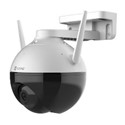
The affordable and weather-resistant options offered by the Ezviz C8C Outdoor Pan/Tilt Camera should be the right choice for protecting your home or office. The support for mechanical pan and tilt controls would give you better control over your camera performance. It can work seamlessly with smart home devices and provides a sharp recording.
However, the camera lacks two-way communication, which can be bothersome. The camera also provides you with a round, black-and-white IP65 weather-resistant enclosure. The mounting bracket is what would make it an excellent option to install on a wall or even an overhang.
The camera can swivel up to 352 degrees and tilt it up to 95 degrees. Some features of the security camera include adjustable Wi-Fi antennas, a 2.4GHz Wi-Fi radio, and a weather-protected MicroSD card slot.
The app used for the Ezviz C8C camera remains the same as the one used for Ezviz DB1C Wi-Fi Video Doorbell and the Ezviz C3X Outdoor Camera. Installing and setting up the camera is quite simple and easy.
As soon as you install and set up the camera, you will begin enjoying a detailed 1080p video. The videos during the day are in color and are pretty vibrant and saturated. The night pictures, which are in black and white, are crisp enough and quite bright enough.
The motion alerts and mechanical pan and tilt operations are pretty responsive.
Pros
A very reasonable and affordable price
A sharper HD quality video
Responsive mechanical pan and tilt operations
Cons
No two-way audio feature
Cannot stream to smart audio devices
Ezviz C8C Lite – A Sneak Peek
There is not much difference between the Ezviz C8C and C8C Lite, and the two come with almost similar features. The 360-degree security camera can be an excellent option in providing you with outstanding performance excellence.
The motorized pan and tilt for the 360-degree coverage are what would provide you with one of the most excellent functions. The AI-powered human figure detection is what you would find unique in several ways. The flexible pan and tilt design should distinguish it from the rest.
The camera provides you with a 1080p video quality. The storage support with a microSD card for up to 256 GB can make it a good choice for crystal clear images and videos. The audio pick feature on the camera is yet another good option for the security camera. The camera offers you a 352-degree horizontal and 95-degree vertical tilt, and pan operations can give you a good performance.
The super night vision of up to 30 meters (100 feet) is set to provide precise details of what is around you. The elegant and durable design gives you a round and compact design. The stylish design makes it look great irrespective of where you have installed them. The weatherproof design can protect entirely from wind, rain, or snow.
Ezviz C3N – An overview
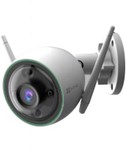
The Ezviz C3N is a budget Wi-Fi outdoor security camera, and you would find it offering you one of the most decent security camera alternatives. The excellent night vision provided by the camera can further make it a formidable choice. Despite being a camera worthy of being the best in its class, it offers you bargain-worthy pricing.
The full HD camera with waterproof functionality should make it a prime choice. The base functionality and connectivity provided by the camera are pretty exciting and powerful. Installation is simple and easy, and you can also be assured that it is pretty intense when you look at the build quality.
The black and night vision offered by the camera is unique. You would find lower levels of grains in the footage, and the IR LEDs can be strong enough to provide crystal clear imagery. The motion detection has an automatic mode wherein the night vision switches to color as soon as it detects a motion.
The IP66 waterproof design is a bit above the other security cameras in a similar genre. The camera also offers you a 110-degree viewing angle and a 1080p video capture capability.
The built-in noise-canceling microphone provides you with clearer audio of up to 16 feet, even in a noisy environment. The two infrared LEDs offer you 100 feet of automatically activated night vision.
The camera provides you with intelligent motion-detection zones and notification options. The camera also comes with multiple storage options. You can use a microSD card of up to 256 GB or opt for EZVIZ NVR (network video recorder, sold separately for $230).
Pros
Excellent video and audio quality
Customizable motion detection capability
Ease of installation.
Handles all the light levels efficiently.
Cons
Software may not be up to the mark
Wired power supply only
The Concluding Thoughts
The three security cameras from the brand Ezviz have been quite effective in providing a great experience dealing with robust security for your home and office environments. The comparison between Ezviz C8C, C8C Lite, and C3N, as outlined in this post, should help you pick the right choices per your individual preferences.
All three Ezviz cameras have their plus points, and you can choose the ones per your need-based requirements.
ISOCELL CMOS camera sensors from Samsung are helpful for a wide range of products, including digital cameras, mobile phones, computers, and more. These sensors use pixel-type technologies, including FSI (frontside-illuminated), BSI (backside-illuminated), ISOCELL, ISOCELL Plus, and ISOCELL 2.0. Out of many image sensors from Samsung, some of the most notable ones are ISOCEL S5KGM1, GM1, and GM2.
Demand for high-resolution, ultra-small image sensors is increasing as smartphones evolve to convey new and exciting camera experiences. The introduction of cutting-edge 0.8μm pixel Samsung ISOCELL S5KGM1, GM1, and GM2 image sensors make sure Samsung is committed to providing innovation in image sensor technologies.
Let’s first look at the details of each of these image sensors and then go through their comparison:
This ISOCELL image sensor allows slim mobile devices to provide leading camera performance with vivid color and rich detail. Smart WDR and Tetrapixel technologies in this sensor offer excellent color reproduction and light sensitivity.
Also, this sensor is widespread for presenting fast and precise focus. Though the pixel size is small, i.e., 0.8 μm, they are high-performing pixels that offer high resolution in slim devices.
List of phones equipped with ISOCELL S5KGM1 image sensor:
Samsung Galaxy S10 Lite
Samsung Galaxy A90 5G
Samsung Galaxy M30s
Fairphone 3+
Lenovo Z6 Pro
Meizu 16Xs/Note 9
Oppo A93
Oppo F11/F11 Pro
Oppo F17 Pro
Poco M3Motorola One Fusion
Motorola One Vision
Realme 7 5G
Realme V5 5G
Redmi Note 7
Redmi Note 8
Redmi Note 9
Vivo iQOO Neo3
Vivo iQOO Z1
ZTE Axon 10 Pro
Features:
ISOCELL Bright’s Tetrapixel technology significantly enhances light sensitivity in dim light conditions. It combines four adjacent pixels to function as one large pixel.
ISOCELL Plus pixel type conveys color accurate, crystal-clear photos although there is dim light condition.
ISOCELL Plus substitutes that metal barrier with an advanced new material developed by Fujifilm, which reduces light reflection and optical loss.
The Smart WDR (Wide Dynamic Range) feature offers multiple exposures in one shot. Consequently, it presents excellent detail for both dark and bright areas.
With the advanced PDAF (Phase Detecting Auto Focus), the sensor recognizes the distance of fast-moving objects, although the light condition is dim. This leads to accurate and fast auto-focusing.
The 3-stack FRS (Fast Readout Sensor) offers high-speed captures at Full HD video recording.
ISOCELL GM1:
The ISOCELL GM1 image sensor supports 48 MP resolution and provides 12 MP (Pixel binning) output for capturing bright photos. It is implemented with Tetrapixel technology and comes with intelligent WDR support.
Tetracell technology merges four adjacent pixels to function as a single giant pixel that offers increased light sensitivity equivalent to a 1.6 μm pixel image sensor. Moreover, Tetrapixel technology provides brighter, sharper image output in low light conditions.
Owing to the reduced pixel size, this sensor offers excellent design flexibility. So, it allows manufacturers to build small modules or pack plenty of pixels into existing designs. Based on the latest pixel isolation technology from Samsung, the ISOCELL Plus pixel type optimizes performance specifically for smaller-dimension pixels. So, the sensor is a perfect solution for super-resolution cameras.
Features:
ISOCELL Plus technology significantly increases light sensitivity and color fidelity of 0.8um pixels for more accurate photos.
With the implementation of the Tetrapixel technology, this sensor’s big pixel helps it capture bright pictures. The remosaic algorithm generates detailed 12 MP high-resolution images.
The smart WDR technology assists the sensor in capturing vibrant photos with fine details irrespective of lighting conditions.
There is support for the Gyro-based electronic image stabilization (EIS) that provides rapid and precise image capture.
ISOCELL GM2:
This Samsung image sensor depicts fine details with lifelike colors. It is an ultra-high 48 MP image sensor that provides excellent light sensitivity with Tetrapixel/Remosaic technology. Though the pixel size is small, it conveys high-resolution performance.
ISOCELL Plus technology utilizes unique wall material, decreasing light reflection and optical light. So, the sensor can receive more light in sub-micro-sized pixels as well. Consequently, the sensor can pack 48 million 0.8 μm pixels and convey picture output with high color fidelity. Night shots captured with a device having this sensor appear bright and sharp.
Features:
Tetrapixel technology combines four adjacent 0.8 μm pixels to work as a single 1.6 μm pixel. So, the image sensor’s light sensitivity is increased by four times, which helps it to capture 12 MP images in dim light conditions.
In a bright outdoor environment, the Remosaic algorithm implemented in this sensor re-arranges the color filter array to the RGB Bayer pattern. So, the sensor can capture highly detailed 48 MP photographs.
Super-PD AF focuses on using a unique oval lens over two pixels to function as one of several phases detecting agents within the sensor. Super-PD AF makes sure they are sharper, whether subjects are still or moving.
Smart-ISO offers an optimal dynamic range with less noise. It employs light to an electric signal converting system that adapts the conversion depending on the darkness or brightness of the environment.
Through Smart-ISO, images captured in a low-lit environment have more detail and less noise. They appear more vibrant in outdoor conditions.
The sWDR pattern receives and processes two diverse exposure sets for real-time HDR.
Through multi-exposure processing, images captured wherein light and dark areas co-exist will still appear sharp with enough brightness.
Comparison of ISOCELL S5KGM1 vs ISOCELL GM1 vs ISOCELL GM2:
ISOCELL S5KGM1
ISOCELL GM1
ISOCELL GM2
Features
ISOCELL Bright’s Tetrapixel technology
Tetracell technology
Tetrapixel technology
Sensor Technology
48 MP
48 MP
50 MP
Resolution
0.8 μm
0.8 μm
0.8 μm
Pixel size
ISOCELL Plus
ISOCELL Plus
ISOCELL 2.0
Pixel type
–
Tetrapixel RGB Bayer Pattern
Tetrapixel RGB Bayer Pattern
Color filter
1/2″
1/2″
1/2″
Optical format
30 fps
Up to 30fps @12M full
Up to 10fps @full (Tetrapixel RGB Bayer),
30fps @12M (Bayer)
Normal frame rate
–
Up to 120fps @FHD, 240fps @HD
Up to 240fps @FHD
Video frame rate
–
Electronic rolling shutter
and global reset
Electronic rolling shutter
and global reset
Shutter type
–
10-bits
10 bits
ADC accuracy
MIPI 4 Lane RAW
MIPI 4 Lane RAW
MIPI 4 Lane RAW
Interface
Tetrapixel
Tetra
Tetra
Chroma
PDAF
PDAF
Super-PD (PDAF)
Autofocus
–
RAW8 (using DPCM/PCM compression), RAW10
RAW8 (using DPCM/PCM compression), RAW10
Output formats
–
-20℃ to +70℃
-20℃ to +70℃
Operating temperature
–
2.8V for Analog, 1.8V or 2.8V for I/O,
and 1.05V for digital core supply
2.8V for Analog, 1.8V for I/O,
and 1.05V for digital core supply
Supply Voltage
–
x16
x32
Analog gain
Smart WDR
Smart WDR
Smart WDR
WDR
Concluding Note:
When it comes to light sensitivity, irrespective of the lighting condition, the ISOCELL S5KGM1 is a better choice to consider. If you want to capture high-resolution, vibrant images with rich details, the ISOCELL GM1 is a better choice of the three discussed image sensors. If you want to get sharp image output with fast, precise autofocus, the ISOCELL GM2 is a better choice.
To present detailed image output, the sensor in your smartphone should have a large pixel size. The Samsung ISOCELL HMX and IMX686 sensors have large pixel dimensions to deliver precise and sharper image output.
Moreover, both of them come with excellent light absorption efficiency. Despite boasting several similarities, there are specific noticeable differences between these two image sensors. Let’s first look at the details of each of them and then look at the comparison:
Samsung ISOCELL HMX is a unique ultra-high 108 MP mobile image sensor implemented with cutting-edge pixel technologies like Smart-ISO and ISOCELL Plus. These technologies let the sensor generate sharp images with excellent color fidelity.
With 108 million pixels, this sensor captures and produces well-defined images showcasing fine details. These many pixels contribute to a single image so that a photo can remain sharp, although cropped or zoomed in. The sensor uses tiny 0.8 μm -sized pixels to incorporate such a huge number of pixels (1.6 μm when binned together).
This Samsung sensor is the first mobile image sensor that adopts a huge 1/1.33-inch size. So, it can absorb more light compared to smaller sensors. The light absorption efficiency is high, although there is dim light around. This is why this sensor is an ideal choice for those who are looking to capture professional-grade photography.
To capture and generate color appropriately, all small 0.8 μm-sized pixel needs to absorb adequate light information without getting tainted by adjacent pixels. The ISOCELL HMX pixels are implemented with Samsung’s ISOCELL Plus technology for precise color reproduction. It is a cutting-edge pixel isolation technology that reduces cross-talk and optical loss by applying a barrier across each pixel.
List of phones with Samsung ISOCELL HMX sensor:
Xiaomi Mi Note 10
Mi Mix Alpha (Draco)
Mi Note 10 Pro (Tucana)
Mi 10 (umi)
Mi 10 Pro (cmi)
Features:
The gain assists in enhancing picture quality, specifically in low-light environments, but a fixed single native ISO comes with its limits. So, this sensor is designed with two native ISOs -a low and a high ISO. So, more flexibility is offered in the amount of gain provided.
Smart-ISO technology smartly chooses the level of amplifier gains per the environment’s illumination. It works on the optimal light-to-electric signal conversion, giving your camera more versatility in different light settings.
Once the light information is obtained by the pixels, it passes through a signal amplifier or a fixed amount of analog gain. Subsequently, it is transformed into a digital signal through ADC (analog-digital converter).
For improved low-light photography, this sensor transforms the 0.8 μm pixels into 1.6 μm pixels through Tetrapixel technology. This technology blends adjacent four pixels to function as a single pixel. Though merging decreases to 27 MP from 108 MP, the converted 1.6 μm pixels enhance the sensor’s light sensitivity. So, output appears better in dim light conditions.
Super-PD autofocus, the latest phase detecting autofocus solution, provides accurate and fast focusing on still or swift-moving objects, although the light setting is dim.
The shutter type is electronic rolling shutter and global reset.
ADC accuracy is 10-bits.
The range of operating temperature is -20℃ to +70℃.
The output format is RAW10.
The analog gain is x32.
Sony IMX686:
The Sony IMX686 is a 64 MP camera sensor having a pixel resolution of 9248 x 6944. It can capture images with real-time HDR support. Moreover, it measures 1/1.7-inch in size and is paired with a 1.6 μm pixel dimension. Some of the features of IMX686 are identical to Samsung’s GW1 sensor that was available on Redmi Note 8 Pro and several other phones.
This Sony sensor supports image plane phase-difference AF and HDR imaging. It owns the ability to capture vivid, low-noise photos and videos during dim light conditions. The IMX686 boasts a four times higher dynamic range compared to previous sensors.
In low light conditions, this sensor may not be efficient. But, because the superpixels of the IMX686 chiefly rely on efficient algorithms to reduce noise, noticeable advances in software will be observed in the near future.
List of phones with Samsung ISOCELL HMX sensor:
Xiaomi Redmi K30
Xiaomi Redmi K30 5G
Oppo Reno 3
Oppo Reno 3 Pro
Features:
Total effective pixel, i.e., 64 MP, is based on the image sensor effective pixel specification technique.
The Quad Bayer color filter array creates a 16 MP high-resolution binned image with a pixel size of 1.6μm.
High resolution and high sensitivity are offered with the Quad Bayer array.
The Quad Bayer color filter combines 2×2 adjacent pixels to create a single large pixel. Hence, pictures with 12 MP and 16 MP resolution are created.
The 4-in-1 pixel-binning process amplifies the actual edge length of each pixel, from 0.8 µm to 1.6 µm. This means more light absorption that leads to detailed image capturing.
2×2 On-Chip Lens (OCL) solution uses a condenser lens at the top of four neighboring pixels arranged in a Quad Bayer color filter array. This system enhances phase detection and offers high accuracy for tiny objects. Also, this increases the focus performance in low-light environments.
The latest sensor technology allows the sensor to enhance low-light capturing ability. It does this by increasing the light utilization factor.
Comparison of Samsung ISOCELL HMX vs IMX686:
Features
Samsung ISOCELL HMX
Sony IMX686
Resolution
12,032 x 9,024 (108M)
64 MP (9248 x 6944)
Pixel size
0.8 μm
0.8 μm to 1.6 μm (pixel binning)
Pixel type
ISOCELL Plus
Exmor RS sensors
Color filter
Tetrapixel RGB Bayer Pattern
Quad Bayer color filter
Optical format
1/1.33″
1/1.7″
9.3 mm
(1/1.94″)18
(1/1.72″)16
Normal frame rate
Up to 10 fps @ full
Up to 240 fps @ full
Video frame rate
Up to 148 fps @1080p
Up to 60 fps @4K
Shutter type
Electronic Rolling Shutter
and Global Reset
–
ADC accuracy
10-bits
–
Interface
MIPI 4 Lane RAW
–
Autofocus
Super-PD (PDAF)
PDAF
Output formats
RAW10
Bayer RAW (Quad Bayer
RGB)
Analog gain
x32
–
Concluding Note:
When it comes to low-light photography, Samsung ISOCELL HMX is more suitable than the IMX686 sensor. In terms of high dynamic range, high-resolution video recording, and high absorption ability, IMX686 is a better choice.
In terms of accurate color reproduction, low optical loss, and fast autofocus performance, ISOCELL HMX is a better choice.
The image sensors from Samsung are well-known for outstanding camera performance with advanced autofocus technology. Samsung released three of the best image sensors in this regard. They are ISOCELL JN1, GN1, and GN5. Let’s go through the details of each of these image sensors and then look at their comparison:
ISOCELL combines 3D-BSI with Front-side, Full-depth, Deep-Trench Isolation (F-DTI), and Vertical Transfer Gate (VTG). This provides increased light sensitivity and higher color fidelity even in inadequate lighting situations.
ISOCELL JN1 is Samsung’s first image sensor that features 0.64μm pixels and packs in 50 MP resolution. It comes in an ultra-slim package for portability. You will observe unique details and vivid colors in every photo you capture.
Features:
Implemented with the ISOCELL 2.0, an advanced pixel isolation technology, this sensor provides enhanced color fidelity and light sensitivity.
Whether it’s daytime or nighttime, this sensor captures crystal-clear images and videos due to the Tetrapixel technology.
Especially in dim light environments, it can collect sufficient light from conveying clear and crisp night shots. With the Double Super PD, this sensor quickly focuses even in dark backgrounds. Therefore, you can easily capture swift-moving subjects.
With the perfect balance of highlights and shadows, the HDR technology ensures your photos appear lifelike.
There is the use of inter-scene HDR, which is the latest HDR technology that conveys enhanced dynamic range.
With the high frame rate recordings, this sensor preserves every detail.
The cinematic 4K video recording supports a 60-fps frame rate that allows the sensor to capture your favorite moments in stunning detail.
Samsung ISOCELL GN1:
With the best-in-class Dual Pixel technology, Samsung’s ISOCELL GN1 conveys supreme autofocus performance. This results in detailed and accurate images. With the Tetrapixel technology, this 50 MP image sensor can capture outstanding photos anywhere, anytime.
This sensor accepts light information from every photodiode to generate a 100 MP resolution image through a software algorithm. It can immediately lock in on an object or area and develop sharp photos. The 1.2 μm sized pixels are implemented with exceptional light sensitivity. They generate true-to-life photographs.
Features:
Dual Pixel technology increases the speed and improves the accuracy of the autofocus capabilities. So, users can quickly get crisp and clear pictures.
Every pixel in this sensor contains two photodiodes. This feature allows the component to implement ultra-fast autofocus and capture moving objects irrespective of whether they are covered in the frame.
Tetrapixel technology lets the sensor maximize the benefits of huge pixels. It blends four adjacent pixels into a single 2.4 μm sized pixel. So, the light sensitivity increases by four times. Due to bigger pixels, the sensor can capture blur-free images in a dimly lit environment.
ISOCELL Plus implements a cutting-edge material to maximize the partition of individual pixels. During that, it optimizes their light absorption abilities via the micro-lens.
With minimum light reflection and optical loss, this sensor conveys significant improvements in light sensitivity and color reproduction. So, the high-resolution photography features naturalistic tones and shades.
Native-ISO decides how much sensitivity the sensor is to light. The high native ISO is more suitable for low-lit settings, whereas the low native ISO is more suitable for bright environments.
The Smart-ISO technology enables automatic shooting with the low native-ISO in bright settings. It switches to high native-ISO when you shoot in darker environments. Hence, photos will always feature optimal dynamic range in dark and colorful backgrounds, with reduced noise.
Real-time HDR enables the sensor to rapidly generate stunning images and videos with a high dynamic range. This technology lets the sensor preview and capture scenes in dim light environments in several exposures simultaneously. Ultimately, it produces HDR images in real-time.
Samsung ISOCELL GN5:
With the ultra-fast autofocus technology of the ISOCELL GN5 sensor, you are guaranteed stunning photographs.
This super-slim 50MP sensor is the industry’s first 1.0 μm image sensor to implement Dual Pixel Pro technology. With this technology, this sensor always preserves every detail of your memories. It is an all-directional autofocusing technology that significantly enhances autofocusing abilities. You can effortlessly create blur-free, detailed images of swift-moving objects with fast, accurate autofocus.
Features:
Two photodiodes are placed in every 1.0 μm pixel. They are placed vertically or horizontally to identify pattern changes in every direction.
The one million phase-detecting type multi-directional photodiodes encompass all areas of the sensor. So, autofocusing instantly conveys sharper images irrespective of the lighting conditions.
Samsung’s proprietary pixel technology applies Front Deep Trench Isolation (FDTI) (applied on a Dual Pixel product for the first time in the industry).
Although the photodiode size is microscopic, FDTI allows every photodiode to absorb and embrace more light information. So, it improves the full-well capacity (FWC) of photodiodes and reduces crosstalk in the pixel.
Comparison of Samsung ISOCELL JN1 vs GN1 vs GN5:
Features
ISOCELL JN1
ISOCELL GN1
ISOCELL GN5
Sensor Technology
Tetrapixel technology
Dual Pixel technology
Dual Pixel Pro technology
Resolution
50 MP
50 MP
50 MP
Pixel size
0.64 μm
1.2 μm
1.0μm
Pixel type
ISOCELL 2.0
ISOCELL Plus
ISOCELL 2.0
Color filter
Tetrapixel RGB Bayer Pattern
Dual Tetrapixel RGB
Bayer Pattern
Dual Tetrapixel RGB Bayer Pattern
Optical format
1/2.76″
1/1.31″
1/1.57″
Normal frame rate
10 fps @50 MP mode
Up to 24 fps @full 50 MP
Up to 27 fps @ full 50 MP
Video frame rate
30 fps @12.5 MP, 60 fps @4K, 240 fps @FHD
240 fps @1080p (w/AF),
400 fps @1080p (w/o AF)
30 fps @8K, 120 fps @4K, 240 fps @FHD
Shutter type
Electronic rolling shutter
and global reset
Electronic rolling shutter
and global reset
Electronic rolling shutter
and global reset
ADC accuracy
10-bits
10-bits
10 bits
Interface
4 lanes (2.15 Gbps per lane)
4 lanes (4.5Gbps per lane) D-PHY /
3 lanes (3Gsps per lane) C-PHY
4 lanes (2.5Gbps per lane) D-PHY /
3 trios (3.5Gsps per trio) C-PHY
Chroma
Tetra
Tetra
Tetra
Autofocus
Double Super PD (PDAF)
Dual-PD (PDAF)
Dual Pixel Pro (PDAF)
Output formats
RAW10
RAW8 (using DPCM/PCM compression),
RAW10
RAW8/10/12
Operating temperature
-20℃ to +85℃
-20℃ to +85℃
-20℃ to +85℃
Supply Voltage
2.8V for analog, 1.8V for I/O, and 1.05V for digital core supply
2.8V for analog, 1.8V for I/O, and 1.05V for digital core supply
2.2V for analog, 1.8V for I/O, and 0.92V for digital core supply
Analog gain
x16
x64 @12.5Mp (4in 1),
x16@Full capture
x64 @12.5MP (4in1)
and x16 @full capture
WDR
Inter-scene DCG
3D/Tetra HDR
Smart-ISO Pro (iDCG), Staggered HDR
Concluding Note:
The ISOCELL JN1 sensor can be considered when you want fine details, vivid colors, and excellent light sensitivity in the captured images and videos.
When it comes to reduced noise, perfect color reproduction, and decent light sensitivity irrespective of the light condition, you can consider ISOCELL GN1.
The ISOCELL GN5 offers fast, accurate autofocus. It helps you capture lifelike images and videos of steady and fast-moving objects.
As per Samsung, the ISOCELL GN5 is prevalent as the world’s first 1.0μm image sensor that combines an all-directional autofocusing technology and Dual Pixel Pro technology.
This combination boosts autofocusing capabilities.
The latest 50 MP OV50A smartphone sensor from OmniVision guarantees you ‘DSLR level’ phase detection autofocus performance. It offers 100% phase detection autofocus (PDAF) coverage.
There are some similarities between the ISOCELL GN5 and OmniVision’s OV50A sensors. However, there are specific noteworthy differences as well. Let’s first look at the details of each of these sensors and then carry out its comparison:
Implemented with the Dual Pixel Pro technology, the ISOCELL GN5 sensor preserves all details of your memories. With speedier, more accurate autofocus, the smartphones equipped with this sensor let you effortlessly create blur-free and detailed images of swift-moving objects. With its high-resolution capabilities, all scenes you shoot with this sensor will be lifelike and detailed.
With the help of intelligent ISO technology and the power of Tetrapixel, this sensor can generate precise and crisp shots even in poorly lit light environments. The smartphones with this sensor help you transform your remembrances into cinematic videos.
With the support for 8K video recording @ 30 fps and 4K videos @ 120 fps, this sensor contains all the necessary features required to record and preserve your precious moments.
Samsung Galaxy S22 and S22+ will be equipped with this image sensor.
OmniVision’s OV50A:
This image sensor from OmniVision is perfect for PC multimedia, smartphones, and video conferencing devices. It is designed with the help of OmniVision’sPureCel Plus-S stacked die technology. It supports 50 MP resolution through one-micron pixel size, on-chip remosaic quad phase detection (QPD) autofocus, and selective conversion gain.
One of the most significant selling points for mobile phones is camera performance. A smartphone with excellent camera performance can compete with DSLR cameras, making the gap smaller. The QDP autofocus technology implemented in this sensor makes the gap even smaller with the DSLR level autofocus performance.
OmniVision also boasts the low-light performance of the sensor as the best-in-class through the unique blend of massive 1.0-micron pixel size, high conversion gain mode, selective conversion gain’s low-noise, and the giant 1/1.5″ optical format.
The QPD autofocus technology facilitates the 2×2 phase detection autofocus (PDAF) all over the image array of the sensor. Consequently, it provides 100% coverage. Contrasting the microlens and half-shield PDAF technologies that can merely capture 3-6% of the phase-detection data, the QPD autofocus technology captures 100% of this data.
As a result, it provides enhanced distance calculation, better low-light performance, and faster autofocus.
With the help of a QPD color filter array and hardware remosaic, this sensor offers excellent autofocus performance and superior quality, 50 MP Bayer output or 8K video in real-time.
With the use of near-pixel binning, this sensor delivers a 12.5 MP image output for a 4K2K video (4096 × 2304). So, the sensitivity increases by four folds, leading to camera performance analogous to 2.0-micron pixel size for video and preview.
With QPD autofocus, the output format includes 50 MP or 8K video at 30 fps, 12.5 MP (supports 2x digital crop zoom) at 60 fps, 4K2K video at 90 fps, 1080p at 240 fps, and 720p at 480 fps. These options can be delivered as output at up to 3.5 Gbps per trio. This output is provided via the CPHY MIPI interface of the sensor. The lens chief ray angle is 36.24° linear.
List of smartphones equipped with OmniVision OV50A sensor:
Comparison of ISOCELL GN5 vs OmniVision OV50A – Specs & Differences:
Features
ISOCELL GN5
OmniVision’s OV50A
Sensor Technology
Dual Pixel Pro technology
QPD
PureCel®Plus-S
HDR
Resolution
50 MP
50 MP
Pixel size
1.0μm
1.008 µm
Pixel type
ISOCELL 2.0
Four diagonally paired pixels
Color filter
Dual Tetrapixel RGB Bayer Pattern
QPD color filter array
Optical format
1/1.57″
1/1.55″
Normal frame rate
Up to 27fps @full 50MP
Up to 30 fps@ full 50 MP
Video frame rate
30fps @8K, 120fps @4K, 240fps @FHD
30fps @8K, 90fps @4K, 240fps @FHD, 720p @ 480 fps
Shutter type
Electronic rolling shutter
and global reset
Rolling shutter
ADC accuracy
10 bits
10 bits
Interface
4 lanes (2.5Gbps per lane) D-PHY /
3 trios (3.5Gsps per trio) C-PHY
SCCB MIPI
Autofocus
Dual Pixel Pro (PDAF)
QPD autofocus technology
Output formats
RAW8/10/12
RAW
Operating temperature
-20℃ to +85℃
-30°C to +85°C
Concluding Note:
The ISOCELL GN5 sensor is a decent choice for blur-free detailed image and video output with accurate autofocus. For faster autofocus, low-light performance, 100% coverage, and excellent image sensitivity, OmniVision’s OV50A is a decent choice.

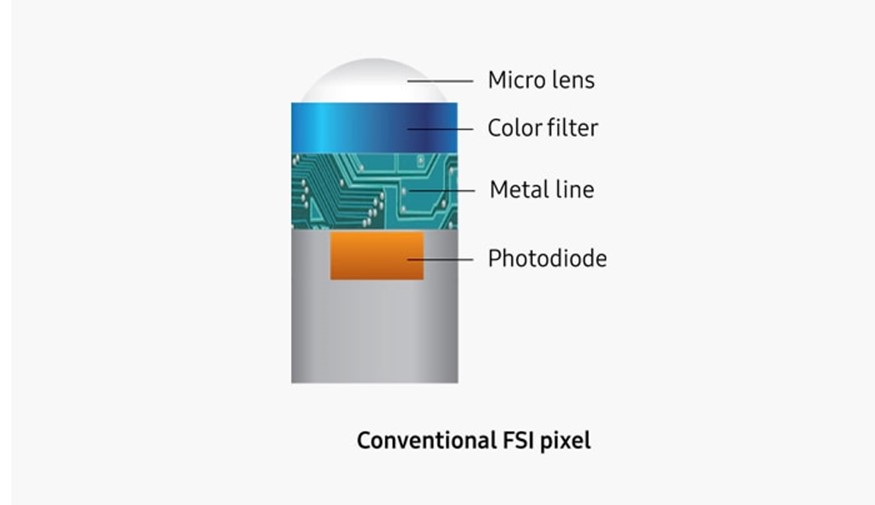 The latest ISOCELL Plus sensor technology from Samsung powers the top-notch cameras seen on the brand’s flagship devices. Samsung tackled the engineering challenges of smartphone cameras and built the ISOCELL Plus technology, which pushes the boundaries of the image sensor to convey color-accurate, crystal-clear photos even in challenging lighting conditions.
 Sony developed Exmor-RS, the world’s foremost stacked CMOS image sensor that conveys superior picture quality in a compact size. It is designed for use in tablets and smartphones. It includes a unique, advanced ‘stacked structure.’