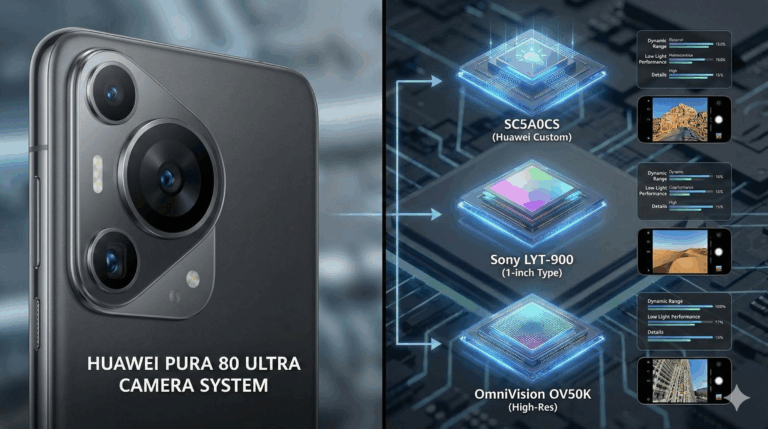
The smartphone imaging landscape has fractured. With the release of the Huawei Pura 80 Ultra, the mobile industry witnesses a historic pivot: the abandonment of Sony’s LYT-900 silicon in favor of the domestic SC5A0CS 1-inch sensor. This deep dive explores the architectural differences between Huawei’s new LOFIC-based hardware and the traditional stacked transistors used by competitors like the Xiaomi 14 Ultra. From the physics of the retractable lens mechanism to the computational merging of the XD Motion Engine, we analyze whether Huawei’s proprietary RYYB and XMAGE pipeline can truly outperform the established global supply chain.
The Sensor War: SC5A0CS vs. The World
Huawei has decoupled from Sony. The Pura 80 Ultra introduces a domestic 1-inch sensor that challenges the established hierarchy of mobile imaging.
The release of the Huawei Pura 80 Ultra marks a technical divergence in the smartphone industry. For years the sector relied on a predictable supply chain dominated by Sony Semiconductor Solutions. Manufacturers bought sensors like the IMX989 and differentiated via software. Huawei has broken this pattern.
The device integrates the SC5A0CS. This is a 1-inch type sensor manufactured by SmartSens Technology. It replaces the Sony silicon found in previous generations. This shift is not merely political; it introduces specific architectural differences in how the camera handles light, dynamic range, and color. We compared this new entrant against the current market leaders: Sony’s LYT-900 and OmniVision’s OV50K.
Technical Specifications
The primary battleground is the 1-inch format. All three contenders operate in this physical class. The differences lie in the pixel architecture and the method used to manage electron saturation.
| Specification | Huawei / SmartSens SC5A0CS | Sony LYT-900 | OmniVision OV50K |
|---|---|---|---|
| Optical Format | 1.0-inch Type | 1.0-inch Type | 1.0-inch Type |
| Resolution | 50 MP | 50 MP | 50 MP |
| Pixel Pitch | 1.6µm | 1.6µm | 1.2µm (Crop dependent) |
| Dynamic Range Tech | LOFIC (Capacitor) | Dual-Layer Transistor | TheiaCel (LOFIC) |
| Color Filter | RYYB (Yellow) | Quad-Bayer RGGB | Quad-Bayer RGGB |
| Process Node | 22nm HKMG Stacked | 40nm/22nm Stacked | 22nm Stacked |
Architecture: LOFIC vs. Stacked Transistors
The defining feature of the SC5A0CS is LOFIC (Lateral Overflow Integration Capacitor). Standard sensors suffer from saturation in bright conditions. When a photodiode fills with electrons, additional data is lost. This results in clipped highlights, such as a white sky with no texture.
LOFIC addresses this by placing a high-density capacitor next to the photodiode. When the main well fills, excess electrons flow into this capacitor rather than vanishing. The readout circuit measures both the main well and the capacitor. This preserves highlight detail in single exposures.
Sony takes a different route with the LYT-900. It uses a Dual-Layer Transistor Pixel structure. Sony physically separates the photodiode layer from the transistor layer. This increases the volume available for the photodiode, effectively making the bucket bigger. OmniVision’s OV50K uses TheiaCel technology, which functions similarly to Huawei’s LOFIC approach.
Dynamic Range & Noise Floor Comparison
The RYYB Difference & XMAGE Integration
The Pura 80 Ultra persists with Huawei’s proprietary RYYB color filter array. Most sensors use RGGB (Red-Green-Green-Blue). Huawei replaces green pixels with yellow pixels. Yellow pixels transmit both red and green light. This increases total photon intake by approximately 40%.
The SC5A0CS is the first 1-inch sensor to natively implement this array. The challenge has historically been color accuracy. Yellow pixels make it difficult to separate green frequencies from red ones. To counter this, the Pura 80 Ultra pairs the sensor with a “Red Maple” multispectral unit. This external hardware analyzes the light spectrum to correct the raw data from the main sensor.
XMAGE: The Software Bridge
With the departure of Leica, Huawei established XMAGE. This pipeline is tuned specifically for the quirky output of RYYB sensors. RYYB sensors are naturally “warm” and prone to tinting shadows green or magenta. XMAGE applies a dynamic color mapping matrix (CCM) that shifts based on scene luminance, correcting the raw data before it becomes a JPEG. This is critical for the Pura 80 Ultra, as the new domestic sensor likely has different spectral sensitivity curves than previous Sony iterations.
Fabrication: The HKMG Advantage
The SC5A0CS utilizes a 22nm HKMG (High-K Metal Gate) stacked process. This manufacturing technique, typically reserved for processor logic, is a significant evolution for image sensors.
- Lower Power: HKMG reduces current leakage, meaning the sensor consumes less power during 4K video recording.
- Thermal Management: Reduced heat generation lowers thermal noise, which appears as “grain” in long-exposure night shots.
- Readout Circuitry: The logic layer allows for faster parallel processing of the capacitor (LOFIC) data and the photodiode data.
Mechanical Innovation: The Retractable Structure
One-inch sensors require a specific focal length to focus correctly, which typically demands a thick camera bump. The Pura 80 Ultra circumvents this with a telescoping lens mechanism. When the camera app launches, the primary lens physically extends from the body.
Why It Moves
The Flange Distance Problem: To cover a 1-inch sensor, the lens elements must sit at a precise distance from the silicon. Static lenses result in the massive “islands” seen on competitors like the Xiaomi 14 Ultra.
The Huawei Solution: By retracting the lens when inactive, Huawei reduces the device profile. This mechatronic system is rated for 300,000 cycles. It also incorporates a dust-sealed gasket that expands and contracts with the movement, maintaining IP68 water resistance.
Aperture Control: Physical vs. Computational
The SC5A0CS sits behind a variable aperture system ranging from f/1.6 to f/4.0. This is not a digital simulation; physical blades open and close over the sensor.
| Device | Aperture Range | Mechanism | Benefit |
|---|---|---|---|
| Huawei Pura 80 Ultra | f/1.6 – f/4.0 | Stepless Blades | Optical depth of field control; sharp macro at f/4.0 |
| Samsung S24 Ultra | f/1.7 (Fixed) | None | Simplicity; reliance on “Portrait Mode” for blur |
| Xiaomi 14 Ultra | f/1.6 – f/4.0 | Stepped Blades | Similar control, but lacks the retractable housing |
At f/1.6, the sensor gathers maximum light for night shots but has a razor-thin plane of focus. At f/4.0, the blades restrict light but sharpen the edges of the frame and expand the depth of field. This is critical for document scanning and group photos where fixed f/1.7 lenses often blur the subjects in the back row.
Module Analysis: The Telephoto Anomaly
While the main sensor grabs headlines, the telephoto implementation offers a more radical mechanical innovation. The Pura 80 Ultra uses a single sensor for two distinct optical zoom lengths: 3.7x and 9.4x. This contrasts with competitors like the Samsung Galaxy S25 Ultra, which use separate sensors for 3x and 5x/10x zoom.
Telephoto Hardware Specs
- Sensor Size: 1/1.28-inch (Large Format)
- Resolution: 50 MP
- Aperture: f/2.1 (at 3.7x)
- Mechanism: Internal Floating Lens Group
The Physics: The 1/1.28-inch sensor is massive for a zoom lens. It is larger than the primary sensor on a base model iPhone 15. This surface area allows Huawei to crop into the sensor for the 9.4x zoom without dropping below acceptable resolution standards, while the 3.7x mode utilizes the full sensor width.
This “One Sensor, Two Lenses” approach reduces the total weight of the device and ensures consistent color science across zoom ranges. The sensor is likely a custom-spec unit from a domestic supplier, optimized for the periscope form factor.
Secondary Optics: The Support Crew
The complete optical system includes two additional sensors that round out the focal lengths. Unlike the main and telephoto units, these components prioritize field of view over raw dynamic range.
| Module | Resolution | Supplier Likelihood | Key Function |
|---|---|---|---|
| Ultra-Wide | 40 MP | OmniVision (OV50 Series derivative) | Macro capabilities (5cm focus) + 120° FOV |
| Front/Selfie | 13 MP | SmartSens / OmniVision | Wide-angle group shots + Facial Auth |
Super Macro: The Ultra-Wide sensor often doubles as the macro lens on competing devices. However, Huawei utilizes the telephoto lens for macro shots (telemacro). By shifting the floating lens elements, the Pura 80 Ultra can focus at 5cm with 35x magnification, avoiding the distortion common in wide-angle macro shots.
Video Performance: The Readout Challenge
Large sensors often struggle with “rolling shutter” (jello effect) in video because reading 50 million pixels takes time. This is where the maturity of Sony’s silicon typically shows.
The Gap: Sony’s LYT-900 excels with exceptionally fast readout speeds, allowing for minimal distortion during rapid pans. The Huawei SC5A0CS, while capable of 4K/60fps, relies heavily on AIS (AI Stabilization) to crop and counter-shake the image digitally. While effective for walking, rapid lateral movements may still exhibit skewing artifacts compared to the faster Sony silicon found in the iPhone 16 Pro or Xiaomi 14 Ultra.
Computational Layer: XD Motion Engine
The SC5A0CS sensor hardware was designed specifically to feed the “XD Motion Engine.” This is Huawei’s answer to motion blur in high-speed photography.
How it works: The sensor executes a dual-readout protocol. It captures a short exposure (to freeze motion) and a long exposure (to capture detail/color) simultaneously. The ISP (Image Signal Processor) merges these frames in real-time. This technique requires a sensor with exceptionally fast readout speeds to prevent “ghosting” artifacts where the two frames do not align perfectly.
*The vectors are merged by the AI ISP instantly.
Interactive Sensor Selector
Different architectures suit different photographic needs. Use the tool below to identify which sensor technology aligns with your shooting priorities.
Find Your Sensor Match
Select your primary use case:
Domestic Manufacturing Context
The SC5A0CS is likely a derivative of the SmartSens SC550XS. It utilizes a 22nm HKMG process. This validates the capability of domestic Chinese foundries to produce large-format, high-performance logic layers for stacked sensors. While Sony retains an advantage in global readout speeds, the gap in static image quality has closed.
The Huawei Pura 80 Ultra proves that proprietary optical chains are viable. It combines domestic silicon with mechatronic innovation, such as the retractable lens and variable aperture, to bypass the limitations of off-the-shelf components.