back to top
Home Blog Page 3

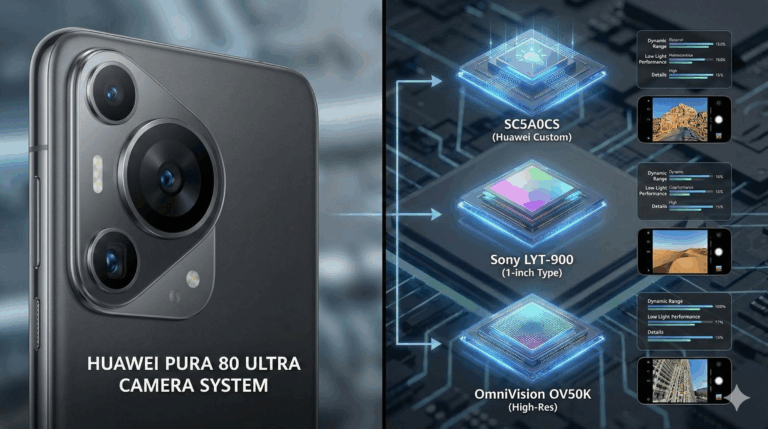
Huawei Pura 80 Ultra Camera: SC5A0CS vs. Sony LYT-900 & OmniVision OV50K

The smartphone imaging landscape has fractured. With the release of the Huawei Pura 80 Ultra, the mobile industry witnesses a historic pivot: the abandonment of Sony’s LYT-900 silicon in favor of the domestic SC5A0CS 1-inch sensor. This deep dive explores the architectural differences between Huawei’s new LOFIC-based hardware and the traditional stacked transistors used by competitors like the Xiaomi 14 Ultra. From the physics of the retractable lens mechanism to the computational merging of the XD Motion Engine, we analyze whether Huawei’s proprietary RYYB and XMAGE pipeline can truly outperform the established global supply chain.

SC5A0CS vs LYT-900 vs OV50K – LensXP.com
Tech Analysis / October 2025 / Mobile Hardware

The Sensor War: SC5A0CS vs. The World

Huawei has decoupled from Sony. The Pura 80 Ultra introduces a domestic 1-inch sensor that challenges the established hierarchy of mobile imaging.

The release of the Huawei Pura 80 Ultra marks a technical divergence in the smartphone industry. For years the sector relied on a predictable supply chain dominated by Sony Semiconductor Solutions. Manufacturers bought sensors like the IMX989 and differentiated via software. Huawei has broken this pattern.

The device integrates the SC5A0CS. This is a 1-inch type sensor manufactured by SmartSens Technology. It replaces the Sony silicon found in previous generations. This shift is not merely political; it introduces specific architectural differences in how the camera handles light, dynamic range, and color. We compared this new entrant against the current market leaders: Sony’s LYT-900 and OmniVision’s OV50K.

Technical Specifications

The primary battleground is the 1-inch format. All three contenders operate in this physical class. The differences lie in the pixel architecture and the method used to manage electron saturation.

Specification Huawei / SmartSens SC5A0CS Sony LYT-900 OmniVision OV50K
Optical Format 1.0-inch Type 1.0-inch Type 1.0-inch Type
Resolution 50 MP 50 MP 50 MP
Pixel Pitch 1.6µm 1.6µm 1.2µm (Crop dependent)
Dynamic Range Tech LOFIC (Capacitor) Dual-Layer Transistor TheiaCel (LOFIC)
Color Filter RYYB (Yellow) Quad-Bayer RGGB Quad-Bayer RGGB
Process Node 22nm HKMG Stacked 40nm/22nm Stacked 22nm Stacked

Architecture: LOFIC vs. Stacked Transistors

The defining feature of the SC5A0CS is LOFIC (Lateral Overflow Integration Capacitor). Standard sensors suffer from saturation in bright conditions. When a photodiode fills with electrons, additional data is lost. This results in clipped highlights, such as a white sky with no texture.

LOFIC addresses this by placing a high-density capacitor next to the photodiode. When the main well fills, excess electrons flow into this capacitor rather than vanishing. The readout circuit measures both the main well and the capacitor. This preserves highlight detail in single exposures.

Sony takes a different route with the LYT-900. It uses a Dual-Layer Transistor Pixel structure. Sony physically separates the photodiode layer from the transistor layer. This increases the volume available for the photodiode, effectively making the bucket bigger. OmniVision’s OV50K uses TheiaCel technology, which functions similarly to Huawei’s LOFIC approach.

Dynamic Range & Noise Floor Comparison

Figure 1: Estimated usable dynamic range (EV) and low-light signal-to-noise ratio based on architectural capabilities. Higher is better.

The RYYB Difference & XMAGE Integration

The Pura 80 Ultra persists with Huawei’s proprietary RYYB color filter array. Most sensors use RGGB (Red-Green-Green-Blue). Huawei replaces green pixels with yellow pixels. Yellow pixels transmit both red and green light. This increases total photon intake by approximately 40%.

The SC5A0CS is the first 1-inch sensor to natively implement this array. The challenge has historically been color accuracy. Yellow pixels make it difficult to separate green frequencies from red ones. To counter this, the Pura 80 Ultra pairs the sensor with a “Red Maple” multispectral unit. This external hardware analyzes the light spectrum to correct the raw data from the main sensor.

XMAGE: The Software Bridge

With the departure of Leica, Huawei established XMAGE. This pipeline is tuned specifically for the quirky output of RYYB sensors. RYYB sensors are naturally “warm” and prone to tinting shadows green or magenta. XMAGE applies a dynamic color mapping matrix (CCM) that shifts based on scene luminance, correcting the raw data before it becomes a JPEG. This is critical for the Pura 80 Ultra, as the new domestic sensor likely has different spectral sensitivity curves than previous Sony iterations.

Fabrication: The HKMG Advantage

The SC5A0CS utilizes a 22nm HKMG (High-K Metal Gate) stacked process. This manufacturing technique, typically reserved for processor logic, is a significant evolution for image sensors.

  • Lower Power: HKMG reduces current leakage, meaning the sensor consumes less power during 4K video recording.
  • Thermal Management: Reduced heat generation lowers thermal noise, which appears as “grain” in long-exposure night shots.
  • Readout Circuitry: The logic layer allows for faster parallel processing of the capacitor (LOFIC) data and the photodiode data.

Mechanical Innovation: The Retractable Structure

One-inch sensors require a specific focal length to focus correctly, which typically demands a thick camera bump. The Pura 80 Ultra circumvents this with a telescoping lens mechanism. When the camera app launches, the primary lens physically extends from the body.

Why It Moves

The Flange Distance Problem: To cover a 1-inch sensor, the lens elements must sit at a precise distance from the silicon. Static lenses result in the massive “islands” seen on competitors like the Xiaomi 14 Ultra.

The Huawei Solution: By retracting the lens when inactive, Huawei reduces the device profile. This mechatronic system is rated for 300,000 cycles. It also incorporates a dust-sealed gasket that expands and contracts with the movement, maintaining IP68 water resistance.

Aperture Control: Physical vs. Computational

The SC5A0CS sits behind a variable aperture system ranging from f/1.6 to f/4.0. This is not a digital simulation; physical blades open and close over the sensor.

Device Aperture Range Mechanism Benefit
Huawei Pura 80 Ultra f/1.6 – f/4.0 Stepless Blades Optical depth of field control; sharp macro at f/4.0
Samsung S24 Ultra f/1.7 (Fixed) None Simplicity; reliance on “Portrait Mode” for blur
Xiaomi 14 Ultra f/1.6 – f/4.0 Stepped Blades Similar control, but lacks the retractable housing

At f/1.6, the sensor gathers maximum light for night shots but has a razor-thin plane of focus. At f/4.0, the blades restrict light but sharpen the edges of the frame and expand the depth of field. This is critical for document scanning and group photos where fixed f/1.7 lenses often blur the subjects in the back row.

Module Analysis: The Telephoto Anomaly

While the main sensor grabs headlines, the telephoto implementation offers a more radical mechanical innovation. The Pura 80 Ultra uses a single sensor for two distinct optical zoom lengths: 3.7x and 9.4x. This contrasts with competitors like the Samsung Galaxy S25 Ultra, which use separate sensors for 3x and 5x/10x zoom.

Telephoto Hardware Specs

  • Sensor Size: 1/1.28-inch (Large Format)
  • Resolution: 50 MP
  • Aperture: f/2.1 (at 3.7x)
  • Mechanism: Internal Floating Lens Group

The Physics: The 1/1.28-inch sensor is massive for a zoom lens. It is larger than the primary sensor on a base model iPhone 15. This surface area allows Huawei to crop into the sensor for the 9.4x zoom without dropping below acceptable resolution standards, while the 3.7x mode utilizes the full sensor width.

This “One Sensor, Two Lenses” approach reduces the total weight of the device and ensures consistent color science across zoom ranges. The sensor is likely a custom-spec unit from a domestic supplier, optimized for the periscope form factor.

Secondary Optics: The Support Crew

The complete optical system includes two additional sensors that round out the focal lengths. Unlike the main and telephoto units, these components prioritize field of view over raw dynamic range.

Module Resolution Supplier Likelihood Key Function
Ultra-Wide 40 MP OmniVision (OV50 Series derivative) Macro capabilities (5cm focus) + 120° FOV
Front/Selfie 13 MP SmartSens / OmniVision Wide-angle group shots + Facial Auth

Super Macro: The Ultra-Wide sensor often doubles as the macro lens on competing devices. However, Huawei utilizes the telephoto lens for macro shots (telemacro). By shifting the floating lens elements, the Pura 80 Ultra can focus at 5cm with 35x magnification, avoiding the distortion common in wide-angle macro shots.

Video Performance: The Readout Challenge

Large sensors often struggle with “rolling shutter” (jello effect) in video because reading 50 million pixels takes time. This is where the maturity of Sony’s silicon typically shows.

The Gap: Sony’s LYT-900 excels with exceptionally fast readout speeds, allowing for minimal distortion during rapid pans. The Huawei SC5A0CS, while capable of 4K/60fps, relies heavily on AIS (AI Stabilization) to crop and counter-shake the image digitally. While effective for walking, rapid lateral movements may still exhibit skewing artifacts compared to the faster Sony silicon found in the iPhone 16 Pro or Xiaomi 14 Ultra.

Computational Layer: XD Motion Engine

The SC5A0CS sensor hardware was designed specifically to feed the “XD Motion Engine.” This is Huawei’s answer to motion blur in high-speed photography.

How it works: The sensor executes a dual-readout protocol. It captures a short exposure (to freeze motion) and a long exposure (to capture detail/color) simultaneously. The ISP (Image Signal Processor) merges these frames in real-time. This technique requires a sensor with exceptionally fast readout speeds to prevent “ghosting” artifacts where the two frames do not align perfectly.

Conventional:
Single Long Exposure (Blur Risk)
XD Motion:
Short Exp
Long Exp

*The vectors are merged by the AI ISP instantly.

Interactive Sensor Selector

Different architectures suit different photographic needs. Use the tool below to identify which sensor technology aligns with your shooting priorities.

Find Your Sensor Match

Select your primary use case:

Select a priority above to see the recommendation.

Domestic Manufacturing Context

The SC5A0CS is likely a derivative of the SmartSens SC550XS. It utilizes a 22nm HKMG process. This validates the capability of domestic Chinese foundries to produce large-format, high-performance logic layers for stacked sensors. While Sony retains an advantage in global readout speeds, the gap in static image quality has closed.

The Huawei Pura 80 Ultra proves that proprietary optical chains are viable. It combines domestic silicon with mechatronic innovation, such as the retractable lens and variable aperture, to bypass the limitations of off-the-shelf components.
Frequently Asked Questions

Does the SC5A0CS perform better than the Sony IMX989? Based on dynamic range, the SC5A0CS with LOFIC offers superior highlight retention compared to the older IMX989. Low-light performance is comparable due to the RYYB filter compensating for any quantum efficiency gaps.
What is the benefit of the Red Maple system? It acts as a hardware calibration tool. It reads the exact spectral power distribution of the scene to fix the color shifts often caused by the RYYB filter on the main sensor.
Is the Telephoto sensor also made by SmartSens? The 1/1.28-inch telephoto sensor (50MP) is widely believed to be domestic, aligning with the main sensor strategy. Its large size is atypical for telephotos, suggesting a custom wafer run.
What is the expected price of the Pura 80 Ultra? While regional pricing varies, import listings and Chinese launch data suggest a price point roughly equivalent to €1,400 – €1,500, positioning it directly against the iPhone Pro Max and Samsung Ultra series.
Does the mechanical lens affect durability? Huawei rates the mechanism for 300,000 actuations. If the phone detects a drop via its accelerometer, the lens automatically retracts to protect the mechanism before impact.

© 2025 LensXP.com. Independent Optical Analysis.

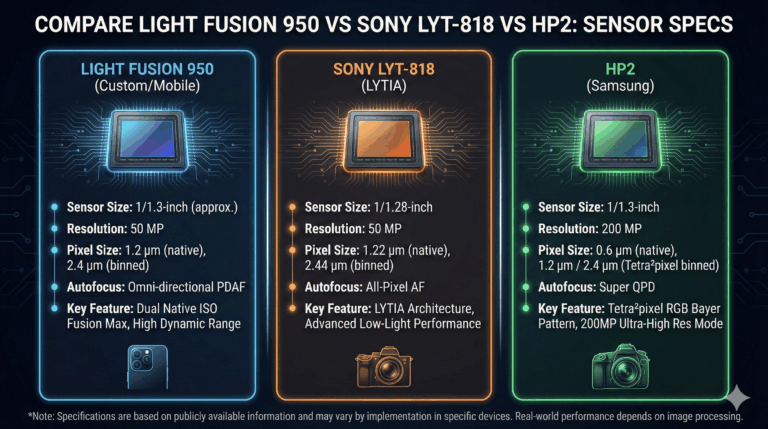
Compare Light Fusion 950 vs Sony LYT-818 vs HP2: Sensor Specs

The era of the megapixel war is over; the battle for photonic efficiency has begun. In this technical deep dive, we strip away the marketing gloss to compare the industry’s heavyweights: the Light Fusion 950 (OVX9500), Sony’s video-centric LYTIA 818, and Samsung’s high-resolution ISOCELL HP2.

While manufacturers push 200MP numbers, the real story lies in pixel pitch, readout speeds, and the revolutionary LOFIC architecture found in the ‘L’ series variants. Does the Light Fusion 950’s 1/1.31-inch format strike the perfect balance between physics and form factor, or does Sony’s noise control still reign supreme? We analyze the silicon to find the truth.

Light Fusion 950 vs Sony LYTIA 818 vs Samsung HP2 | LensXP Deep Dive

The Sensor War.
Light Fusion 950 vs The World.

By Tech Analysis Team | Oct 2025 | Deep Dive

Mobile photography changed in the mid-2020s. We moved past the megapixel wars. The focus shifted to photonic efficiency, computational dynamic range, and logic layer optimization. The battleground is now defined by electron capacity and signal-to-noise ratios.

1. The Light Fusion 950 (OVX9500)

The Light Fusion 950, technically the OVX9500, anchors performance devices like the Poco F8 Ultra and Xiaomi 17. It challenges the Sony and Samsung duopoly with a 1/1.31-inch optical format. This size hits a specific balance. It is large enough for photon collection but fits within slimmer device profiles.

Key Specs

  • Format: 1/1.31-inch
  • Resolution: 50MP
  • Pixel Pitch: 1.2µm (Native)
  • Dyn. Range: 13.5 EV

The 50MP resolution allows for a 1.2µm native pixel pitch. This is distinct from 200MP sensors that use tiny 0.6µm pixels. Larger pixels hold more electrons. This creates higher native dynamic range and reduces reliance on aggressive noise reduction.

Fig 1. Visual representation of Native Pixel Area (1.2µm vs 0.6µm). The Light Fusion 950 gathers 4x more light per pixel natively.

Dual Native ISO Fusion

The “Fusion” name refers to its HDR handling. Conventional sensors use one gain setting. Low gain preserves highlights. High gain cleans up shadows. The OVX9500 accesses both. It reads data from high and low gain paths to compose a single frame. This results in 13.5 EV of dynamic range. It captures bright skies and shadowed subjects simultaneously without motion artifacts.

2. The “L” Factor: LOFIC Technology

Confusion exists between the standard Light Fusion 950 and the Light Hunter 950L. The “L” signifies a major architectural change: Lateral Overflow Integration Capacitors (LOFIC).

How LOFIC Works

Standard Sensor

When a pixel fills with electrons (saturation), extra light is lost. This creates clipped, white highlights.

950L with LOFIC

Excess charge flows laterally into a secondary capacitor. The sensor has a “spare tank” for light information.

This pushes dynamic range to 16.5 EV. That is a 3-stop improvement over the standard 950. In practice; a sunset becomes a defined orange disk rather than a white blob.

3. Technical Analysis: FWC & Readout Speed

The user experience is often dictated by two invisible metrics: Full Well Capacity (FWC) and Readout Speed. FWC determines how much light a pixel handles before it clips white. Readout speed determines how fast the sensor clears data to prevent “jello” effects in video.

Readout Speed

The LYT-818 leads with ~5ms readout. The 950 trails slightly at ~8ms. The HP2 is slower due to 200MP processing loads.

Full Well Capacity

LOFIC pushes the 950L to nearly 38,000e-. Standard sensors average 14,000e-. This is the physical limit of dynamic range.

Video HDR

Sony’s 3-Gain architecture allows for single-frame HDR in 4K60 video. The 950 uses Dual ISO Fusion to achieve similar results.

Fig 3. Sensor Readout Latency (Lower is Better). High readout speeds reduce rolling shutter artifacts.

4. Signal-to-Noise Ratio (SNR) Physics

SNR is the definitive metric for low-light performance. It is the ratio of valid light data (signal) to electronic static (noise). As light levels (lux) drop, noise becomes dominant.

The 0.6µm Penalty

Competitors like the Samsung HP2 use 0.6µm pixels. Even with 16-in-1 binning (combining pixels to 2.4µm), the “read noise” accumulates from each individual physical pixel. The Light Fusion 950 starts with 1.2µm physical buckets. This structural advantage means the 950 retains color accuracy in shadows where the HP2 often shifts to magenta or green due to noise floor interference.

Crosstalk Interference

Deep Trench Isolation (DTI): The 950 uses vertical walls between pixels to stop photons from leaking into neighbors.

Benefit: Leaking photons cause color smearing. The 950’s larger pixel pitch allows for thicker DTI walls compared to the microscopic barriers required on 200MP sensors.

Fig 4. Signal-to-Noise degradation as light decreases. Note the sharper drop-off for high-res small-pixel sensors.

5. Autofocus Architecture

Focus speed is determined by the phase detection layout. Not all pixels are used for focus, creating blind spots in certain sensor designs.

Super QPD (Samsung HP2)

Samsung uses “Super Quad Phase Detection.” It groups four adjacent pixels under a single micro-lens to detect phase differences.

The Flaw: It is highly effective vertically but can struggle with horizontal pattern detection in low contrast.

2×2 OCL / Dual Pixel (Light Fusion)

The Light Fusion 950 employs a 2×2 On-Chip Lens solution covering the entire sensor surface. Every pixel acts as a focus agent.

The Advantage: Omni-directional focus. It locks onto subjects regardless of orientation or texture direction, even in -4 EV darkness.

6. The Thermal Envelope

High resolution comes at a thermal cost. Processing 200 million pixels (HP2) requires massive bandwidth from the Image Signal Processor (ISP).

  • 01. Throughput Heat: To shoot 4K video on the HP2, the sensor must bin 200MP down to ~12MP or 8MP continuously. This downscaling generates significant heat at the logic layer, leading to quicker thermal throttling (dimming screens, stopping recording).
  • 02. The 50MP Sweet Spot: The Light Fusion 950 requires less computational overhead to bin 50MP to 12.5MP. This results in cooler operation during extended 4K60fps recording sessions, maintaining sensor linearity for longer.

7. The Competition: Sony & Samsung

VS Sony LYT-818

Sony focuses on purity. The LYT-818 (1/1.28-inch) uses Ultra High Conversion Gain (UHCG). This achieves a read noise of just 0.95e-. In extreme darkness; the Sony sensor introduces less electronic static. It uses a 3-Gain Readout for video HDR; making it preferred for video-centric flagships.

VS Samsung ISOCELL HP2

Samsung bets on resolution. The HP2 packs 200MP into the same physical space. The pixels are tiny (0.6µm). It relies on 16-in-1 binning for low light. Its strength is zoom. By cropping into 200MP; it offers lossless 4x zoom. The Light Fusion 950 tops out at 2x crop zoom before quality degrades.

Sensor Size Res Dyn. Range Tech Readout Max FPS

8. The Lens Factor

A sensor is only as good as the glass in front of it. The large 1/1.31″ format of the Light Fusion 950 requires a lens with a large image circle. If the lens quality is poor; users see corner softness and vignetting.

“High-resolution sensors like the HP2 (200MP) are often diffraction-limited at apertures narrower than f/2.0. The Light Fusion 950’s larger pixels are more forgiving of lens imperfections.”

9. Strategic Outlook

The Light Fusion 950 defines the “Rational Flagship.” It acknowledges that 1-inch sensors are too large for every device. The 1/1.31-inch format is the new high-end baseline.

Future iterations will likely bring LOFIC technology down from the “Pro” lines. OmniVision’s roadmap prioritizes dynamic range expansion over resolution increases. For the user; this means cameras that capture scenes closer to how the human eye perceives them.

Technical Glossary

LOFIC

Lateral Overflow Integration Capacitor. A technology that captures excess light in bright scenes to prevent white clipping.

Dual Native ISO

The ability of a sensor to use two different amplification circuits; one optimized for brightness and one for shadow detail.

QPD (Quad Phase Detection)

An autofocus method grouping 4 pixels under one lens. Fast, but can struggle with horizontal lines compared to Dual Pixel.

Full Well Capacity (FWC)

The maximum amount of charge (electrons) a single pixel can hold before saturating. Higher is better for dynamic range.

Binning

Combining adjacent pixels (e.g., 4-in-1 or 16-in-1) to act as a single large pixel; reducing resolution to increase sensitivity.

Frequently Asked Questions

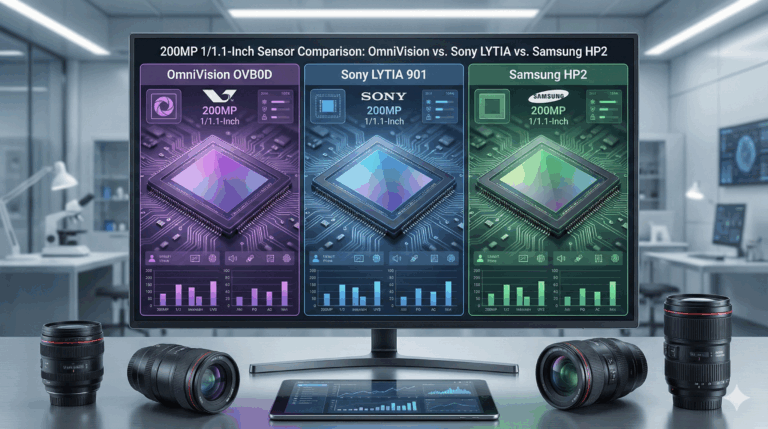
Comparing OmniVision OVB0D vs. Sony LYTIA 901 vs. Samsung HP2: 200MP 1/1.1-Inch

The era of the “mid-sized” 1/1.3-inch flagship sensor is officially ending. For years, the Samsung ISOCELL HP2 has dominated the high-resolution landscape, but a massive shift in semiconductor physics has arrived. The 2025 flagship tier is defined by a new 1/1.1-inch standard, challenging the limits of mobile optics.

In this comprehensive analysis, we track the divergence of two conflicting philosophies: OmniVision’s OVB0D, which champions raw light capture through a standard Bayer filter and LOFIC capacitors, versus Sony’s LYTIA 901, which relies on complex Quad-Quad Bayer arrays and on-chip AI to redefine computational photography. From autofocus architectures to single-frame HDR video, here is how the new giants stack up against the Samsung incumbent.

Deep Dive: OmniVision OVB0D vs Sony LYTIA 901 | LensXP
Deep Dive Analysis

The 200MP War: OmniVision OVB0D vs. Sony LYTIA 901 vs. Samsung

By LensXP Team October 29, 2025 12 Min Read

The era of the “mid-sized” flagship sensor is ending. For years, Samsung ruled the high-resolution market with its 1/1.3-inch sensors. That changes now. OmniVision and Sony have broken the mold with massive 1/1.1-inch chips that challenge physics and computation alike.

We are tracking a major split in mobile imaging. OmniVision is betting on raw physics with the OVB0D. Sony is doubling down on AI with the LYTIA 901. Samsung is diversifying into specialized telephoto units. This report breaks down the technical divergence that will define smartphone cameras through 2028.

Sensor Size Visualization

This interactive canvas renders the actual physical scale difference between the 1/1.3″ standard (Samsung HP2) and the new 1/1.1″ class (OmniVision/Sony).

Fig 1. Physical surface area comparison generated via HTML5 Canvas.

The Physics of Light: Why 1/1.1 Inch?

The move to 1/1.1-inch sensors is not marketing fluff; it is a geometrical necessity. As resolution increases to 200MP, individual pixels shrink. On a 1/1.3-inch sensor (Samsung HP2), pixels are approximately 0.6μm. This restricts the amount of light each pixel collects, increasing noise in low light.

By expanding the canvas to 1/1.1 inches, OmniVision and Sony increase the pixel pitch to roughly 0.7μm. This 15-20% gain in per-pixel surface area significantly improves Signal-to-Noise Ratio (SNR) before any software processing touches the image.

Technical Insight

SNR Advantage

Larger pixels = deeper electron wells. The OVB0D is capable of holding more electrons before saturation, directly translating to cleaner shadows in high-contrast scenes.

The New 1/1.1-inch Standard

Size matters in photonics. The shift from 1/1.3-inch to 1/1.1-inch represents a roughly 40% increase in surface area. This is not a trivial update. It moves the main camera into a “Goldilocks” zone. These sensors are large enough to provide natural background separation and superior light intake; yet they remain just small enough to fit inside a phone without the massive lens protrusions required by 1-inch type sensors.

OmniVision OVB0D

The Purist Approach

Uses a Standard Bayer filter. It refuses to group pixels for color, betting on its massive capacitors (LOFIC) to handle dynamic range. It captures pure, high-frequency color detail.

  • High color fidelity
  • Lower cross-talk noise
  • Requires powerful ISP

Sony LYTIA 901

The Computationalist

Uses a Quad-Quad Bayer filter. It groups 16 pixels together to create a “virtual” giant pixel. It relies on on-chip AI to reconstruct detail and manage zoom.

  • Superior digital zoom
  • Faster HDR readout
  • Potential color artifacts

Detailed Specification Matrix

Use the filters below to isolate specific competitive landscapes. The OVB0D and LYT-901 are direct rivals for 2026 flagships; the HP2 is the incumbent they aim to replace.

Feature OmniVision OVB0D Sony LYTIA 901 Samsung HP2 Samsung HP9
Role Primary Wide Primary Wide Incumbent Wide Telephoto Zoom
Size 1/1.1″ (Largest) 1/1.12″ 1/1.3″ 1/1.4″
Filter Type Standard Bayer Quad-Quad Bayer Tetra²pixel Tetra²pixel
HDR Tech LOFIC Gen 2 Hybrid Frame Smart-ISO Pro Smart-ISO Pro
Pixel Pitch ~0.70μm 0.70μm 0.60μm 0.56μm
Autofocus QPD (2×2) All-Pixel AF Super QPD Dual Pixel

Effective Dynamic Range Potential

Theoretical stop performance based on Full Well Capacity (LOFIC) vs. Composite Multi-frame.

OmniVision OVB0D (LOFIC) 108 dB
Single-Shot
Sony LYTIA 901 (HF-HDR) >100 dB
Composite
Samsung HP2 (Incumbent) ~100 dB
Dual Gain

Video Architecture: The Single-Frame Advantage

Video is where the architectural differences between OmniVision and Sony become stark. In high-contrast video (e.g., recording a concert or a sunset), traditional sensors must capture two frames—one short exposure for highlights, one long for shadows—and merge them. This often creates “ghosting” artifacts on moving subjects.

OmniVision’s LOFIC Edge:

Because LOFIC works via capacity, not time, it captures HDR data in a single exposure. This effectively eliminates motion artifacts in HDR video, making the OVB0D potentially superior for sports and action cinematography.

Video Specs
  • 8K Recording 30 FPS
  • 4K Slow-Mo 120 FPS
  • HDR Format 10-bit DCG

Autofocus Architectures Explained

200 million pixels create a massive focusing challenge. If the lens is slightly out of focus, the high resolution makes blur immediately obvious. Manufacturers have diverged on how to handle this.

Samsung Super QPD

Used in HP2

Uses groups of 4 adjacent pixels under a single lens to detect phase differences vertically and horizontally. Excellent for low light.

OmniVision QPD

Used in OVB0D

Covers 100% of the image array. The 2×2 ML (micro-lens) ensures that every pixel contributes to focus, improving speed in erratic motion scenarios.

Sony Octa-PD

Used in LYT-900 series

A variation of Quad Bayer focusing. Sony prioritizes horizontal tracking speed, crucial for video, though sometimes struggles with horizontal lines in the subject.

The Hidden Cost: Optical Physics

Moving to a 1/1.1-inch sensor creates a physics problem: Depth of Field (DoF). As the sensor gets larger, the plane of focus gets thinner.

Typical Aperture
f/1.6

Required to keep device thin.

Close Focus Limit
~15cm

Cannot focus closer without macro mode.

Natural Bokeh
High

Optical blur replaces software blur.

*Implication: Users taking photos of documents or food may find the edges of the subject naturally blurred. This is not a defect; it is a characteristic of large sensors.

The 4x Zoom Battle: Remosaic vs. AI

The primary justification for 200MP is not printing billboards; it is “in-sensor zoom.” Both sensors can crop into the center 12MP to simulate a long telephoto lens.

Sony’s Approach

Sony uses “In-sensor Zoom” combined with AI upscaling. Because the LYTIA 901 uses a Quad-Quad structure, it must “remosaic” (rearrange) pixels to get a color image at 4x zoom. This requires heavy processing.

Result: Smooth, painting-like textures

OmniVision’s Approach

The OVB0D’s standard Bayer filter is physically superior for cropping. Since the color filter pattern is consistent, cropping into the center yields a “truer” RAW image with less need for algorithmic guessing.

Result: Sharper, grainier, more authentic

The “Samsung Factor” & ISOCELL Lineage

Samsung is flooding the zone. While they have not announced a 1/1.1-inch main sensor to rival OmniVision directly, they maintain a diverse portfolio. Understanding the “HP” numbering is crucial.

Sensor Model Size Target Use Key Characteristic
ISOCELL HP2 1/1.3″ Ultra Flagship Main Deep Trench Isolation (DTI) for color separation.
ISOCELL HP3 1/1.4″ Mid-Range Main Smaller pixels (0.56μm), fits smaller phones.
ISOCELL HP9 1/1.4″ Telephoto (Zoom) High-refractive microlenses for light gathering at long focal lengths.
ISOCELL HP5 1/1.56″ Foldables / Compact Slim profile design to minimize Z-height.

Verdict

If you value natural optics and artifact-free HDR:

The OmniVision OVB0D is the superior choice. Its use of a standard Bayer filter and LOFIC technology prioritizes image fidelity over computational tricks. It is the photographer’s sensor.

If you value seamless zoom and video consistency:

The Sony LYTIA 901 wins. Its Quad-Quad Bayer structure and on-chip AI are designed to make 4x digital zoom look like optical zoom. It is the versatile, generalist king.

Technical Glossary

LOFIC

Lateral Overflow Integration Capacitor. A secondary storage tank for electrons within a pixel that prevents bright highlights from clipping to white.

Quad-Quad Bayer

A filter array where 16 pixels share the same color filter. Enables excellent low-light sensitivity but reduces color resolution in bright light. [Image of Quad bayer vs standard bayer filter pattern]

Full Well Capacity (FWC)

The maximum amount of charge a pixel can hold before saturating. Higher FWC equals better dynamic range.

Remosaic

The software process of converting a binned pixel arrangement (like Quad Bayer) back into a standard high-resolution color image.

Frequently Asked Questions

What is LOFIC and why does it matter? +

LOFIC stands for Lateral Overflow Integration Capacitor. It is a technology borrowed from the automotive industry. It places a large capacitor inside the pixel to catch excess light that would normally cause the image to blow out (turn white). This allows the sensor to capture very bright highlights and dark shadows in a single shot; preventing motion blur often seen in traditional HDR.

Is 200MP actually useful on a phone? +

Yes; but primarily for zoom. You rarely view 200MP photos at full size. Instead; the sensor crops into the center to provide “lossless” zoom at 2x and 4x magnification. The 200MP count provides enough data to make these crops sharp.

Which phones will use these sensors? +

Based on current supply chain reports; expect the OmniVision OVB0D to appear in flagship devices from Vivo and Oppo in 2026. The Sony LYTIA 901 will likely be adopted by Xiaomi and potentially OnePlus. Samsung Electronics will likely stick to its own ISOCELL sensors for the Galaxy series.

List of VPG 400 Certified Cards & Camera Compatibility Guide

The VPG 400 certification is the new standard for professional video, guaranteeing a minimum sustained write speed of 400 MB/s. This is essential for 8K RAW recording on cameras from Canon, Nikon, and Sony. This guide provides the complete list of certified CFexpress Type A and Type B cards, explains camera compatibility, and helps you avoid costly recording failures.

VPG 400: The 2025 Guide to Certified Cards & Camera Compatibility

VPG 400: The 2025 Guide

Official Certified Cards & Camera Compatibility.

Updated: October 8, 2025

What is VPG 400?

VPG 400 is a memory card certification from the CompactFlash Association (CFA). The “VPG” stands for Video Performance Guarantee. The “400” represents the most important number for video recording: 400 megabytes per second (MB/s).

This is not a “max speed” or “burst speed” used in marketing. VPG 400 is a tested, verified promise that the card’s write speed will never drop below 400 MB/s. This guarantee prevents dropped frames, corrupted files, and recording failure during demanding video capture, such as 8K RAW.

VPG vs. SD Card V-Class

The VPG standard for CFexpress cards operates in a different class than the “V-Class” standard for SD cards. The fastest V-Class card, V90, only guarantees 90 MB/s.

Chart: Minimum Guaranteed Write Speeds (MB/s)

The Need for Speed: Why VPG 400 Was Created

The VPG 400 standard was created to solve a specific problem: new camera sensors are capturing video at data rates older cards could not handle.

As cameras moved to 8K resolution, 12K recording, and high-frame-rate 4K (like 120p), the amount of data written per second increased dramatically. An 8K RAW video file, for example, can require a constant write speed of 300 MB/s or more. Older cards, even fast ones, could fail during these recordings.

The Data Bottleneck

Old Card (e.g., V90 / VPG 200)

8K Camera Sensor
Video Data Stream (350 MB/s)
Card (Max 200 MB/s) FAIL

New Card (VPG 400)

8K Camera Sensor
Video Data Stream (350 MB/s)
Card (Min 400 MB/s) OK

VPG 400 provides the necessary high-speed “floor” (400 MB/s) for these new professional video formats. It is the new minimum standard for high-end cinema and mirrorless cameras.

Megabits vs. Megabytes

A common point of confusion is data rate measurement.

  • Cameras: List bitrates in Megabits per second (Mbps).
  • Cards: Market speeds in Megabytes per second (MB/s).
=
1

8 Megabits = 1 Megabyte

To see if a card is fast enough, divide the camera’s Mbps bitrate by 8.

=
0 MB/s Required

Example: A 2600 Mbps RAW file requires a 325 MB/s sustained write speed.

The “Floor” vs. The “Ceiling”

VPG 400 is only the guaranteed floor (400 MB/s). It is not the card’s actual performance. Many certified cards have actual sustained write speeds far higher than the 400 MB/s guarantee.

This is the most important detail for users of high-end cameras like the Nikon Z9, which can record at data rates higher than 400 MB/s. For those cameras, the VPG 400 logo identifies the class of card, but you must still check that card’s actual sustained speed.

Chart: Actual Sustained Write Speed vs. VPG 400 Guarantee (MB/s)

Warning: The “Faked Flag” Risk

Some camera manufacturers, like Sony, program their cameras to check for a VPG firmware flag. If the flag is absent, high-frame-rate recording modes are disabled.

Uncertified card makers have been caught adding this VPG flag to their cards without passing the certification tests. The camera is “tricked” and unlocks the video modes. The user starts recording, but the card cannot handle the data stream. The recording fails, leading to lost footage.

The only way to avoid this failure is to buy cards that are officially certified by the CFA.

CFexpress Type A vs. Type B: A Quick Guide

The “VPG 400” certification applies to different card types. The primary difference is their physical size, which dictates their potential speed and camera compatibility.

  • Type A: A very small card, similar in size to an SD card. It is used almost exclusively by Sony. Its small size (using one PCIe lane) limits its maximum theoretical speed.
  • Type B: A larger card that uses the same physical shape as older XQD cards. It is used by Canon, Nikon, and others. The larger size (using two PCIe lanes) allows for much higher maximum speeds.

The two types are not interchangeable. You must buy the card type that fits your camera’s slot.

Feature CFexpress Type A CFexpress Type B
Physical Size 20 x 28 x 2.8 mm 29.6 x 38.5 x 3.8 mm
Max Speed (CFx 4.0) ~2000 MB/s ~4000 MB/s
Primary Users Sony Canon, Nikon, Fujifilm

VPG 400 Certified Cards: CFexpress Type B

Manufacturer Product Line Capacities Spec Actual Sustained Speed

VPG 400 Certified Cards: CFexpress Type A

Why Buy VPG 400 Type A?

No current Sony Alpha or FX camera requires VPG 400 (they only require VPG 200). These VPG 400 Type A cards are built for future-proofing (for next-generation cameras like the A1 II), workflow speed (faster 4.0 offload), and maximum reliability.

Manufacturer Product Line Capacities Spec

VPG 400 Camera Compatibility

The VPG 400 requirement depends entirely on your camera system. Some mandate it, while others need *more* speed.

Canon System

EOS R1, R3, R5, R5 C

VPG 400 is REQUIRED.

This is a hard requirement, either by firmware (R1) or by the physical data rate of 8K RAW (R5/R5C). The camera’s 325-400 MB/s bitrates demand a VPG 400 card.

Action: Buy any card from the VPG 400 Type B list.

Nikon System

Nikon Z9, Nikon ZR

VPG 400 is the BASELINE.

This is the most complex case. The Z9’s 8K 60p N-RAW format needs ~723 MB/s. The ZR’s REDCODE RAW needs ~476 MB/s. Both are higher than the 400 MB/s guarantee.

Action: Buy a VPG 400 Type B card, but only one with an actual sustained speed over your camera’s bitrate (e.g., Lexar Diamond, Nextorage B1PRO).

Sony Alpha / FX

A1, A7S III, FX3, FX6

VPG 200 is REQUIRED.

These cameras (using Type A cards) only require VPG 200 to unlock S&Q modes. Their actual bitrate is low (~75 MB/s). VPG 200 is a firmware check to prevent uncertified card failures.

Action: Buy VPG 200 for current use. Buy VPG 400 Type A to prepare for future cameras.

RED & Blackmagic

Komodo-X, V-Raptor, URSA Cine

DO NOT USE VPG.

These systems do not use the VPG standard. They use their own certification programs. RED uses “RED APPROVED” media. Blackmagic uses proprietary media modules or its own approved list.

Action: Ignore VPG. Check only your camera manufacturer’s official media list.

The Heat Factor: Understanding Thermal Throttling

Writing data at speeds of 400 MB/s or faster generates a significant amount of heat in a small, enclosed card.

To prevent permanent damage, the card’s internal controller will automatically slow down (or “throttle”) its speed when it reaches a certain temperature. This is known as thermal throttling. If a card overheats, its sustained write speed can drop dramatically, sometimes falling below the 400 MB/s VPG guarantee.

What This Means for You

A card’s true sustained performance depends on both the card’s design and the camera’s ability to dissipate heat.

  • Camera bodies with internal fans (like the EOS R5 C) or larger bodies (like the Nikon Z9) are better at managing card heat.
  • Cards with metal casings or internal heat sinks are generally more resistant to throttling than all-plastic cards.
  • Long, continuous recordings (over 20 minutes) at maximum quality are most likely to trigger throttling.

Final Purchase Checks

Before you buy, follow this simple 3-step process.

  1. 1

    Check the CFA List

    Your first check. Is the card on the official CompactFlash Association (CFA) VPG certified list? If not, do not buy it. This is the only way to avoid the “faked flag” risk.

  2. 2

    Check Your Camera’s List

    Your second check. Cross-reference the CFA list with your camera manufacturer’s (Nikon, Canon, Sony) own “approved media list.” This ensures maximum compatibility.

  3. 3

    Get a Fast Reader

    Many VPG 400 cards are also CFexpress 4.0, with read speeds over 3,000 MB/s. You will only see this offload speed if you pair the card with a CFexpress 4.0-compatible reader.

© 2025 LensXP.com. All rights reserved. This guide is for informational purposes only.

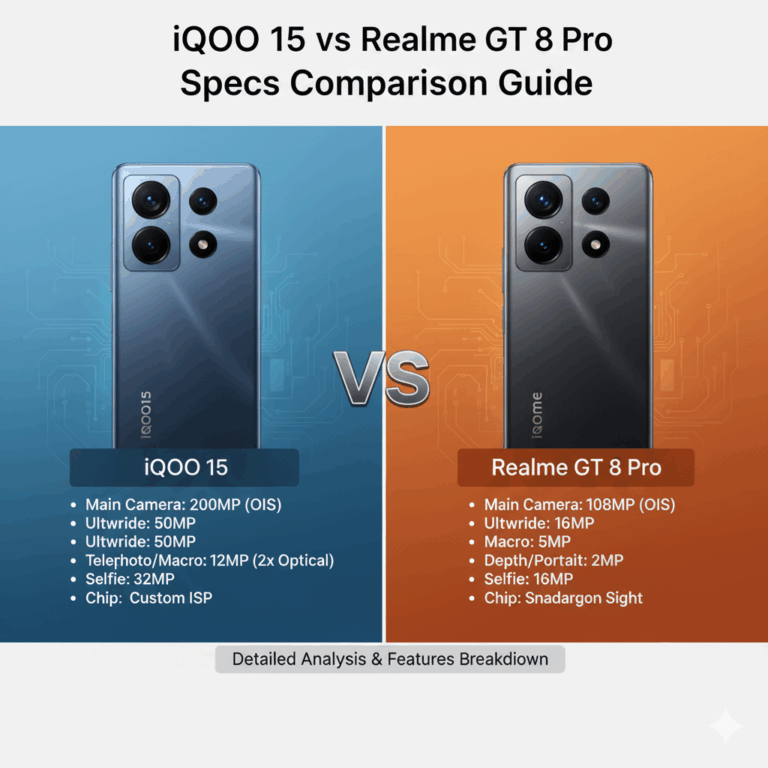
iQOO 15 vs Realme GT 8 Pro Camera Specs Comparison Guide

The late 2025 flagship smartphone battle is a tale of two camera philosophies. The iQOO 15 champions a balanced, consistent triple 50MP system. The Realme GT 8 Pro, however, is a specialist, countering with a revolutionary 200MP periscope telephoto and a deep, four-year Ricoh GR software partnership. In this deep dive, we compare the specs, analyze the sensors (HP5 vs. IMX921 vs. LYT700), and help you decide which system wins. iQOO 15 vs. Realme GT 8 Pro - Camera Specs Comparison

iQOO 15 vs. Realme GT 8 Pro

A Comparative Analysis of Flagship Camera Hardware

Updated: October 2025

Filter View

Show or hide sections to focus on what matters to you.

A Tale of Two Philosophies: Consistency vs. Specialization

This comparative analysis looks at the camera systems in the iQOO 15 and the Realme GT 8 Pro. The analysis reveals a fundamental divergence in imaging philosophy. The iQOO 15 employs a "balanced" approach, prioritizing high-level uniformity across its entire imaging system. It achieves this with a triple 50-megapixel (MP) rear camera array, ensuring a predictable user experience when switching between focal lengths.

The Realme GT 8 Pro, in contrast, adopts a strategy of aggressive specialization. It pairs competent 50MP main and ultrawide sensors with a technically groundbreaking 200MP periscope telephoto system. This hardware-centric approach is augmented by a deep, co-engineered "Ricoh GR-tuned" software ecosystem, a partnership four years in the making. This collaboration targets a specific "enthusiast" or "creative" user.

The core technical conflicts defining this comparison are:

  1. The Telephoto Divide: The iQOO 15’s conventional 50MP 3x optical zoom telephoto is pitted against the Realme GT 8 Pro's 200MP telephoto. The Realme's sensor is multifunctional, enabling advanced "in-sensor" lossless zoom at 6x and 12x and a unique telemacro capability.
  2. The Processing Pipeline: Both devices use the new Snapdragon 8 Elite Gen 5 platform. However, the iQOO 15 incorporates its gaming-centric "Q3" co-processor, while the Realme GT 8 Pro uses a media-focused "HyperVision AI chip".
  3. The Software Experience: The iQOO 15 features its in-house camera software. The Realme GT 8 Pro's entire user experience is defined by the profound, UI-integrated Ricoh GR partnership.

This analysis finds that the iQOO 15 presents a robust, high-performance, and reliable all-around imaging system. The Realme GT 8 Pro is a more ambitious and specialized toolkit, offering superior zoom and creative capabilities for the photography enthusiast.

At-a-Glance Hardware Matrix

Specification iQOO 15 Realme GT 8 Pro
Rear Main
Megapixels 50 MP 50 MP
Sensor Model Sony IMX921 Sony LYT700
Sensor Size 1/1.56" 1/1.56"
Pixel Size 1.0µm 1.0µm
Aperture f/1.9 f/1.8
Rear Telephoto
Megapixels 50 MP 200 MP
Sensor Model Sony IMX882 Samsung HP5
Sensor Size 1/1.95" 1/1.56"
Pixel Size 0.8µm 0.5µm (Bins to 1.0µm or 2.0µm)
Aperture f/2.7 f/2.6
Optical Zoom 3x 3x (plus 6x/12x Lossless)
Rear Ultrawide
Megapixels 50 MP 50 MP
Sensor Model Samsung JN5 (Assumed) Samsung JN5 (Assumed)
Sensor Size 1/2.76" 1/2.8"
Pixel Size 0.64µm 0.64µm (Assumed)
Aperture f/2.1 f/2.0
Front-Facing
Megapixels 32 MP 32 MP
Aperture f/2.2 f/2.4
Focal Length 21mm (Wide) 24mm (Wide)

Interactive Data Visualization

Use these charts to visually compare the key hardware specifications. The differences, particularly in the telephoto system, become immediately clear.

Chart 1: Megapixel Distribution (Rear Lenses)

Notice the massive 200MP sensor on the Realme GT 8 Pro's telephoto lens, compared to the balanced 50MP setup on the iQOO 15.

Chart 2: Physical Sensor Size (Calculated Area)

Bigger bars represent larger sensors, which can capture more light. The Realme GT 8 Pro's telephoto sensor is the same large size as both phones' main sensors.

Key Differentiators: Infographics

Zoom Versatility

iQOO 15
3x Optical
Realme GT 8 Pro
3x Optical
6x Lossless
12x Lossless

Dedicated Co-Processors

iQOO Q3 Chip

Focus: Gaming, Ray Tracing, Performance

HyperVision AI Chip

Focus: Media, AI Imaging, HDR Enhancement

Primary Camera Analysis: A Virtual Draw

The primary cameras present the closest hardware match-up. Both devices use a 50MP sensor with an identical 1/1.56-inch optical format. The iQOO 15 features the Sony IMX921, while the Realme GT 8 Pro employs the Sony LYT700. The LYTIA line is Sony's strategic successor to the IMX series, designed to offer superior low-light and HDR performance. On physical size, the main sensors are effectively a draw. However, the Realme GT 8 Pro's combination of a fractionally wider aperture and a newer-generation LYTIA stacked sensor gives it a marginal on-paper advantage in raw light-gathering potential.

Telephoto System: The 50MP IMX882 vs. The 200MP HP5

This category represents the central and most significant point of divergence. The phones adopt fundamentally different technologies for zoom photography.

iQOO 15: The Conventional Portrait Specialist

The iQOO 15 features a strong, conventional telephoto system: a 50MP Sony IMX882 sensor with a 1/1.95-inch optical format and 3x optical zoom. This is a robust configuration ideal for high-quality portraits. Its limitation is its specialization. This lens has a minimum focusing distance of 70 cm, rendering it physically incapable of macro photography.

Realme GT 8 Pro: The Multi-Functional Powerhouse

The Realme GT 8 Pro’s telephoto system is technically revolutionary. It uses a 200MP Samsung HP5 sensor with 3x optical zoom. The most important hardware distinction is sensor size. The Realme GT 8 Pro's telephoto sensor has a 1/1.56-inch optical format—the exact same physical size as its main sensor. Compared to the iQOO 15's 1/1.95-inch telephoto sensor, the Realme's is vastly larger, allowing it to capture significantly more light.

The 200MP Versatility Advantage

The 200MP resolution is the mechanism for the lens's versatility:

  • In-Sensor Zoom: The sensor uses its high pixel count for "in-sensor cropping." This enables an "up to 6x 'lossless' zoom mode" and "up to 12x lossless zoom." This effectively gives the Realme GT 8 Pro two "optical quality" focal lengths (3x and 6x) from a single module.
  • Telemacro Functionality: The lens features a close-focusing distance of 10-25 cm. This, combined with the 3x optical magnification, transforms the periscope into a "makeshift macro" or "Telephoto Close-up."

Sensor Deep Dive: The Hardware Behind the Megapixels

Beyond the megapixel counts, the specific sensors used reveal the core design choices for each phone. This is where the technical philosophies truly separate.

Main Sensor: Sony IMX921 (iQOO) vs. Sony LYT700 (Realme)

This is a battle of sensor generations. Both are 1/1.56-inch sensors with 1.0µm pixels, making them functionally identical in size. The key difference is the branding: the Realme GT 8 Pro's Sony LYT700 is part of Sony's newer "LYTIA" line, which uses a stacked CMOS architecture. The iQOO 15's Sony IMX921 is part of the established IMX generation. The LYTIA stacked design separates the photodiode and transistor layers, which typically allows for a wider dynamic range and better low-light performance. While the real-world difference may be subtle, the Realme GT 8 Pro has the more modern sensor technology for its main camera.

Telephoto Sensor: Sony IMX882 (iQOO) vs. Samsung HP5 (Realme)

This is the most significant hardware difference in the entire comparison. The iQOO 15 uses a 50MP Sony IMX882, a 1/1.95-inch sensor that is a common and reliable choice for a 3x telephoto lens. It's a standard, high-quality component.

The Realme GT 8 Pro, however, uses the 200MP Samsung HP5. This sensor is a technical specialist. What's most important is its physical size: at 1/1.56-inch, it is physically much larger than the iQOO's telephoto sensor. It's the same large size as the main cameras on both phones. This large size, combined with its high resolution, is what unlocks its advanced features.

Infographic: The 200MP Samsung HP5 Specialist

The 200MP sensor doesn't just take 200MP photos. It uses "pixel binning" to adapt to any situation. (Learn more about how the HP5 compares to other sensors.)

  • Native Mode (200MP): In bright light, it can use all 200 million of its tiny 0.5µm pixels for maximum detail.
  • 4-in-1 Binning (50MP): It combines four pixels (0.5µm) into one larger 1.0µm pixel, resulting in a cleaner, brighter 50MP image. This is ideal for most "lossless" zoom shots.
  • 16-in-1 Binning (12.5MP): In low light, it combines 16 pixels into one massive 2.0µm "Tetrapixel," creating an extremely sensitive 12.5MP image that captures more light.

This technology is why the HP5 sensor is perfect for a versatile telephoto lens, allowing it to function as a high-detail zoom, a low-light performer, and a 4K/120fps video camera.

Ancillary Systems and Processing

Ultrawide and Front-Facing

Both devices use a 50MP sensor for their ultrawide cameras, likely the same Samsung JN5. With autofocus supported on both, this category is a hardware draw. Similarly, the front-facing cameras are both 32MP units with 4K video support, representing another hardware draw.

The Processing Pipeline

Both phones are built on the new Snapdragon 8 Elite Gen 5 (SD 8 E G5) System-on-a-Chip. This platform includes the powerful Qualcomm Spectra AI ISP, which serves as the foundation for both camera systems. Where the phones diverge is in their use of proprietary, dedicated co-processors. The iQOO 15 includes its "Q3 gaming chip," while the Realme GT 8 Pro includes a "HyperVision AI chip." The iQOO Q3 chip's primary functions are for gaming. The Realme HyperVision AI chip, by contrast, is explicitly tied to media and imaging, implying a dedicated hardware path for imaging enhancement.

Software & User Experience: The "Ricoh" Decoded

iQOO 15: Standard Flagship Processing

The iQOO 15 will feature iQOO's (and parent company Vivo's) standard, high-quality image processing and camera application. It lacks a co-branded software experience.

Realme GT 8 Pro: The "Ricoh GR-Tuned" Ecosystem

The Realme GT 8 Pro features a "long-term strategic partnership" with Ricoh, described as "profound" and "four years in the making." This is not a simple filter pack; it is a deep co-engineering effort. This partnership delivers a unique and tangible software experience (UX) that the iQOO 15 lacks.

Infographic: The Ricoh GR Partnership Decoded

This "four-year co-creation" is more than a logo. It's a full user experience integration:

  • Dedicated "GR Mode": A custom camera interface that mimics Ricoh's "Snap by No Rules" philosophy. It offers a fast-start interface for street photography.
  • "Snap Focus" Presets: Allows users to preset focal distances (e.g., 28mm, 40mm) for instant, no-autofocus "zone focusing," a classic street photography technique.
  • Five Classic Ricoh Tones: Co-engineered color science profiles, including "Standard," "Positive Film," "Negative Film," "Monotone," and "High-Contrast B&W," which can be customized.
  • Immersive UI: The experience includes the signature "GR shutter click" sound, GR-style watermarks, and dedicated album labels for photos taken in GR Mode.

The software battle is a one-sided victory for Realme. It offers a unique, co-engineered, and highly stylized software ecosystem designed for a specific creative purpose.

Comparative Video Capabilities

Both devices offer strong video recording, but a key differentiator exists. For high-resolution capture, both phones are matched, supporting 8K at 30fps. They also both include OIS on the main and telephoto sensors. A significant divergence appears in 4K high-frame-rate recording: the iQOO 15 is capped at 4K at 60fps, while the Realme GT 8 Pro supports 4K at 120fps, a significant advantage for high-quality slow-motion.

Table 2: Comparative Video Capabilities
Feature iQOO 15 Realme GT 8 Pro
Max Rear Resolution 8K@30fps 8K@30fps
4K Frame Rates (Rear) 4K@24/30/60fps 4K@30/60/120fps
Front Camera Video 4K@30/60fps 4K@30/60fps

Analysis: Front-Facing Cameras

On the front, both phones offer very similar hardware, representing a draw for most users. Both feature a 32MP sensor capable of high-quality 4K video at both 30 and 60fps, which is a premium feature for vlogging and high-quality video calls.

The minor differences are in focal length and aperture. The iQOO 15's 21mm (f/2.2) lens is slightly wider than the Realme GT 8 Pro's 24mm (f/2.4) lens. This means the iQOO 15 may be slightly better for fitting more people into a group selfie, while its slightly wider f/2.2 aperture gives it a tiny on-paper advantage in gathering light. In practice, these differences are minimal and processing will be the larger differentiator.

Final Recommendations

The following table distills the entire analysis into the four key areas of divergence that should inform a purchasing decision.

Table 3: Key Differentiator Analysis
Feature iQOO 15 Realme GT 8 Pro
Telephoto System 50MP 1/1.95" Sensor 200MP 1/1.56" Sensor
Telephoto Versatility 3x Optical Zoom 3x Optical, 6x/12x Lossless, Telemacro
Dedicated Co-Processor Q3 Gaming Chip HyperVision AI Chip (Imaging-focused)
Software Partnership None documented Deep Ricoh GR Integration

Recommendation: The Pragmatic Power-User

Choose the iQOO 15

Rationale: This user seeks a powerful, consistent, and balanced flagship camera system. Its triple-50MP system is engineered for uniformity. The color science and user experience are likely to be highly consistent when switching between lenses. It is a "no-fuss" system that delivers predictable, high-quality results for a power-user who demands a top-tier "point-and-shoot" camera.

Recommendation: The Creative Enthusiast

Choose the Realme GT 8 Pro

Rationale: This user will directly benefit from the superior telephoto hardware. The 200MP sensor provides a "best-in-class" 3x image, a highly usable 6x lossless zoom, and a unique telemacro capability that the iQOO 15 physically cannot match. This hardware is paired with a unique, tangible software ecosystem (the Ricoh GR integration) that offers a distinct creative voice and specialized tones.

Frequently Asked Questions

Is the 200MP telephoto on the Realme GT 8 Pro just a gimmick?

No. While the 200MP number is large, its real advantage is twofold. First, the sensor itself is 1/1.56-inch, which is exceptionally large for a telephoto and allows for excellent light gathering. Second, the high resolution enables advanced "in-sensor zoom," providing high-quality 6x lossless zoom and also allows for pixel binning (combining pixels) to create cleaner, brighter images in low light.

What exactly is the "Ricoh GR-tuned" software?

It's a deep software partnership, not just a filter. Based on our research, it's a "four-year co-creation" that includes a custom "GR Mode" camera UI, unique color profiles modeled after Ricoh's classic film tones (like "Positive Film"), and special features like "Snap Focus" presets that mimic a classic street photography experience. It's a tangible, unique user experience for photographers.

Is the iQOO 15's "Q3 gaming chip" used for the camera?

The iQOO Q3 chip's primary function is gaming (enhancing frame rates, ray tracing). The main camera processing is handled by the Snapdragon 8 Elite Gen 5's powerful Spectra ISP. While the Q3 chip *may* assist with some post-processing or display enhancements, it's not its core function. In contrast, the Realme GT 8 Pro's "HyperVision AI chip" is explicitly marketed for media and AI imaging enhancements.

Which phone is better for video recording?

Both are extremely capable, offering 8K at 30fps and 4K at 60fps from their rear cameras, and 4K@60fps from their front cameras. However, the Realme GT 8 Pro has a clear advantage for slow-motion enthusiasts, as it supports 4K at 120fps, a feature the iQOO 15 lacks according to the latest specifications.

Conclusion: A Clear Choice for Every User

This comparison reveals a clear split in philosophy. The iQOO 15 is the "Pragmatic Powerhouse," built on a foundation of balance and consistency. Its triple 50MP system is engineered to deliver a predictable, high-quality experience at every focal length. It's the reliable, "do-it-all" flagship for the user who wants outstanding photos without fuss.

The Realme GT 8 Pro is the "Creative Specialist." It makes a strategic decision to specialize, pairing two strong 50MP sensors with a truly class-leading 200MP telephoto system. This gives it tangible hardware advantages in zoom and macro photography that the iQOO cannot replicate. This hardware superiority is then paired with a unique, enthusiast-focused software experience via the Ricoh partnership.

Ultimately, the choice is not about which phone is "better," but which user you are. Do you value consistent, all-around excellence for any situation? The iQOO 15 is your camera. Or do you crave specialized tools, superior zoom, and a unique creative software experience? The Realme GT 8 Pro is built for you.

LensXP.com

© 2025 LensXP.com. All rights reserved. Information is based on analysis and available data as of October 2025.

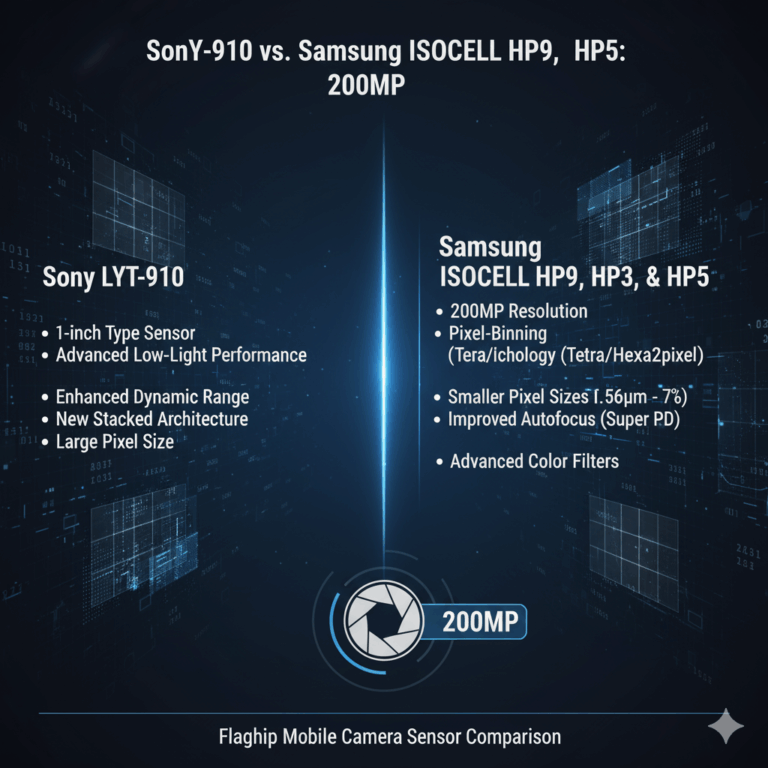
Sony LYT-910 vs. Samsung ISOCELL HP9, HP3, & HP5: 200MP

The initial race for a 200MP camera sensor in mobile imaging has ended. The market is now entering a new, more complex phase defined by application-specific sensors. This shift is best illustrated by Samsung’s diversified ISOCELL HP-series, which features the HP3 for mainstream main cameras, the HP5 for compact telephoto, and the HP9 for high-performance periscope zoom.

This new landscape creates a major strategic conflict, pitting Sony’s revolutionary 2-Layer Transistor Pixel architecture, found in the new Sony LYTIA LYT-910, against Samsung’s advanced iterative engineering. This analysis provides a deep dive and technical breakdown of this LYTIA vs. ISOCELL showdown, comparing the architectures, intended market applications, and real-world performance of the LYT-910, HP9, HP3, and HP5 to provide a complete overview of the ultra-high-resolution imaging market. Sony LYTIA LYT-910 vs. Samsung ISOCELL HP9, HP3, and HP5

An Architectural and Application-Specific Analysis of 200MP Mobile Image Sensors: Sony LYTIA LYT-910 vs. Samsung ISOCELL HP9, HP3, and HP5

A deep dive into the new era of mobile imaging, comparing Sony's 2-Layer architecture against Samsung's diversified HP-series.

Published by LensXP.com Tech | Updated: October 26, 2025

I. Executive Overview: The 200MP Sensor Market—A New Era of Application-Specific Design

The initial phase of the mobile imaging "megapixel war," characterized by the pursuit of the 200MP resolution benchmark, has concluded. The market is now transitioning into a more mature, fragmented, and strategically complex second phase. This new era is defined not by a singular race for the largest main camera sensor, but by a diversification into application-specific dominance. Samsung’s ISOCELL HP portfolio is the primary evidence of this fragmentation, featuring sensors now explicitly engineered for distinct market segments: the ISOCELL HP3 for mainstream main cameras, the ISOCELL HP5 for compact, high-zoom telephoto modules, and the ISOCELL HP9 for high-performance periscope telephoto systems.

This report frames the central conflict in this new market as a two-pronged battle:

  1. A Conflict of Architectural Philosophy: This analysis contrasts Sony's revolutionary "2-Layer Transistor Pixel" architecture against Samsung's advanced iterative engineering. Sony's approach fundamentally alters pixel structure by separating the photodiode and pixel transistor onto different layers, a move designed to dramatically enhance dynamic range and light saturation. In contrast, Samsung’s strategy relies on mitigating the physical limitations of its ultra-small pixels (0.5µm to 0.56µm) through sophisticated materials science and proprietary pixel isolation technologies, including Front Deep Trench Isolation (FDTI), Dual Vertical Transfer Gate (D-VTG), and DTI Center Cut (DCC).
  2. A Conflict of Market Strategy: This report also examines the divergent go-to-market strategies. Sony is executing a focused, top-down assault with a single, premium 200MP sensor—the LYTIA LYT-910—aimed squarely at the flagship main camera slot. This contrasts with Samsung's horizontal "dominate-all-niches" strategy, leveraging its diversified HP-series portfolio to capture multiple applications and price points.

Furthermore, an emerging trend indicates a shift away from off-the-shelf components. The development of the Samsung-Vivo "ISOCELL HPB"—a custom-tuned version of the HP9—demonstrates a future where sensor hardware is merely a platform for deep OEM co-development. This new paradigm integrates the sensor with custom optics (like Zeiss T coatings), advanced mechanical stabilization, and bespoke processing algorithms, making the phone manufacturer's research and development as critical as the sensor's base specifications.

This report provides an exhaustive technical breakdown of the Sony LYT-910, Samsung HP9, Samsung HP3, and Samsung HP5. It compares their underlying architectures, intended market applications, and validated real-world performance to provide a comprehensive understanding of the current ultra-high-resolution imaging landscape.

II. Comparative Technical Specification Matrix

The foundational specifications for the four sensors are presented below. This matrix is essential for establishing a baseline for comparison. While some sensors, particularly the ISOCELL HP3 and HP9, appear nearly identical on paper—sharing the same resolution, 1/1.4-inch optical format, and 0.56 µm pixel pitch—their intended applications are fundamentally different. The "Primary Application" column is therefore critical for resolving this ambiguity and framing the subsequent architectural and performance analysis.

Filter by Application:
C
Feature Sony LYTIA LYT-910 Samsung ISOCELL HP9 Samsung ISOCELL HP3 Samsung ISOCELL HP5
Resolution 200MP 200MP (16,320 x 12,288) 200MP (16,320 x 12,288) 200MP (16,384 x 12,288)
Optical Format 1/1.11" 1/1.4" 1/1.4" 1/1.56"
Pixel Pitch 0.7µm 0.56µm 0.56µm 0.5µm
Primary Application Flagship Main Camera Flagship Telephoto Mainstream Main Camera Compact Telephoto
Pixel Binning QBC (50MP) / QQBC (200MP Remosaic) Tetra²pixel (16-to-1) Tetra²pixel (16-to-1) Tetra²pixel (16-to-1)
Binned Output 12.5MP (Effective) 12.5MP @ 2.24µm 12.5MP @ 2.24µm 12.5MP @ 2.0µm
Autofocus All-pixel AF (likely 2x2 OCL) Super QPD (PDAF) Super QPD (All-pixel) Super QPD (PDAF)
HDR Technology DCG-HDR, >100dB Smart-ISO Pro (iDCG), Staggered HDR Smart-ISO Pro (Triple-ISO), Staggered HDR Smart-ISO Pro (iDCG), Staggered HDR
Stacked Arch. 2-Layer Transistor Pixel Stacked BI CMOS Stacked BI CMOS (implied) Stacked BI CMOS (implied)
Video (Max) 8K/30fps HDR, 4K/120fps HDR 8K/30fps, 4K/120fps, FHD/480fps 8K/30fps, 4K/120fps, FHD/480fps 8K/30fps, 4K/120fps, FHD/480fps (w/o AF)

Visual Spec Comparison: Physical Size

This chart compares the key physical dimensions of the sensors. For Optical Format, a smaller denominator (like 1.11 in 1/1.11") means a larger sensor. For Pixel Pitch, a larger number means a larger individual pixel.

III. Architectural Deep Dive: Sony's 2-Layer Transistor Pixel vs. Samsung's ISOCELL Pixel Mitigation

The performance differences between these sensors are dictated by their fundamental pixel architecture. Sony and Samsung have adopted divergent philosophies to solve the core challenge of mobile imaging: capturing maximum light and dynamic range within a constrained physical footprint.

A. Sony's LYTIA 2-Layer Transistor Pixel Architecture (LYT-910)

Sony's new architecture, which forms the basis of its LYTIA-branded sensors and is the presumptive architecture for the LYT-910, represents a fundamental re-engineering of the stacked CMOS pixel.

  1. The Conventional Limit: In conventional stacked CMOS sensors, the photodiode (which captures photons) and the pixel transistors (which control and amplify the signal) sit side-by-side on the same silicon substrate layer. This arrangement creates an inherent engineering trade-off: to reduce noise, the amp transistor must be made larger, which forces the light-capturing photodiode to become smaller. This zero-sum game limits both dynamic range and low-light performance.
  2. The 2-Layer Breakthrough: Sony's "2-Layer Transistor Pixel" technology solves this conflict by separating the photodiode and the pixel transistors onto different substrate layers, which are then stacked one atop the other.

Infographic: Sony's 2-Layer Transistor Pixel Architecture

Diagram comparing conventional vs. 2-layer pixel architecture. Conventional Stacked Pixel (Side-by-Side) Pixel Layer Photodiode Pixel Transistor Space is limited Sony 2-Layer Pixel (Stacked Layers) Pixel Layer Transistor Layer Expanded Photodiode Expanded Transistor More space for both

Causal-Chain Benefits: This separation yields three distinct advantages:

  • Doubled Saturation Signal: By moving the transistors to the logic layer below, the photodiode is no longer space-constrained and can be expanded to fill the entire pixel area. Sony claims this "approximately doubles" the saturation signal level—the maximum number of electrons a pixel can hold before overexposing.
  • Wider Dynamic Range: A doubled saturation signal level directly translates to a significantly wider dynamic range. This is the technological basis for the LYT-910's consistent rumor of achieving a dynamic range "exceeding 100dB". This allows for the capture of superior detail in high-contrast scenes, reducing blown highlights and crushed shadows.
  • Reduced Noise: Concurrently, the transistors on the dedicated logic layer are also freed from space constraints. This allows Sony to "successfully integrate a larger pixel transistor," specifically the amp transistor, which "dramatically reduce[s] the noise" that traditionally plagues low-light images.

This 2-Layer stack is Sony's core technological argument. It is not a simple iteration but a re-architecture of the pixel itself, enabling "superior performance even with a smaller pixel".

B. Samsung's ISOCELL Architecture (HP3, HP5, HP9)

Samsung's strategy is one of extreme miniaturization, pushing pixel pitch down to 0.56µm and even 0.5µm. As industry analysis notes, boasting about such tiny pixels is counter-intuitive, as smaller pixels inherently capture less light, leading to "unavoidable performance trade-offs" like higher noise.

Samsung's entire ISOCELL HP philosophy is to "defy this expectation" by using brilliant materials science and iterative engineering to mitigate these physical limitations. This is not a re-architecture, but rather a perfection of the current stacked Back-Side Illuminated (BSI) paradigm.

  1. Front Deep Trench Isolation (FDTI): An evolution of Samsung's ISOCELL DTI technology, FDTI creates a deep, physical insulating barrier between pixels before the color filter layer. This minimizes optical crosstalk (light leaking between adjacent tiny pixels), ensuring higher color fidelity and cleaner images.
  2. Dual Vertical Transfer Gate (D-VTG): To enhance the Full Well Capacity (FWC) of its small pixels, Samsung's D-VTG technology introduces two transfer gates within each pixel. This allows the sensor to more efficiently transfer the electrons (the light signal) from the photodiode to the logic layer. Samsung claims this results in up to a 66% higher FWC compared to conventional single-gate designs, improving color reproduction in bright scenes.
  3. DTI Center Cut (DCC): A specialized technology applied to the 0.5µm HP5 sensor. This structure "opens part of the trench among four photodiodes". This seemingly counter-intuitive design is specialized for enhancing autofocus precision while simultaneously enabling a 150% boost in conversion gain (CG) and reducing random noise (RN) by 3% to 40%, depending on conditions.

Samsung's approach allows for thinner and likely more cost-effective sensor modules. However, it creates a heavy reliance on computational photography (pixel binning, HDR stacking) to compensate for the lower native light-gathering capacity of its pixels, a trade-off validated in real-world product reviews.

IV. Analysis of Sony's Flagship Main Camera: LYTIA LYT-910

The LYTIA LYT-910 is Sony's first-ever entry into the 200MP segment, positioned as a premium main camera solution for "Ultra" tier flagship smartphones.

Sensor Profile and Strategic Positioning

The LYT-910's core specifications are 200MP resolution, a 1/1.11-inch optical format, and a 0.7µm pixel pitch.

Its strategic positioning is defined by its physical size. At 1/1.11 inches, the LYT-910 is substantially larger than any of Samsung's 200MP offerings, including the 1/1.4-inch HP3 and HP9 and the 1/1.56-inch HP5. This superior physical size, combined with the advanced 2-Layer Transistor Pixel architecture, forms the basis of its "no-compromise" 200MP performance argument.

Performance Features and Projections

  • Pixel Binning: The sensor is reported to use "QBC" (Quad Bayer Coding) for a 50MP binned output and "QQBC" (presumably Quad-Quad Bayer Coding) Remosaic to achieve its full 200MP output, offering flexibility between high sensitivity and maximum detail.
  • Dynamic Range: The sensor's key marketing metric is its dynamic range, consistently "exceeding 100dB". This is a direct result of the 2-Layer stack's doubled saturation signal and promises superior High Dynamic Range (HDR) performance in both stills and video.
  • In-Sensor Zoom: The 200MP resolution is leveraged to provide 2x and 4x "lossless-quality zoom shots" via in-sensor cropping. This feature directly addresses a primary weakness of 50MP 1-inch sensors, which excel in low light but struggle to produce high-quality digital zoom beyond 2x.
  • Video Capabilities: The LYT-910 is projected to be a video-centric powerhouse, supporting 8K/30fps and, critically, 4K/120fps with HDR enabled. This high-frame-rate HDR video capability is a significant differentiator.

Market Impact and Integration

The LYT-910 is not yet available in mass-market devices and is anticipated to debut in 2026 flagship models. Reports consistently link its adoption to the next generation of "Ultra" flagships from Chinese OEMs, specifically the OPPO Find X9 Ultra and the Vivo X300 Ultra.

This creates a fascinating strategic test within the market. Top-tier devices like the Vivo X100 Ultra currently use Sony's 1-inch 50MP LYT-900 sensor. The rumored adoption of the LYT-910 in the X300 Ultra will force OEMs and consumers to choose between two competing flagship philosophies: the massive 1.6µm pixels of a 50MP 1-inch sensor for unparalleled native low-light performance, or the 0.7µm pixels of the 200MP LYT-910 for superior resolution, versatile in-sensor zoom, and 8K video.

V. Analysis of Samsung's High-Performance Telephoto Sensor: ISOCELL HP9

The ISOCELL HP9 is arguably the most strategically significant sensor in this comparison, as it effectively created a new market category: the ultra-high-resolution telephoto sensor. It is explicitly not a main camera sensor.

Sensor Profile and Application

The HP9 is a 200MP sensor with a 1/1.4-inch optical format and 0.56µm pixels. It is marketed as the "Industry's First 200MP Telephoto Sensor for Smartphones".

The 1/1.4-inch optical format is massive for a telephoto module—as large as the main camera sensor in the Honor 90 and a key reason for the "huge" camera bumps on phones that use it. This size is a deliberate engineering trade-off, sacrificing slimness for raw optical performance.

Core Technology and Performance Features

  • Pixel Binning: The HP9's primary technology is its 16-to-1 (4x4) Tetra²pixel binning. It merges sixteen tiny 0.56µm pixels into a single, massive 2.24µm effective pixel, outputting a 12.5MP image. This is the sensor's "trick" to overcome the "common challenge for traditional telephoto cameras"—poor low-light performance.

Infographic: Samsung's 16-to-1 Tetra²pixel Binning

Diagram showing 16 small pixels merging into one large binned pixel. 16 Native Pixels (4x4) (e.g., 0.56µm each) 16-to-1 Binning 1 Binned Pixel (12.5MP) (e.g., 2.24µm effective) High Sensitivity
  • Autofocus and Sensitivity: It uses Super QPD (Quad Phase Detection) for autofocus and features a new high-refractive microlens material. Samsung claims these upgrades deliver "12% better light sensitivity" (based on SNR 10) and "10% improved autofocus contrast performance" compared to its predecessor (the HP3 platform).
  • Zoom: The 200MP resolution is used to provide 2x and 4x in-sensor zoom. When paired with an optical telephoto lens (e.g., 3x or 3.7x), it can achieve up to 12x hybrid zoom "while maintaining crisp image quality".
  • Video: It brings flagship main camera video specifications to the telephoto slot, including 8K/30fps and 4K/120fps recording.

Performance in Practice: The Vivo X100 Ultra Case Study

The Vivo X100 Ultra provides the first real-world validation of the HP9's capabilities, pairing it with an 85mm (3.7x) f/2.67 periscope lens.

  • Daylight and Zoom: Reviews describe its daylight performance as "superb," capturing "finely-detailed and noise-free" photos with "excellent" dynamic range.
  • Long-Range Zoom vs. Galaxy S24 Ultra: In direct long-range zoom tests, the X100 Ultra's HP9 decisively beats the Galaxy S24 Ultra's 50MP 5x sensor. At 100x zoom, review images show the S24 Ultra's output "devolves into a splotchy mess," whereas the X100 Ultra's image is "much cleaner" and "far more usable".
  • Low Light: The 16-to-1 binning strategy is effective. The HP9 telephoto "consistently outperforms" the previous-generation X100 Pro in the dark and captures "very good detail" while maintaining color saturation.
  • Weakness: The sensor's only noted weaknesses are the physical limitations of its 0.56µm pixels. Full-resolution 200MP shots can be "noisy", and the final images can occasionally appear "heavy-handed" with processing. This confirms the sensor is highly dependent on its binning and processing pipeline.

The Evolution: ISOCELL HPB (A Vivo-Samsung Custom Sensor)

The HP9 is also a successful platform that is now being customized. The upcoming Vivo X300 series will reportedly use the ISOCELL HPB, which is confirmed to be an "upgraded version of Samsung's HP9".

This "B for Blue" sensor is a deep co-development that integrates the sensor with a full imaging system:

  • Custom Optics: Zeiss T coating, Blue Glass, and APO (apochromatic) certified lenses for "purity" and minimal chromatic aberration.
  • Custom Stabilization: An industry-leading CIPA 5.5-level telephoto stabilization system.
  • Custom Algorithms: A unique "telephoto tracking engine" for motion capture and "high-pixel multi-frame fusion" algorithms.

VI. Analysis of Samsung's Miniaturized Telephoto Sensor: ISOCELL HP5

If the ISOCELL HP9 represents maximum telephoto performance, the ISOCELL HP5 represents maximum telephoto compactness.

Sensor Profile and Application

The HP5 is a 200MP sensor on a 1/1.56-inch optical format, notable for being the "world's first" sensor with 0.5µm pixels.

Its application is specifically for compact camera modules where the HP9's 1/1.4-inch size is physically prohibitive. It is "ideal for flexible telephoto and periscope systems", allowing manufacturers to prioritize a slimmer phone design.

Core Technology: A Masterclass in Mitigation

The 0.5µm pixel design is, by nature, poor at light capture. The HP5's entire design is an exercise in "heroic" computational and engineering mitigation. It uses Samsung's most advanced mitigation toolkit:

  1. FDTI (Front Deep Trench Isolation)
  2. D-VTG (Dual Vertical Transfer Gate)
  3. DCC (DTI Center Cut): This technology is particularly highlighted for the HP5, claimed to provide a 150% conversion gain boost and a 3-40% reduction in random noise.

Like the other HP sensors, it uses 16-to-1 Tetra²pixel binning. However, due to its smaller 0.5µm native pixels, the resulting binned pixel is only 2.0µm (versus the 2.24µm of the HP3 and HP9). This represents the ultimate performance-for-size trade-off.

The HP5 also features an End-to-End (E2E) AI Remosaic processing path, designed to output a full 200MP image in "less than two seconds" to address processing lag.

Market Impact and Integration

The HP5's primary business case is enabling advanced zoom in a small package, such as "up to 6x lossless zoom when used with a 3x telephoto lens". It is reportedly being adopted by Realme and other Chinese OEMs, with strong rumors pointing to its use in the Oppo Find X9 Pro's telephoto camera.

This creates a clear strategic choice for OEMs. A manufacturer like Vivo (using the HP9) prioritizes raw telephoto image quality and accepts the large camera bump. A manufacturer like Oppo (using the HP5) prioritizes a slimmer industrial design and accepts the smaller 2.0µm binned pixel, relying on advanced mitigation (DCC) and processing to remain competitive.

VII. Analysis of Samsung's Mainstream 200MP Sensor: ISOCELL HP3

The ISOCELL HP3 is Samsung's 200MP "sensor for the masses". It is designed to bring the 200MP resolution and its associated marketing features (like in-sensor zoom) to the "flagship-killer" and upper-mid-range smartphone markets.

Sensor Profile and Application

The HP3 features 200MP resolution, a 1/1.4-inch optical format, and 0.56µm pixels. Its primary application is as a main camera, marketed as a solution that enables "thinner" smartphone designs.

As noted in Section II, the HP3's headline specifications are identical to the HP9's. This strongly implies the HP9 is a direct evolution of the HP3 platform, but specifically optimized for telephoto use with claims of 12% better light sensitivity and 10% improved autofocus contrast.

Core Technology and Performance Features

  • Autofocus: The HP3's key innovation was Super QPD (Super Quad Phase Detection). It was the first to utilize 100% of its pixels for phase detection, using a single micro-lens over four adjacent pixels to detect phase differences in both horizontal and vertical directions, resulting in faster, more accurate autofocus.
  • HDR & Color: The HP3 introduced an upgraded Smart-ISO Pro technology with a triple-ISO mode (Low, Mid, and High). This, combined with its 14-bit color depth (supporting over 4 trillion colors), was a 64-fold improvement over 12-bit sensors. The sensor can intelligently switch between this and Staggered HDR depending on the scene.
  • Video: It supports 8K/30fps and 4K/120fps video recording, with Samsung claiming "minimal loss in the field of view".

Performance in Practice: Honor 90 & Realme 11 Pro+ Case Studies

The HP3's real-world performance demonstrates the precise trade-offs of its design.

  • Case Study: Honor 90 (Main Camera) The Honor 90 uses the HP3 as its primary 200MP camera. A DXOMARK technical test perfectly summarizes its performance:
    • Pros: The sensor achieves "Accurate target exposure," a "Wide dynamic range in bright light," and "Bright and vivid colors". This confirms the 14-bit Smart-ISO Pro and HDR technologies are highly effective when light is sufficient.
    • Cons: In low light, the sensor exhibits a "Frequent local loss of texture" and significant "shadow noise in photos".

    This is the exact trade-off of the small-pixel design: its sophisticated HDR processing wins in good light, but its 0.56µm native pixels fail in the dark, forcing a reliance on heavy noise reduction that destroys fine detail.

  • Case Study: Realme 11 Pro+ (Main Camera) The Realme 11 Pro+ uses an "Upgraded Samsung ISOCELL HP3 SuperZoom Sensor".
    • Zoom Performance: The 2x "lossless" zoom is considered "great" and "rich in detail". The 4x zoom, however, is confirmed to be not lossless, but rather an "acceptable" 12.5MP crop from the full 200MP mode. It is "noisy" but "the best it could have been done with the technology at hand".
    • Low-Light Performance: The phone's "Auto Nightscape" mode (heavy computational stacking) produces "excellent" and "flagship-grade" results. However, when this processing is turned off, the sensor's native weakness is exposed, producing "much darker" images with a "narrower dynamic range".

    These case studies prove the HP3 is a computationally-dependent sensor. Its native 200MP mode is often "artificial" and "noisy", and its low-light performance is entirely contingent on the quality of the smartphone OEM's image processing stack.

VIII. Synthesis and Strategic Recommendations

This analysis reveals a mobile sensor market that has pivoted from a simple megapixel race to a highly fragmented and sophisticated battle of architectural philosophy and application-specific design.

A. Main Camera Showdown: LYT-910 (Premium) vs. HP3 (Mainstream)

This is not a direct competition; the LYT-910 and HP3 are in different tiers.

  • Sony LYTIA LYT-910 (Premium): The LYT-910 is the clear technical winner for the flagship main camera slot. Its 1/1.11-inch size and 0.7µm pixels give it a fundamental physical advantage in light-gathering over the HP3's 1/1.4-inch 0.56µm pixel design. This physical advantage is then amplified by its superior 2-Layer Transistor Pixel architecture, which promises true hardware-level dynamic range (>100dB) rather than the computationally-stacked HDR of the HP3. The LYT-910 is built for premium "Ultra" flagships where cost and size are secondary to performance.
  • Samsung ISOCELL HP3 (Mainstream): The HP3 is the mass-market champion. It successfully delivers "good enough" 200MP features—including high-resolution shots and a usable 4x in-sensor zoom—and excellent bright-light HDR performance in a cost-effective and thin package. Its native low-light performance is its primary weakness, but this is effectively masked by strong OEM computational photography, as seen in the Honor 90 and Realme 11 Pro+.

B. Telephoto Showdown: HP9 (Performance) vs. HP5 (Compactness)

This is the report's most critical finding. The choice between the HP9 and HP5 is a strategic design choice for an OEM, representing a direct trade-off between physical size and raw image quality.

  • Samsung ISOCELL HP9 (Performance): The HP9 is the definitive choice for "camera-first" flagships, such as the Vivo X100/X200/X300 Ultra series. Its large 1/1.4-inch sensor and massive 2.24µm binned pixels deliver proven, best-in-class long-range zoom and low-light telephoto performance that has been shown to beat Samsung's own Galaxy S24 Ultra. The non-negotiable trade-off is a significant camera bump and module thickness.
  • Samsung ISOCELL HP5 (Compactness): The HP5 is the engineering choice for "design-first" flagships, such as the rumored Oppo Find X9 Pro. It sacrifices raw sensor size (1/1.56") and binned pixel size (2.0µm) to fit within a slimmer chassis. Its 0.5µm pixels rely on a heroic suite of mitigation technologies (FDTI, D-VTG, DCC) to remain competitive, enabling flexible 6x zoom from a 3x lens in a package that does not compromise the phone's industrial design.

C. Final Market Outlook: The Future is Co-Developed

Sony's 2-Layer architecture (LYT-910) represents the next fundamental leap in sensor hardware. Samsung's HP-series (HP3, HP5, HP9) represents the pinnacle of iterative engineering and market-specific mitigation.

However, the emergence of the ISOCELL HPB signals the true future of the industry. The "sensor" is no longer the final product; it is a platform. The winner of the next mobile imaging war will be the OEM that can forge the deepest partnership with a sensor supplier (like Vivo with Samsung) to create a fully integrated imaging solution. This new paradigm pairs a co-developed sensor (HPB) with custom-ground lenses (APO, Fluorite), proprietary optical coatings (Zeiss T), advanced mechanical stabilization (CIPA 5.5-level), and bespoke processing engines.

Therefore, industry observers should shift their focus from comparing sensors to comparing integrated imaging systems.

IX. Frequently Asked Questions (FAQ)

Q: What is the main difference between Sony's LYT-910 and Samsung's HP9?

A: The main difference is their application. The Sony LYT-910 is a large 1/1.11" sensor designed to be a premium main camera for "Ultra" flagships. The Samsung HP9 is a 1/1.4" sensor designed specifically as a high-performance telephoto camera sensor. While both are 200MP, the LYT-910 prioritizes native light-gathering and dynamic range for a main camera, while the HP9 uses 16-to-1 pixel binning to create a massive 2.24µm effective pixel for superior low-light zoom.

Q: Why does Samsung make so many different 200MP sensors (HP3, HP5, HP9)?

A: Samsung has adopted a strategy of creating application-specific sensors to capture different market segments and design priorities:

  • HP3: This is the 200MP main camera for mainstream and "flagship-killer" phones. It's a cost-effective way to bring 200MP features to a wider market.
  • HP9: This is the 200MP telephoto sensor for "camera-first" flagships (like the Vivo X100 Ultra) that prioritize zoom performance above all else, even if it means a large camera bump.
  • HP5: This is the 200MP compact telephoto sensor for "design-first" flagships. Its ultra-small 0.5µm pixels allow for a slimmer phone design while still offering 200MP zoom capabilities, trading some raw performance for compactness.

Q: Is a sensor with more megapixels (like 200MP) always better than a 50MP sensor?

A: Not necessarily. This report highlights the new conflict in flagship phones.

200MP (like LYT-910 or HP-series): Offers superior versatility. The high resolution allows for high-quality, "lossless" in-sensor zoom (e.g., 2x, 4x) and 8K video recording. The trade-off is that the native pixels are smaller (0.5µm - 0.7µm).

50MP (like Sony's 1-inch LYT-900): Offers superior native low-light performance. Its massive 1.6µm pixels can capture far more light natively, leading to cleaner images with less processing in the dark. The trade-off is weaker digital zoom beyond 2x.

The choice depends on the user's priority: versatility and zoom (200MP) vs. an "analogue" or "film-like" native low-light quality (50MP).

Q: What is Sony's "2-Layer Transistor Pixel" architecture and why is it important?

A: It's a revolutionary new sensor design. In traditional sensors, the photodiode (which captures light) and transistors (which amplify the signal) sit side-by-side on one layer, fighting for space. Sony's 2-Layer design stacks them: the photodiode gets the entire top layer, and the transistors are moved to a separate logic layer underneath. This is important because it allows both parts to be bigger, resulting in a doubled saturation signal (more light, wider dynamic range) and larger transistors (less noise). It's a fundamental hardware-level improvement, not just a software trick.

Q: What is "Pixel Binning" and why do all these 200MP sensors use it?

A: Pixel binning is a technique where the sensor groups tiny adjacent pixels (e.g., 16 of them) and electronically combines their light data to act as one single, large "effective" pixel. A 200MP sensor with 0.56µm pixels is natively poor in low light. By using 16-to-1 binning (like in Samsung's Tetra²pixel technology), it can output a 12.5MP image where each "effective" pixel is a massive 2.24µm. This drastically improves low-light sensitivity and dynamic range. It's a computational strategy to get the best of both worlds: high-resolution detail in daylight and high-sensitivity performance in the dark.

4K Indoor Security Camera Alternatives: Xiaomi vs. Eufy, Tapo Nest

The market for the best 4K indoor security camera has evolved in 2025. With crisp 4K resolution now the standard, the real competition has shifted to advanced features like on-device AI processing, reliable Wi-Fi 6 connectivity, and robust privacy controls. This in-depth comparison puts the disruptive Xiaomi C701 to the ultimate test against its top rivals: the dual-lens Eufy S350, the feature-packed TP-Link Tapo C260, the versatile Wyze Cam Pan v4, and the optical zoom specialist Reolink E1 Zoom. We analyze everything from image quality and color night vision to the software experience and total cost of ownership to help you decide which 4K PTZ camera truly reigns supreme for home security. LensXP.com | The Ultimate 4K Indoor Security Camera Showdown (Updated October 2025)

The Ultimate 4K Indoor Security Camera Showdown

An in-depth strategic analysis of the Xiaomi C701 and its top 4K PTZ rivals. Which camera reigns supreme in 2025?

By LensXP Staff | Last Updated: October 10, 2025

The indoor security camera market is at a turning point. Crisp 4K resolution is the new standard, but the real battleground has shifted. Today, market leadership is defined by on-device AI, next-gen Wi-Fi 6 connectivity, and robust privacy controls. This report dives deep into this evolving landscape, using the disruptive Xiaomi Smart Camera C701 as our benchmark.

Xiaomi has thrown down the gauntlet, packing an 8MP sensor, a dedicated 1 TOPS AI chip, Wi-Fi 6, and a physical privacy shield into a camera costing under €60. This aggressive move forces us to ask: can established players justify their premium prices? We'll analyze four key competitors—Eufy, TP-Link Tapo, Wyze, and Reolink—to determine who offers the best value, performance, and peace of mind in the modern smart home.

Meet the Contenders

Xiaomi C701

The market disruptor with an unbeatable price-to-performance ratio, packing Wi-Fi 6 and local AI.

BEST OVERALL VALUE

Eufy IndoorCam S350

The premium choice featuring a unique dual-lens system for unparalleled 8x hybrid zoom clarity.

SUPERIOR IMAGE DETAIL

TP-Link Tapo C260

The AI powerhouse offering the most comprehensive suite of free features, including facial recognition.

MOST FREE AI FEATURES

Wyze Cam Pan v4

A value-driven contender with IP65 weather resistance, but held back by a subscription-reliant model.

INDOOR/OUTDOOR VERSATILITY

Reolink E1 Zoom

The niche specialist that excels with true 3x optical zoom for lossless magnification at a distance.

TRUE OPTICAL ZOOM

First Impressions: Unboxing & Setup

A great camera needs a great first experience. We compared the journey from box to live feed.

Build Quality

Eufy's S350 feels the most premium, with a solid, weighty construction. The Tapo and Xiaomi models are well-assembled but lighter plastic. Wyze's IP65 rating adds a notable robustness, while the Reolink feels the most utilitarian.

Setup Process

Tapo and Eufy offer the slickest setup, with clear, guided steps and fast QR code recognition. Xiaomi's process is simple but requires navigating the broader Mi Home app. Wyze and Reolink are straightforward but have slightly less polished interfaces.

Time to "Live"

From opening the box to viewing a live stream, Tapo was the fastest at under 3 minutes. Eufy and Wyze followed closely. Xiaomi and Reolink took slightly longer due to initial mandatory firmware updates.

Technology Teardown

What do the specs really mean? Here's a breakdown of the key technologies powering these cameras.

Why Wi-Fi 6 Matters

4K streaming requires significant bandwidth. Wi-Fi 6 isn't just faster; it's better at handling multiple devices on a crowded network, reducing lag and ensuring a smooth, reliable video feed when you need it most.

The Power of On-Device AI (NPU)

A dedicated AI chip (NPU) processes video locally on the camera. This means faster, more accurate alerts (e.g., person vs. pet) and enhanced privacy, as sensitive footage doesn't need to be sent to the cloud for analysis.

Sensors and Low-Light Vision

While all are 4K, a larger sensor and a wider aperture (lower f-number) capture more light. This is crucial for clear, colorful images in dim conditions, a key differentiator in real-world performance.

Clarity in the Dark: Night Vision Compared

Excellent night vision is non-negotiable for a security camera. We found two distinct tiers of performance in our testing.

Standard Infrared (IR)

This is the classic black-and-white night vision. Reolink and Xiaomi provide clear IR images, perfectly suitable for identifying shapes and movement in total darkness.

Color Night Vision

By using highly sensitive sensors and ambient light, Tapo, Eufy, and Wyze can produce full-color images in low-light conditions. Tapo's "Starlight" sensor was particularly impressive, revealing details that were invisible on IR-only cameras. This can be crucial for identifying clothing color or other key details.

Night Vision Technology

Infrared

Black & White

Works in 0 light

Color

Full Color

Requires ambient light

The App Experience: Command Central

Hardware is only half the product. A clunky app can ruin the best camera. Here's our software breakdown.

Eufy Security

  • UI/UX: Clean, logical, and fast.
  • Timeline: Excellent event tagging.
  • Rating: ★★★★★

TP-Link Tapo

  • UI/UX: Very intuitive and feature-rich.
  • Timeline: Easy to scrub and filter.
  • Rating: ★★★★★

Wyze

  • UI/UX: Generally good, but pushes subscriptions.
  • Timeline: Event-based, less fluid for continuous video.
  • Rating: ★★★★☆

Xiaomi / Reolink

  • UI/UX: Functional but less polished.
  • Timeline: Basic, can be slow to load.
  • Rating: ★★★☆☆

Interactive Comparison

Filter the cameras by key features and see how they stack up in our interactive charts.

Overall Feature Score

Price Comparison (MSRP in USD)

2-Year Cost of Ownership

(MSRP + 2-Yr Subscription + 256GB Card)

Mechanical Tilt Range (Vertical)

Feature Xiaomi C701 Eufy S350 Tapo C260 Wyze Pan v4 Reolink E1 Zoom

Ecosystem & Connectivity

A smart camera should fit into your smart home, not fight it. We tested voice assistant compatibility and audio performance.

Smart Home Integration

CameraAlexaGoogle HomeHomeKit
Xiaomi C701
Eufy S350Partial*
Tapo C260
Wyze Pan v4
Reolink E1 Zoom

*Eufy offers HomeKit Secure Video on some models, but 4K streaming is often limited.

Two-Way Audio Quality

All cameras support two-way talk, but quality varies. The Eufy S350 delivered the clearest, loudest, and most natural-sounding audio by a significant margin, making conversations easy. Tapo and Wyze were a close second, offering perfectly usable audio. The Xiaomi and Reolink models were serviceable but noticeably more compressed and quieter.

Privacy & Security: A Deeper Look

Your home's security shouldn't compromise your privacy. Here's how the contenders handle your data.

Physical Lens Covers

Xiaomi, Eufy, Tapo, and Wyze include a motor-driven shield that physically blocks the lens. This offers the most definitive "off" state, providing peace of mind that can't be matched by software toggles.

Local-First AI

Xiaomi, Eufy, and Tapo perform their core AI detections on-device. This is a major privacy win, as it minimizes the amount of video footage that needs to be uploaded to the cloud for analysis.

Subscription Impact

Wyze's reliance on the cloud for its best features (via Cam Plus) inherently increases your privacy exposure. Models that offer full functionality without a subscription give users more control over their data.

Storage Flexibility

All cameras offer microSD card support, allowing for completely local storage. However, Tapo, Wyze, and Reolink stand out by supporting larger 512GB cards, enabling much longer continuous recording history without the cloud.

Use-Case Suitability Matrix

Which camera is the right tool for the job? We rate each contender for common household needs.

Use Case Xiaomi C701 Eufy S350 Tapo C260 Wyze Pan v4 Reolink E1 Zoom
Pet Monitoring
Nursery / Baby Cam
General Room Security
Monitoring a Specific Object
Covered Porch / Garage
Excellent Good Adequate

Final Verdict & Recommendations

No single camera is perfect for everyone. Our final verdict depends on your top priority. Find your user profile below for our tailored recommendation.

For the Budget-Conscious Technologist

You want the latest tech (4K, Wi-Fi 6) at the best possible price.

🏆 Winner: Xiaomi C701

Unbeatable combination of future-proof specs, local AI, and privacy features at a disruptive price.

For the Image Quality Purist

You demand the absolute best video detail and are willing to pay a premium for it.

🏆 Winner: Eufy IndoorCam S350

The dual-lens system and 8x hybrid zoom deliver a level of detail at a distance no other camera here can match.

For the Best Overall Experience

You want a hassle-free camera with a polished app and great features without a subscription.

🏆 Winner: TP-Link Tapo C260

A stable, user-friendly app, excellent color night vision, and subscription-free AI make it the most dependable choice.

For the Privacy-Focused User

You prioritize tangible control over your data and minimizing cloud dependency.

🏆 Winner: Xiaomi C701

The combination of a physical, motor-driven lens shield and local-only AI processing provides the strongest privacy assurances.

For the Outdoor Versatility Seeker

You need one camera that can reliably monitor both indoor and covered outdoor areas.

🏆 Winner: Wyze Cam Pan v4

Its unique IP65 weather-resistance rating offers flexibility that no other camera in this analysis provides.

For the Optical Zoom Specialist

Your primary need is lossless magnification for monitoring a specific target from a distance.

🏆 Winner: Reolink E1 Zoom

The only camera with true 3x optical zoom, it's the perfect specialist tool for nurseries or monitoring a cash register.

The Road Ahead: Future Trends

The smart camera market never stands still. Looking ahead, we anticipate the widespread adoption of the Matter connectivity standard, which will simplify integration across different smart home ecosystems. Expect to see more advanced AI that understands not just objects, but context and behavior. As prices for high-end components fall, features like optical zoom and thermal imaging may even begin to appear in more mainstream devices, further blurring the lines between consumer and professional security.

LensXP.com

© 2025 LensXP.com. All rights reserved. An independent analysis of smart home technology.

List of 4:3 Large Format Cinema Cameras with Specs & Lenses

0

Welcome to the definitive 2025 guide to 4:3 large format cinema cameras. In this expert analysis, we break down the top contenders dominating the world of anamorphic filmmaking, from the industry-standard ARRI ALEXA Mini LF to the high-resolution Sony VENICE 2 and RED V-RAPTOR [X]. This interactive resource is designed for cinematographers and filmmakers, featuring a detailed comparison tool, dynamic charts for visualizing key specs like dynamic range and frame rates, and innovative infographics that explain core concepts. Whether you’re shooting an indie film or a blockbuster, our guide will help you choose the perfect large format camera for your next production. The Ultimate Guide to Large Format 4:3 Cinema Cameras (Sept 2025) - LensXP.com

The Definitive Guide to Large Format 4:3 Cinema Cameras

Your expert-driven, interactive resource for choosing the right anamorphic powerhouse. Updated for September 2025.

By the LensXP Tech Team

Why Large Format & 4:3? The Anamorphic Canvas

The move to large format sensors is about more than just resolution; it's a fundamental shift in the geometry of filmmaking. A larger sensor provides a wider field of view for any given lens, creating a shallower depth of field that beautifully isolates subjects. This creates what many describe as a more immersive, "you are there" feeling.

For anamorphic cinematography, this shift is revolutionary. Anamorphic lenses compress a wide image horizontally. To capture this compressed image without losing quality, you need a tall sensor. That's where aspect ratios like 4:3, 3:2, and 6:5 become essential, utilizing the entire height of the sensor and the full power of the lens.

Infographic: Sensor Size Matters

VistaVision / RED VV 40.96x21.60mm
ARRI ALEXA LF 36.70x25.54mm
Full Frame 36x24mm
Super 35 24.89x18.66mm

Hover to see details. Sizes are relative.

Infographic: The Anamorphic Squeeze

1. Wide Scene

2.39:1

2x Anamorphic Lens Squeezes Image

2. Captured on 4:3 Sensor

4:3

Decoding the Specs: Key Terminology Explained

Open Gate

Using the entire physical area of the sensor to record, regardless of aspect ratio. This provides maximum flexibility in post-production for reframing, stabilizing, and delivering to multiple aspect ratios.

Dual Native ISO

A sensor technology with two separate circuits for different base ISOs (e.g., 800 and 3200). This optimizes for low-light performance, producing a much cleaner image at the higher base ISO than simply boosting the gain.

Codecs & Bit Depth

The codec (e.g., ProRes, BRAW, X-OCN) is the compression format. Bit depth (10-bit, 12-bit) determines color information. Higher bit depth in a robust RAW codec provides the most latitude for color grading.

Color Science

The proprietary processing that interprets RAW sensor data into a viewable image. Each manufacturer has a unique "look," famous for how it renders colors and skin tones (e.g., ARRI's naturalism, Canon's warmth).

Anamorphic vs. Spherical: A Visual Breakdown

Understanding the fundamental difference in how lenses project an image onto the sensor is key to appreciating large format 4:3 cameras.

Spherical Lenses

These lenses project a clean, geometrically accurate image. The bokeh (out-of-focus areas) is circular, and there are no spatial distortions. This is the "standard" look for most cinematography.

Clean, Circular Bokeh

Standard Lens Flare

Best for: Architectural accuracy, clean narratives, projects where a naturalistic look is desired.

Anamorphic Lenses

These lenses contain a cylindrical element that squeezes the image horizontally. This creates distinct visual characteristics after being "de-squeezed" in post-production for a widescreen aspect ratio.

Stretched, Oval Bokeh

Iconic Horizontal Lens Flares

Best for: Epic, cinematic feel, science fiction, and productions aiming for a distinctive, stylized visual texture.

A Deeper Look at Dynamic Range

Dynamic Range, measured in "stops," is a sensor's ability to capture detail in the brightest highlights and darkest shadows of a single frame. A wider dynamic range gives you more flexibility in color grading and prevents "clipping" (losing all detail to pure white) or "crushing" (losing detail to pure black).

Shadows Midtones Highlights

Low Dynamic Range (e.g., 8 Stops)

Details in the sky (highlights) and deep shadows are lost. The image feels harsh and less natural.

High Dynamic Range (e.g., 16+ Stops)

Rich detail is preserved across the entire exposure, from the brightest clouds to the darkest corners, allowing for a beautiful, cinematic grade.

Global vs. Rolling Shutter: Capturing Motion Perfectly

How a sensor reads out image data fundamentally impacts motion portrayal. This is a critical distinction, especially for action sequences, VFX work, and live events.

Rolling Shutter

The sensor captures the image by scanning it line by line from top to bottom. While fast, this can create distortion with rapid motion or camera pans, resulting in skewed vertical lines (the "jello effect") or flash banding.

Notice the skewed, distorted look on fast-moving objects.

Prevalence: The vast majority of CMOS sensors in cinema and consumer cameras use a rolling shutter.

Global Shutter

The entire sensor captures the image at the exact same instant. This completely eliminates motion artifacts. Every frame is a perfect, geometrically stable snapshot of the scene.

The propeller blades are captured cleanly without any skew or distortion.

Prevalence: A high-end feature found in cameras like the RED V-RAPTOR [X], prized for its technical perfection.

Interactive Comparison Tool

Filter by Manufacturer:

Camera Sensor Max Anamorphic Resolution Dynamic Range Base ISO Lens Mount Max FPS Codecs

The Gateway to Glass: Lens Mount Ecosystems

The lens mount is more than a physical connection; it's a commitment to an ecosystem. Large format cinematography has ushered in new standards while respecting legacy systems through robust adapters.

LPL

ARRI LPL Mount

The modern standard for large format cinema. With a wider diameter (62mm) and shorter flange distance (44mm) than PL, it's designed for the large image circles and advanced lens data communication (LDS-2) required by modern lenses.

PL

ARRI PL Mount

The undisputed industry workhorse for decades. While not originally for large format, many lenses offer coverage, and its robust, positive-locking design remains a trusted standard. Most cameras offer a PL adapter, ensuring backward compatibility.

RF

Canon RF Mount

Canon and RED's choice for their new cinema bodies. The short flange distance allows for incredible versatility via adapters (PL, EF) and enables innovative "in-between" components like variable ND filters or anamorphic de-squeezers.

E

Sony E-Mount

Featured on the VENICE line, Sony's mirrorless mount is highly adaptable. On cinema cameras, it's often used with a locking collar for security or removed entirely to reveal a native PL mount, offering users the best of both worlds.

Visualizing the Data

Dynamic Range Comparison (Stops)

A higher number indicates a greater ability to capture detail in shadows and highlights.

Max Framerate at Highest Anamorphic Resolution

Higher framerates are crucial for capturing high-quality slow-motion footage.

The Unsung Hero: Internal ND Filters

One of the most significant quality-of-life features on a modern cinema camera is a built-in Neutral Density (ND) filter system. This allows cinematographers to control light exposure without affecting color or depth of field, enabling wide apertures even in bright daylight.

CLEAR 0.6 1.2 1.8 2.4

Speed & Efficiency

No more wasting time on set screwing on or dropping glass filters in a matte box. With the press of a button, you can instantly adapt to changing light conditions.

Creative Control

Internal NDs allow you to maintain a shallow depth of field (e.g., f/2.8) in broad daylight, a creative choice made simple without compromising aperture.

Precision & Consistency

High-end systems offer seamless ranges of ND, providing incredibly precise, repeatable exposure control that is difficult to achieve with external filters.

Beyond the Sensor: Workflow & On-Set Reality

Media & Data Rates

CFx
CODEX
RED

Large format RAW isn't light. Consider the media costs and data wrangling needs. Cameras use proprietary media like Codex Compact Drives or non-proprietary formats like CFexpress.

Power Consumption

V

These cameras are power-hungry. A robust battery solution is non-negotiable, with most productions relying on industry-standard V-Mount or Gold Mount batteries.

Size, Weight & Rigging

A camera's base weight is just the start. "Mini" versions are designed for gimbals, drones, and tight spaces where larger bodies can't go.

The Sound of Silence: Acoustic Performance

An often-overlooked spec is the camera's operating noise. Powerful processors generate heat, requiring fans. In quiet, dialogue-driven scenes, a loud camera can be a major problem for the sound department.

Quiet Operation

Premium cameras like the ARRI ALEXA series are renowned for their whisper-quiet performance, typically operating below 20 dB, making them ideal for sensitive audio environments.

Advanced Fan Modes

Many cameras (RED, Sony) offer user-controllable fan modes. You can set them to ramp up quietly before a take or run at full speed when the camera is not rolling to maximize cooling.

Sound Dept. Friendly

A quiet camera saves time and money in post-production by reducing the need for audio cleanup (dialogue noise reduction) and makes the on-set experience better for everyone.

From Set to Suite: Post-Production Considerations

Shooting in RAW on a large format sensor provides incredible flexibility, but it requires a robust post-production pipeline to handle the data and unlock its full potential.

Data Management & Storage

A single project can generate terabytes of data. You'll need fast, redundant storage solutions (like a RAID array) for both on-set offloading and post-production.

RAW Processing Power

Editing 8K or 12K RAW files requires a powerful computer with a high-end GPU. Most workflows use "proxies"—smaller versions of the footage—for smooth editing.

The Color Grading Process

RAW footage allows colorists to precisely adjust exposure, contrast, and color, using a Look-Up Table (LUT) as a starting point to craft the final look.

Which Camera is Right for Your Production?

The Indie Darling

For independent films, music videos, and passion projects where budget is key but image quality cannot be compromised.

Blackmagic Cinema Camera 6K

Why: Unbeatable price-to-performance ratio. The flexibility of Blackmagic RAW combined with a full-frame sensor and L-Mount adaptability makes it a creative powerhouse.

The Industry Workhorse

For high-end commercials, episodic television, and feature films where reliability, a trusted workflow, and universally loved color science are paramount.

ARRI ALEXA Mini LF

Why: The gold standard. It's trusted by crews worldwide for its bulletproof reliability and the beautiful, natural images it produces. The ARRI workflow is mature and efficient.

The Resolution King

For VFX-heavy blockbusters, IMAX productions, and projects that require the absolute maximum in resolution for cropping, reframing, or large-format exhibition.

Sony VENICE 2 / RED V-RAPTOR [X]

Why: These cameras push the boundaries of technology. The VENICE 2's 8.6K sensor and dual native ISO, and the V-RAPTOR's global shutter and 8K 120fps capabilities offer unparalleled specs.

The Big Decision: Rent or Buy?

Owning a cinema camera is a dream, but the cost of entry is steep, and technology evolves quickly. Renting provides access to the latest gear on a per-project basis. Here’s how to decide.

Reasons to Rent

  • Access the best tool for each specific job without a massive capital investment.
  • Rental houses maintain and service the gear, ensuring it's in perfect working order.
  • Avoid the depreciation of rapidly evolving camera technology.

Reasons to Buy

  • If you shoot consistently (e.g., weekly), ownership can be more cost-effective in the long run.
  • Unlimited access for personal projects, tests, and building deep familiarity with your system.
  • Generate return on investment by renting out your own camera package.

The Future is Bigger & Smarter

The rapid evolution of cinema technology points to several key trends. Large format is no longer a niche, but the new professional standard, displacing Super 35mm. The "resolution war" is maturing, with manufacturers now competing on other fronts like dynamic range, sensor technology (like global shutters), and intelligent workflow enhancements like direct cloud integration.

Looking ahead, we expect the continued democratization of high-end features. Open Gate recording and internal RAW capture will become standard in more accessible cameras. At the highest end, the push into even larger formats will continue, with systems like the ARRI ALEXA 65 and Blackmagic URSA Cine 17K becoming more common. The cinematographer's creative toolkit has never been more powerful or diverse.

LensXP.com

© 2025 LensXP. All rights reserved. Your expert source for professional lens and camera analysis.

iPhone 17 Pro & Pro Max Camera Specs: 48MP with 8K Video & 8x Zoom?

The iPhone 17 Pro and Pro Max camera systems are shaping up to be a revolutionary leap in mobile photography. Based on the latest September 2025 leaks and analyst reports, Apple is moving towards a unified 48MP sensor philosophy for its entire rear camera array—including the Main, Ultra-Wide, and a dramatically upgraded Telephoto lens. This deep-dive explores all the rumored iPhone 17 Pro camera specs, from the potential for 8K video recording and a game-changing variable aperture to the A19 Pro chip’s computational power. We’ll analyze the groundbreaking 24MP front camera, the conflicting reports on an 8x optical zoom, and compare it all to the iPhone 16 Pro baseline. iPhone 17 Pro & Pro Max Camera Deep-Dive | LensXP.com

DEEP-DIVE ANALYSIS

iPhone 17 Pro Camera Systems: A Unified 48MP Revolution

Last Updated: September 8, 2025

The upcoming iPhone 17 Pro models are poised to introduce the most significant architectural evolution in Apple's mobile imaging strategy, pivoting to a unified, high-resolution sensor philosophy across all cameras.

This strategic shift is built upon standardizing a 48-megapixel sensor across the entire rear camera system—encompassing the Main (Wide), Ultra-Wide, and Telephoto lenses—for the first time. It's a deliberate and aggressive strategy to transcend the traditional boundaries of smartphone photography. The move promises unprecedented consistency in detail, color science, and image processing across all focal lengths, further consolidating the iPhone's position as a primary capture device for both enthusiasts and creative professionals.

The Triple 48MP Architecture

Ultra-Wide

48MP

Main (Wide)

48MP

Telephoto

48MP

Behind the Glass: The Sensor Supplier Story

The technological prowess of the iPhone camera system is built on a long-standing, symbiotic partnership between Apple and Sony. For the iPhone 17 Pro, all signs point to Sony continuing as the exclusive supplier for all three rear camera sensors. Sony's cutting-edge stacked CMOS technology allows for faster readout speeds and improved noise reduction, which are critical for features like 48MP ProRAW and advanced video modes. While rumors of Apple diversifying its supply chain with Samsung LSI are circulating, this strategic shift is widely expected to be for the iPhone 18 or later, making the iPhone 17 Pro the potential zenith of the current Apple-Sony collaboration.

The Main Camera: An Engineering Trade-Off

The Main camera is set to continue its use of a 48MP sensor with a 1.22μm pixel size. However, credible reports suggest a slight decrease in physical size to 1/1.3-inch from the 1/1.28-inch sensor in the iPhone 16 Pro. This seems counterintuitive but is likely a calculated engineering trade-off to accommodate a much larger, more complex telephoto system and a new vapor chamber for cooling. Apple is betting that the new A19 Pro chip's ISP and advanced computational photography can more than compensate for the fractional reduction in the sensor's native light-gathering capability.

The Brains of the Operation: A19 Pro ISP

A sensor only captures raw data; the magic happens in the processing. The iPhone 17 Pro will debut the A19 Pro chip, featuring a significantly enhanced Image Signal Processor (ISP). This dedicated silicon is the heart of Apple's computational photography, responsible for billions of operations per second. It handles real-time noise reduction, color science, dynamic range optimization (Deep Fusion, Photonic Engine), and geometric correction. The unified 48MP sensor array will provide the ISP with a richer stream of data than ever before, enabling more intelligent and nuanced processing across every lens.

The Modern Imaging Pipeline

📷

Lens & Sensor

Light Capture

🧠

A19 Pro ISP

Raw Data Processing

Computational AI

Deep Fusion / HDR 5

🖼️

Final Image

HEIC/ProRAW

The Telephoto Revolution

The telephoto system represents the most ambitious upgrade, moving from 12MP to a 48MP sensor. This fourfold resolution increase enables high-quality "in-sensor zoom" by cropping the central 12MP portion of the sensor, effectively creating a 2x digital zoom with near-optical quality. A native 5x optical lens, for example, could also provide a high-quality 10x hybrid zoom.

The rumor mill is divided on the native optical focal length, with possibilities ranging from 3.5x (ideal for portraits), 5x, or even a class-leading 8x continuous optical zoom, potentially exclusive to the Pro Max model.

Proposed Telephoto Zoom Scenarios

Zoom Mode Technology Use Case
3.5x Optical Native Tetraprism Lens (~85mm) Portraiture, short-telephoto subjects
5x-7x Hybrid 48MP In-Sensor Crop General purpose telephoto, events
8x Optical (Pro Max) Moving Lens Mechanism (~200mm) Sports, wildlife, distant subjects

Front Camera & New Capabilities

The front-facing TrueDepth camera is also getting its most substantial upgrade in years, moving to a 24MP sensor with a more complex six-element (6P) lens. This transforms it from a simple "selfie" shooter into a high-performance imaging tool for content creators. Key hardware improvements include:

  • Phase Detection Autofocus (PDAF): For the first time, the front camera will gain PDAF, allowing for rapid and accurate focus on subjects at varying distances, crucial for vlogging and dynamic self-portraits.
  • Optical Image Stabilization (OIS): The addition of sensor-shift OIS will dramatically improve low-light selfies and stabilize handheld video, resulting in smoother, more professional-looking content.
  • Six-Element (6P) Lens: An upgrade from the previous 5P lens, the new design will improve image sharpness and reduce optical aberrations.

Next-Generation Video Capabilities

The Leap to 8K

The powerful combination of 48MP sensors and the A19 Pro chip will finally unlock 8K video recording on an iPhone. This feature is not just about higher resolution for 8K displays; it provides filmmakers with significant creative flexibility, allowing them to crop, reframe, and stabilize footage in a 4K timeline without losing any quality.

Dual-Stream Recording for Creators

A rumored "pro" camera app may enable dual-stream recording, allowing users to capture video from two cameras simultaneously (e.g., front and rear, or wide and telephoto). This is a game-changer for interviews, reaction videos, and behind-the-scenes content, streamlining production workflows.

Pioneering: Mechanical Variable Aperture

One of the most exciting rumors is a mechanical variable aperture, giving photographers true control over depth of field, from a blurry background (wide aperture) to a sharp scene (narrow aperture).

Shallow Depth of Field

A wide aperture (low f-number) isolates the subject by creating a beautifully blurred background. Perfect for portraits.

Data Visualized

Sensor Size Comparison (Main & Telephoto)

A physically larger sensor can capture more light, improving low-light performance. Note the slight decrease in the Main sensor to accommodate a significantly larger Telephoto sensor.

Megapixel Evolution by Lens

The most dramatic shift is the Telephoto lens jumping from 12MP to 48MP, completing the all-48MP rear system and unlocking powerful hybrid zoom capabilities.

Spec-for-Spec Comparison

Use the filters below to compare the rumored iPhone 17 Pro models against the established iPhone 16 Pro baseline.

Feature iPhone 16 Pro / Max iPhone 17 Pro iPhone 17 Pro Max
Main Camera 48MP, 1/1.28" 48MP, 1/1.3" 48MP, 1/1.3"
Ultra-Wide Camera 48MP, 1/2.55" 48MP, 1/2.55" 48MP, 1/2.55"
Telephoto Camera 12MP, 1/3.06" 48MP, 1/2.55" 48MP, 1/2.55"
Optical Zoom 5x Optical 3.5x - 5x Optical Up to 8x Continuous
Front Camera 12MP, 5P Lens 24MP, 6P Lens, OIS 24MP, 6P Lens, OIS
New Tech N/A Variable Aperture, 8K Video Variable Aperture, 8K Video

Key Technology Spotlight

Advanced Thermal Management: Vapor Chamber

The immense processing load from three 48MP sensors, 8K video recording, and the A19 Pro chip generates significant heat. To prevent thermal throttling and maintain peak performance, Apple is rumored to be introducing a new vapor chamber cooling system. This is a more efficient thermal solution than the graphite sheets used in previous models and is a critical enabling technology for the camera system's most demanding features. This focus on cooling is what necessitates the slight reduction in the main sensor's size, showcasing Apple's holistic approach to system design.

Final Outlook: An Architectural Statement

The camera system of the iPhone 17 Pro is not simply an upgrade; it is a statement. It signals a strategic shift away from improving individual cameras in isolation and toward engineering a seamlessly integrated, high-resolution imaging system. It prioritizes consistency, telephoto versatility, and professional-level control above all else.

As the pinnacle of the long-standing Apple-Sony imaging partnership, it is set to establish a new benchmark for mobile photography and videography, setting an incredibly high bar for the next era that will commence with the iPhone 18. The ultimate takeaway is clear: Apple is no longer just competing in the smartphone camera space; it is redefining its boundaries.

Faceofit.com

Your daily source for tech analysis and insight.

© 2025 LensXP.com. All Rights Reserved.

Compare Canon C70 vs Sony FX3: Filmmaker’s Specs & Limits

0

Choosing between the Canon C70 and Sony FX3 is one of the biggest decisions a modern filmmaker can make in 2025. It’s a battle of philosophies: Canon’s ready-to-shoot cinema workhorse against Sony’s modular low-light powerhouse. This definitive guide goes beyond simple spec sheets to deliver an in-depth comparison of what truly matters on set. We analyze everything from the C70’s game-changing internal ND filters and Cinema RAW Light against the FX3’s legendary full-frame low-light performance and tenacious autofocus. From ergonomics and color science to the true cost of ownership, we provide the clarity you need to invest in the right tool for your filmmaking future. Canon C70 vs. Sony FX3: The Ultimate Filmmaker's Guide | LensXP.com

IN-DEPTH ANALYSIS

A Definitive Analysis: Canon EOS C70 vs. Sony FX3

Which compact cinema camera reigns supreme for the modern filmmaker? We break down the philosophy, performance, and price of these two titans.

By Alex Hawthorne | Last Updated: September 8, 2025

The choice between the Canon C70 and Sony FX3 is more than a spec comparison—it's a commitment to a workflow, an ecosystem, and a creative philosophy. The C70 is a pure cinema camera shrunk down; the FX3 is a mirrorless camera scaled up. This report dives deep to help you decide which tool is the right strategic partner for your filmmaking career.

Which Camera Is Right For You?

Select your primary filmmaking needs to get an instant recommendation.

Recommendation: Canon EOS C70

Ideal for professionals prioritizing a "ready-to-shoot" cinema package. Its built-in NDs, pro audio, and timecode make it a workhorse for efficient, reliable production in documentary, event, and corporate settings.

Recommendation: Sony FX3

The perfect tool for solo creators who demand ultimate low-light capability, a compact form factor for specialized rigging, and access to a vast lens ecosystem. A powerhouse for gimbal work and hybrid shooting.

At a Glance: Core Specifications

Feature Canon EOS C70 Sony FX3
Sensor SizeSuper 35 DGO CMOSFull-Frame BSI-CMOS
Internal ND FiltersYes, Mechanical (2-10 Stops)No
Image Stabilization5-Axis Digital IS5-Axis In-Body (IBIS)
Internal RAWYes, 12-bit Cinema RAW LightNo (External Only)
Base ISO (Log)ISO 800 (Dual Gain)Dual Base: 640 & 12,800
Audio Inputs2x Mini-XLR (Built-in)2x Full-XLR (via Handle)
TimecodeYes, BNC In/Out (Built-in)Requires Adapter
Weight (Body + Batt)~1340 g~716 g

Infographic: Sensor Size Matters

Full-Frame

(35.6 x 23.8 mm)

Sony FX3

Shallower DoF, Wider FoV

Super 35

(26.2 x 13.8 mm)

Canon C70

Industry Standard, Cinema Look

The FX3's full-frame sensor has ~2.3 times the surface area of the C70's Super 35 sensor, impacting depth of field and low light performance.

The Workflow Game-Changer: Built-in ND Filters

Arguably the single greatest practical advantage of the Canon C70 is its integrated mechanical ND filter system. This is a cornerstone of professional cinema workflow, allowing the filmmaker to maintain a consistent aperture and shutter angle in changing light. The Sony FX3 has no built-in ND, forcing reliance on slower, external solutions.

Interactive Demo: The Power of Internal ND

Click the buttons to see how the C70 can instantly control bright light without changing aperture or shutter speed.

A bright outdoor scene

ND: 0 Stops

Low-Light Performance: A Nuanced Battle

The FX3 is a low-light champion, leveraging its large sensor and incredible dual base ISO of 640 and 12,800. The C70's DGO sensor prioritizes signal integrity, producing exceptionally clean images in its native range but without the extreme high-ISO reach of the Sony.

Interactive Chart: ISO Performance

The FX3's high base ISO of 12,800 is a production-enabling feature for capturing clean images in near darkness, a feat the C70 cannot match.

The Ecosystem Factor: Lens Selection

A camera is an entry point into a lens ecosystem. The Sony E-mount is the most mature mirrorless system, with vast third-party support offering incredible choice and value. The Canon RF mount features superb native optics and excellent adaptation for legacy EF lenses, but has limited third-party autofocus options.

314+

Lenses

Sony E-Mount

Unmatched variety and value from Sony and third-parties like Sigma & Tamron.

88+

Lenses

Canon RF Mount

Exceptional native quality and powerful adaptation of the vast EF lens library.

Handling & Philosophy: A Tale of Two Designs

Beyond specs, the physical experience of using these cameras reveals their core identities. The C70 is built as a self-contained cinema tool with a focus on operator control. The FX3 is a master of modularity, designed to be built up or stripped down as needed.

Canon C70: The Operator's Camera

  • Vertical Grip: Designed for comfortable handheld shooting, with a prominent record button and multi-function grip.
  • Assignable Buttons: 13 customizable buttons allow operators to tailor the camera to their exact needs, minimizing menu dives.
  • Cinema Menus: The professional Canon Cinema EOS menu system provides deep, granular control over every image parameter.
  • Taller Form Factor: Can be more challenging to balance on smaller gimbals compared to the FX3.

Sony FX3: The Modular Powerhouse

  • Compact Body: A "cage-free" design with multiple 1/4"-20 mounting points for ultimate rigging flexibility.
  • Top Handle Unit: The included handle not only provides XLR inputs but also a robust and comfortable way to carry and get low-angle shots.
  • Tally Lamps: Front and rear tally lamps are a clear indicator of recording status, invaluable for on-camera talent and crew.
  • Mirrorless Menus: While improved with touch capability, the menu system is still adapted from Alpha still cameras, feeling less intuitive for dedicated video shooters.

The Heart of the Image: Codecs & Media

The format you record in dictates your flexibility in post-production and your storage requirements. The C70 offers a powerful internal RAW codec, while the FX3 provides highly efficient and widely compatible options.

Recording Format Canon C70 Sony FX3
Internal RAW12-bit Cinema RAW Light (ST, LT, HQ)Not Available
External RAWNot Available16-bit ProRes RAW via HDMI
Primary 10-bit CodecXF-AVC (4:2:2, Intra-Frame)XAVC S-I (4:2:2, Intra-Frame)
High Frame Rate CodecH.264/MP4 (4:2:0 8-bit at 180fps)XAVC HS/S (4:2:2 or 4:2:0 10-bit)
Media Slots2x SD UHS-II2x CFexpress Type A / SD UHS-II

Key Takeaway: The C70's internal Cinema RAW Light is a massive advantage for colorists who want maximum flexibility without needing an external recorder. The FX3 counters with more robust high-frame-rate options and faster, though more expensive, CFexpress Type A media cards which are required for its highest quality codecs.

Built for the Crew: I/O and Connectivity

A camera's ports determine how it integrates into a professional production environment. The C70 is built with on-set needs in mind, featuring professional locking connectors and built-in functionality that often requires adapters on the FX3.

Canon C70 Ports

✅ Full-Size HDMI Out

✅ 2x Mini-XLR Audio In

✅ 3.5mm Mic & Headphone

✅ Timecode BNC In/Out

✅ USB-C

❌ SDI Out

The dedicated Timecode BNC port is critical for multi-camera shoots, eliminating sync issues in post. Mini-XLRs provide pro audio without extra hardware.

Sony FX3 Ports

✅ Full-Size HDMI Out

✅ 2x Full-XLR (via Handle)

✅ 3.5mm Mic & Headphone

❌ Dedicated Timecode Port

✅ USB-C & Micro USB

❌ SDI Out

The full-size HDMI is a welcome feature for reliability. Pro audio relies entirely on the included top handle, and timecode sync requires a separate adapter cable.

All-Day Shooting: Battery & Power

Reliable power is non-negotiable on set. The C70 uses larger, professional cinema batteries, while the FX3 uses the smaller, ubiquitous batteries from Sony's Alpha mirrorless line.

Approximate 4K/24p Continuous Record Time

Canon C70 (BP-A30 Battery) ~175 Minutes
Sony FX3 (NP-FZ100 Battery) ~135 Minutes

While the C70 offers longer runtimes with its standard battery, the FX3's NP-FZ100 batteries are smaller, cheaper, and widely available. Both cameras can be powered externally via USB-C PD for extended shooting.

The Autofocus Showdown

For solo operators and small crews, a reliable autofocus system is mission-critical. Both Canon and Sony are at the top of their game, but their systems have distinct strengths and operational feel.

Canon: Dual Pixel CMOS AF II

  • Strengths: Renowned for its smooth, cinematic, and "human-like" focus pulls. The touch-and-drag functionality on the rear screen is incredibly intuitive for racking focus. Excellent face and eye detection that is predictable and rarely hunts.
  • Best For: Interviews, narrative work, and situations where smooth, organic focus transitions are paramount.

Sony: Real-time Tracking AF

  • Strengths: Unbelievably "sticky" and tenacious. Sony's AI-driven subject recognition for humans, animals, and vehicles is industry-leading. Once it locks onto a subject, it refuses to let go, even if they turn away or are briefly obstructed.
  • Best For: Sports, wildlife, documentary follow-scenes, and any scenario where a subject is moving erratically and cannot be missed.

Slow Motion Capabilities

High frame rate (HFR) recording is a key creative tool. Here's how the cameras stack up when you need to slow things down.

Frame Rate Canon C70 Sony FX3
4K up to 60pFull Sensor Readout, 10-bit 4:2:2Full Sensor Readout, 10-bit 4:2:2
4K at 120pSuper 16mm Crop, 10-bit 4:2:2~1.1x Crop, 10-bit 4:2:2
2K / 1080p at 120pSuper 16mm Crop, 10-bit 4:2:2Full Sensor Readout, 10-bit 4:2:2
Max Frame Rate180p (2K/1080p, S16 Crop)240p (1080p, via S&Q mode)
Audio in HFRYes, up to 120pNo (S&Q Mode)

Key Takeaway: The Sony FX3 is the clear winner for 4K slow motion, offering 120p with a barely noticeable crop. The C70's significant Super 16mm crop at 4K/120p is a major creative limitation, requiring different framing and lenses. However, the C70's ability to record audio at high frame rates is a professional advantage for conforming audio later.

Color Science: The Soul of the Image

Color is subjective, but each brand has a "look" that serves as a starting point for the grade. Canon is famed for its pleasing skin tones, while Sony offers a clean, modern, and highly flexible image.

Canon Cinema EOS Color

With C-Log 2, C-Log 3, and Wide DR Gamut, Canon provides a rich cinematic base. The color science is often described as "organic" and is particularly flattering for skin tones straight out of the camera. Many DPs feel they have to do less work to get a beautiful image from Canon footage, making it a favorite for fast-turnaround projects that still require a high-quality look.


Sony Cinema Line Color

The FX3 features S-Log3 and the popular S-Cinetone picture profile. S-Log3 captures an enormous amount of dynamic range, providing a very flat but data-rich file perfect for heavy color grading. S-Cinetone is Sony's answer to the demand for a pleasing, ready-to-use look with rich colors and soft highlight roll-off, inspired by their VENICE cinema camera. It offers a great balance of quality and efficiency.

Cost of Ownership: Beyond the Body

A true cost analysis must include the accessories required to make each camera fully functional on set. The C70's higher initial price includes key features that must be purchased separately for the FX3.

Interactive Calculator: Total Rig Cost

Canon C70 Rig

Features like ND, Timecode, and Pro Audio are built-in.

Body Price$4,800
Included
Included
Included

Total Rig Cost: $4,800
Sony FX3 Rig

Select accessories to match the C70's core features.

Body Price$3,900

Total Rig Cost: $3,900

Final Verdict and Recommendations

The Canon EOS C70 and Sony FX3 are both exceptional filmmaking tools, but they are designed for different users with different priorities. The final choice should be guided by a strategic assessment of your primary shooting style, workflow needs, and existing equipment.

Profile 1: The Documentary, Event, and Corporate Filmmaker

Recommendation: Canon EOS C70. This user thrives on efficiency and reliability. The C70's built-in ND filters, integrated audio, and dedicated timecode create a self-contained workhorse that is faster to deploy and operate on set.

Profile 2: The Solo Creator, Gimbal Operator, and Low-Light Specialist

Recommendation: Sony FX3. This user prioritizes portability and creative flexibility. The FX3's compact body, phenomenal high-ISO performance, and 5-axis IBIS are game-changing for filmmakers who rely on available light and dynamic camera movement.

Profile 3: The Hybrid Shooter and Small Production House

Recommendation: Sony FX3. For a team needing one camera for high-quality video and competent stills, the FX3 is the more versatile hybrid tool. Its superior stills capabilities and cohesive E-mount ecosystem make it a more flexible system for a small company.

LensXP.com

Your definitive source for modern filmmaking gear analysis.

Join Our Newsletter

Get the latest reviews and deals straight to your inbox.

© 2025 LensXP.com. All Rights Reserved.