Smartphone camera hardware design is shifting away from software reliance. This document tracks publicly verified smartphone and industrial camera sensors equipped with Lateral Overflow Integration Capacitor technology.
We separate confirmed silicon specifications from unverified market reports. Review the data for OmniVision’s TheiaCel line, Sony’s LYTIA L910, and SmartSens Lofic HDR 3.0 implementations.
These physical hardware components replace multi-frame software processing with native single-exposure high dynamic range capture. The database below catalogs pixel sizes, optical formats, and dynamic range decibel limits across the current mobile imaging market.
Confirmed LOFIC Imaging Sensors
This document tracks publicly verified smartphone and industrial camera sensors equipped with Lateral Overflow Integration Capacitor technology. The data clearly separates confirmed specifications from unverified reports.
Sensor Database
| Manufacturer | Sensor Model | Specifications | LOFIC Details |
|---|---|---|---|
| OmniVision | OV50K40 | 50MP, 1/1.3-inch | First smartphone TheiaCel sensor. Combines LOFIC with established HDR architecture. |
| OmniVision | OV50X | 50MP, 1-inch, 1.6µm pixels | Supports DCG plus LOFIC HDR mode. Designed for flagship main cameras. |
| OmniVision | OV50R40 | 50MP, 1/1.3-inch | Second-generation TheiaCel architecture. Rated for up to 110 dB single-exposure HDR. |
| Sony | LYTIA L910 | 50MP, 1/1.28-inch | First LYTIA mobile sensor with LOFIC. Combines it with Triple Conversion Gain HDR. Specifies 100 dB single-exposure HDR. Scheduled for summer 2026 mass production. |
| SmartSens | SC5A6XS | 50MP, 1-inch | Uses Lofic HDR 3.0. Claims up to 115 dB dynamic range and 4K 60fps in LOFIC-HDR mode. |
| SmartSens | SC575XS | 50MP, 1/1.56-inch | Lofic HDR 3.0. Reaches up to 110 dB dynamic range. Targeted at premium phone main cameras. |
| SmartSens | SCC90XS | 200MP, 1/1.28-inch | First 200MP mobile sensor with a LOFIC ultra-HDR mode using Lofic HDR 3.0. |
Manufacturer Analysis
OmniVision
- Pros: Early market entry. High integration with Dual Conversion Gain. Proven deployment in commercial devices.
- Cons: Sensor naming conventions can cause confusion among consumers.
Sony
- Pros: Wide adoption by major smartphone brands. Strong ISP compatibility. Integration with Triple Conversion Gain.
- Cons: Slower to adopt LOFIC for the mobile sector compared to competitors. Currently limited to a single confirmed mobile model.
SmartSens
- Pros: Broadest announced product range. High stated dynamic range figures up to 115 dB. First to offer a 200MP variant.
- Cons: Lower historical presence in western flagship smartphones compared to Sony.
Single-Exposure Range
The following visual data representation compares the stated single-exposure dynamic range decibel limits of selected models.
The Core Mechanism
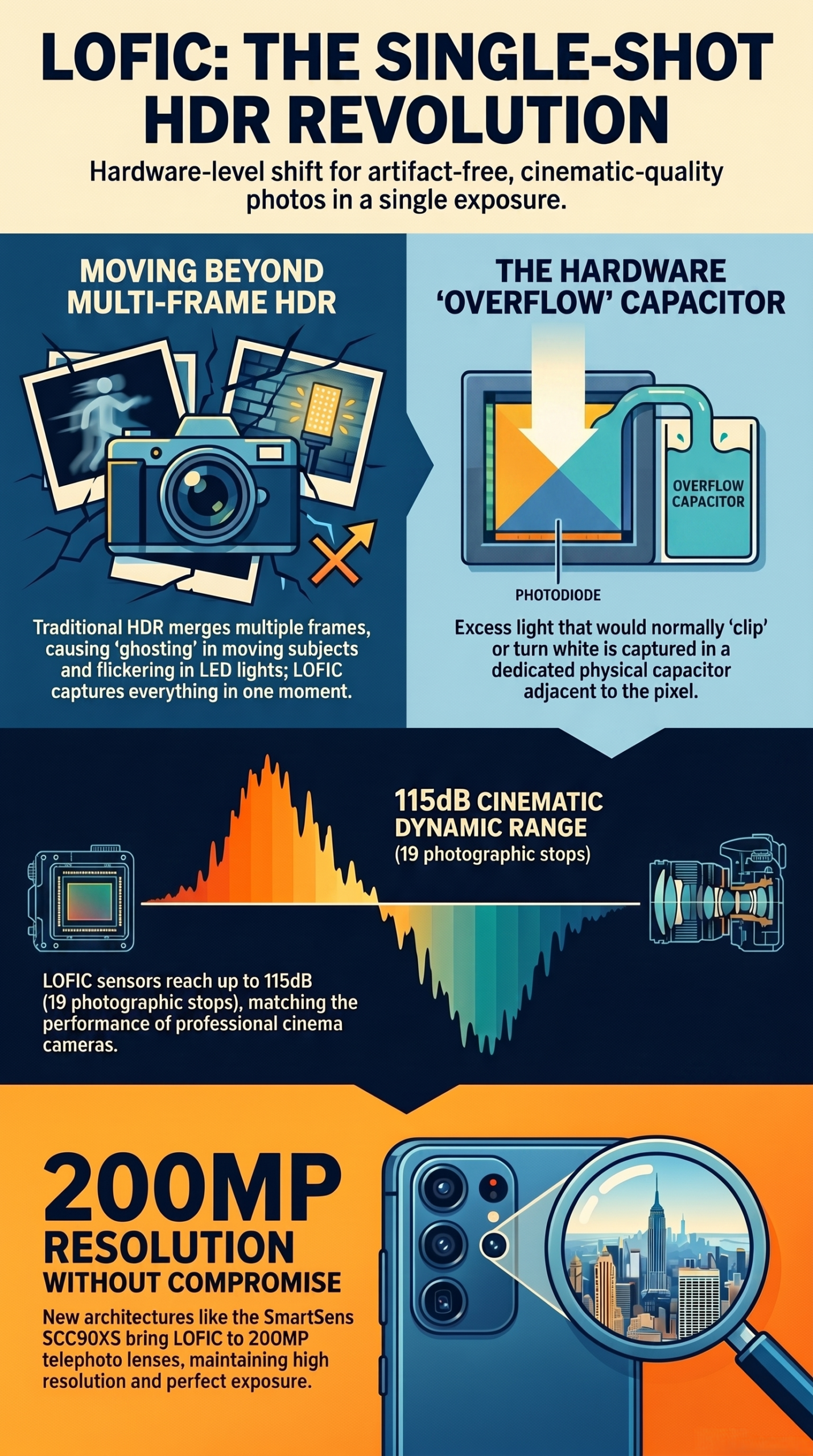
Understanding Lateral Overflow Integration Capacitor technology requires looking at how pixels capture light. Standard sensor pixels act like buckets collecting photons. When exposed to bright light sources like the sun or neon signs, these buckets quickly fill up and overflow. This overflow results in blown-out, pure white highlights with zero recoverable detail.
LOFIC architecture solves this physical limitation. Engineers place a high-density storage capacitor adjacent to each individual photodiode. When the primary pixel bucket fills up, the excess photoelectrons do not spill over and cause clipping. Instead, they flow laterally into this secondary storage capacitor. The sensor system then reads the data from both the primary diode and the overflow capacitor simultaneously. This preserves extreme highlight detail natively within a single exposure cycle.
Visualizing the Single-Shot Process
The diagram below illustrates the physical architecture of these sensor nodes. It maps out how the system expands capacity through the lateral overflow structure.
Impact on Photography
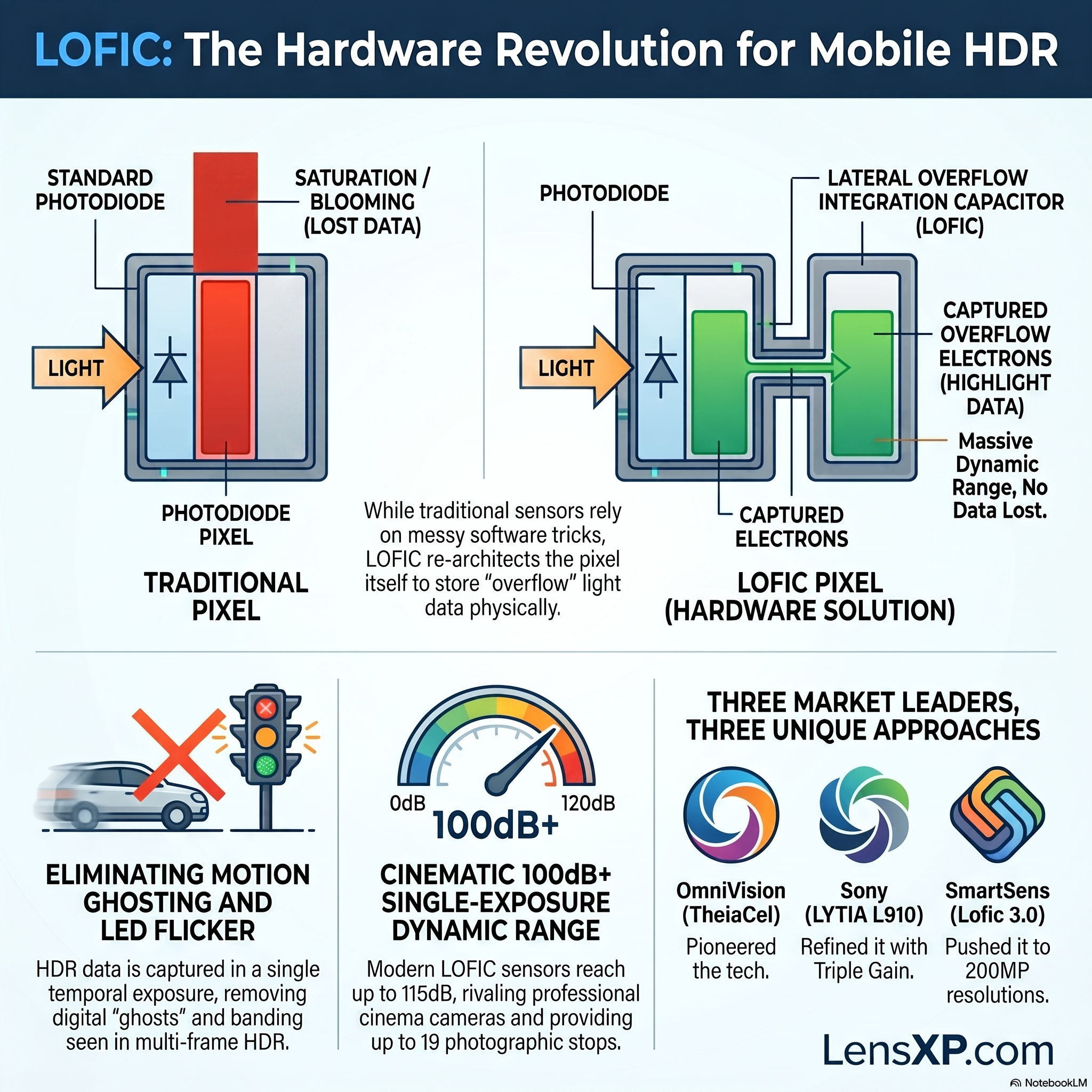
Modern smartphones rely heavily on computational photography to achieve High Dynamic Range. The traditional method forces the camera to rapidly shoot multiple frames at varying exposure lengths. The image signal processor then merges these frames. This multi-frame approach creates severe ghosting artifacts when subjects move during the capture sequence.
Sensors equipped with overflow capacitors alter this processing pipeline entirely. Because the hardware captures an immense dynamic range in one physical shot, the phone no longer needs to rely on aggressive multi-frame blending for standard lighting scenarios. This hardware capability eliminates motion ghosting. It also dramatically reduces the computational load on the device processor, leading to faster capture times, lower heat generation, and improved battery efficiency during heavy camera use.
Power Consumption Metrics
Processing multiple frames simultaneously forces the Image Signal Processor to operate at maximum clock speeds. This intense data processing generates measurable excess heat inside the phone chassis. Hardware-level high dynamic range minimizes this processing overhead. The image sensor sends a single compiled frame directly to the processor. This streamlined data pipeline lowers overall system temperatures during extended video recording sessions and extends total battery life.
Pixel Pitch Constraints
The physical capacitor requires physical space on the silicon die. Early hardware designs placed these capacitors alongside the light-gathering photodiodes. This limited how small the pixels could be manufactured. Newer stacking technologies place the storage layer directly beneath the pixel layer. This vertical arrangement allows hardware engineers to achieve massive 200-megapixel densities without sacrificing the critical overflow capacity.
Video Capture Dynamics
Still photography represents only one aspect of sensor performance. High-resolution video stresses sensor pipelines significantly more than static image capture. Traditional HDR video requires the sensor to alternate exposures frame by frame. This alternating exposure technique creates jarring motion artifacts in fast-moving scenes.
Hardware-level overflow capacitors capture the entire dynamic range natively within each continuous frame. The SmartSens SC5A6XS targets this specific use case by processing 4K resolution at 60 frames per second while maintaining full dynamic range capacity. This produces clean video output that handles extreme backlit subjects without motion smearing.
Wafer Fabrication Methods
Building these complex pixel structures requires precise silicon manufacturing techniques. The overflow capacitor demands dedicated physical die space. Engineers utilize wafer-to-wafer stacking to solve this geometric problem. They fabricate the light-gathering photodiodes on a top silicon layer. They build the logic circuits and the physical storage capacitors on a separate bottom layer.
Copper-to-copper bonding connects these layers at the microscopic level. This three-dimensional construction allows manufacturers to maintain large capacitor volumes without reducing the size of the primary light-gathering diodes.
Sensor Format Evolution
Optical format sizes dictate absolute light gathering limits. The 1-inch class provides the largest physical surface area for individual pixels in mobile devices. The SmartSens SC5A6XS utilizes this large area to maximize both photodiode size and capacitor volume. Conversely, manufacturers also package high resolutions into smaller 1/1.28-inch formats to fit standard phone chassis. The Sony L910 and SmartSens SCC90XS prove that capacitor integration functions reliably even as physical pixel pitch shrinks.
ISP Signal Processing
Camera hardware requires external processors to interpret the captured data. Standard Image Signal Processors expect sequential frames for high dynamic range compiling. Overflow capacitor sensors send a completely different data package. They transmit the standard pixel readout alongside the overflow capacitor data simultaneously. Mobile chipmakers must update their silicon processors to decode this parallel data stream efficiently to realize the full hardware benefits.
Future Hardware Outlook
The transition to hardware-level overflow capacity marks a permanent shift in mobile camera engineering. Future iterations will likely focus on increasing the physical size of the storage capacitors to push dynamic range limits beyond 120 decibels. Manufacturers are currently researching new dielectric materials to increase capacitor density without requiring more silicon die space. This material science progression will eventually allow these components to fit into ultra-compact folding smartphones.
Proprietary Naming
Manufacturers use distinct marketing terms for identical core concepts. OmniVision uses the brand name TheiaCel. This architecture combines an overflow capacitor structure with standard Dual Conversion Gain. SmartSens uses the term Lofic HDR 3.0 for its implementation. Sony pairs the capacitor overflow mechanism with a Triple Conversion Gain structure on the LYTIA L910. The fundamental engineering principle remains identical across these implementations.
Hardware Trends
The initial wave of these sensors concentrated on 50-megapixel resolutions and 1-inch optical formats. SmartSens expanded this baseline. The SCC90XS introduced a 200-megapixel configuration on a 1/1.28-inch format. Sony targets the 1/1.28-inch class with its L910 model, scheduling mass production for summer 2026. This indicates a hardware shift toward fitting high dynamic range capabilities into smaller camera modules.
Cross-Industry Use
Mobile electronics represent only one segment of this hardware ecosystem. Automotive and security applications demand high dynamic range performance. OmniVision supplies the OX08D10 for automotive camera arrays. Sony produces the IMX908 for dedicated security hardware. These sectors prioritize single-exposure dynamic range to handle variable lighting conditions like headlights at night without producing motion artifacts.
Notable Exclusions
Market reports frequently misidentify standard high dynamic range sensors as LOFIC models. The following sensors do not qualify based on official manufacturer specifications.
- Sony LYT-828 and LYT-901: These sensors support advanced HDR modes. Sony has not categorized them as LOFIC products.
- Samsung ISOCELL HP6 and HPA: Reports regarding these models consist of pre-release rumors. Samsung has not published confirmed specifications for these units.
Frequently Asked Questions
Conclusion
The integration of lateral overflow capacitors marks a physical shift in digital imaging hardware. Manufacturers like OmniVision, Sony, and SmartSens are solving dynamic range limitations at the silicon level instead of relying on software workarounds. This hardware approach eliminates motion artifacts and reduces processing heat. The industry is moving toward single-exposure high dynamic range as the standard for premium mobile photography.