back to top

LATEST ARTICLES

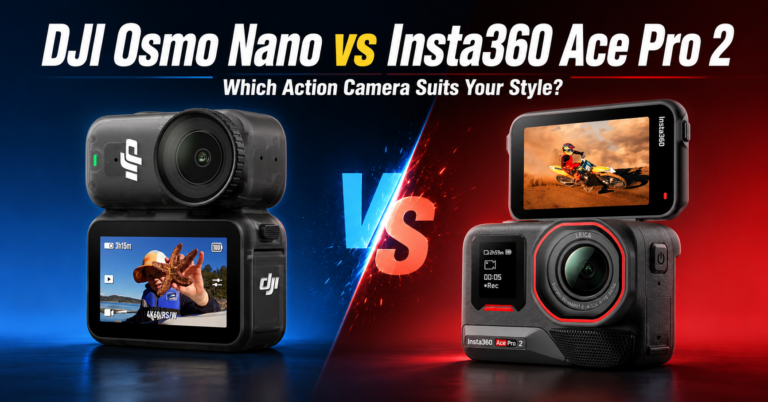
DJI Osmo Nano vs Insta360 Ace Pro 2: Which Action Camera Suits Your Style?

Action cameras have evolved into specialized tools that serve very different purposes. Both the DJI Osmo Nano and the Insta360 Ace Pro 2 utilize a 1/1.3-inch sensor size, but their hardware design philosophies are polar opposites.

The Osmo Nano prioritizes extreme portability and flexible POV mounting for athletes and creators who need a “barely there” camera. Conversely, the Insta360 Ace Pro 2 functions as a full-sized flagship, packing 8K resolution, Leica optics, and extensive professional workflow features into a traditional rugged body.

Understanding these differences is key to picking the right gear for your next shoot. Below, we compare the design, imaging output, and real-world utility of both models.

DJI Osmo Nano vs Insta360 Ace Pro 2 Specs Comparison | LensXP

Updated till Feb 2026

DJI Osmo Nano vs Insta360 Ace Pro 2 Specs Comparison

Two very different approaches to action cameras using the same 1/1.3 inch sensor size.

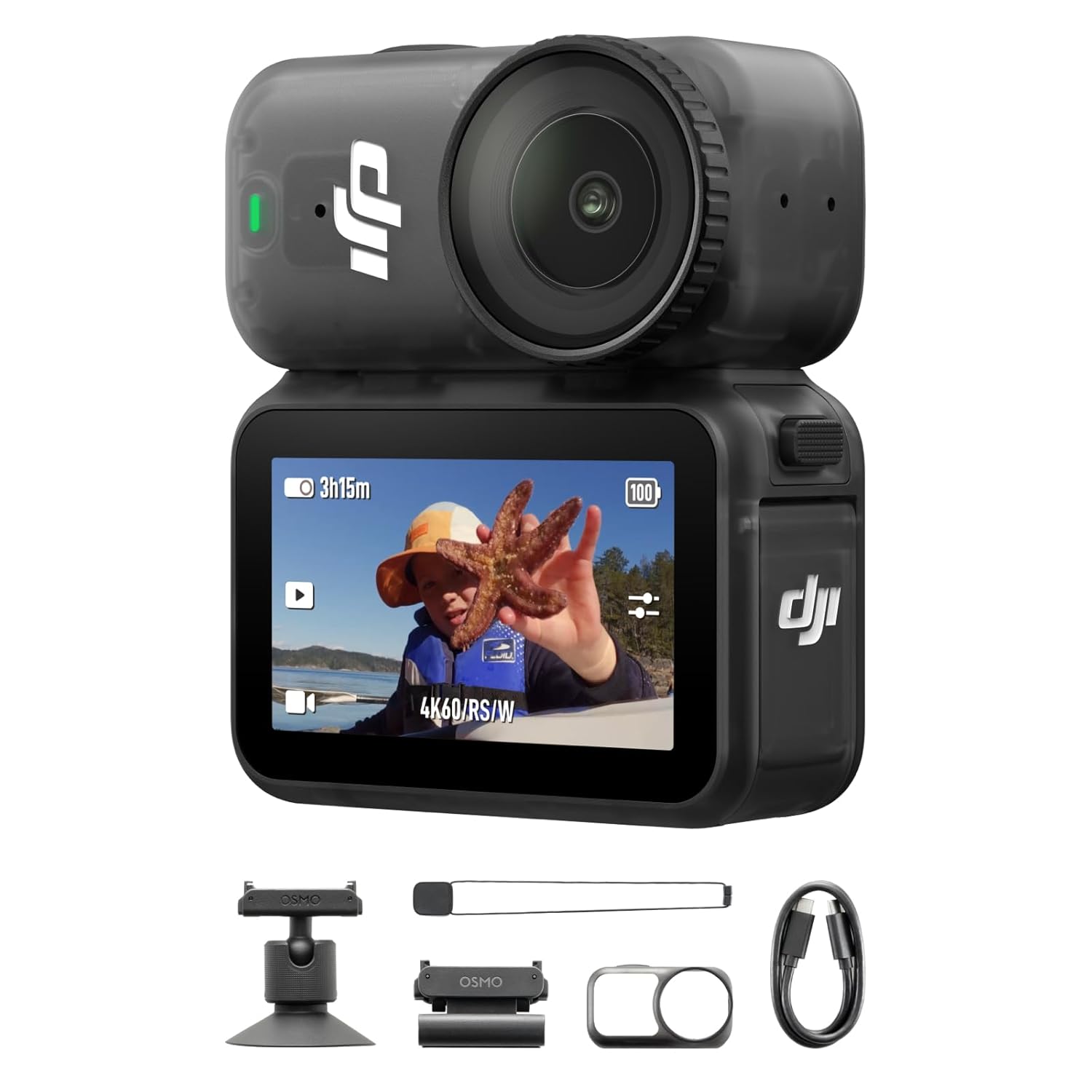
DJI Osmo Nano

DJI Osmo Nano

An ultra compact wearable POV camera weighing just 52 grams for the camera module.

Check on Amazon
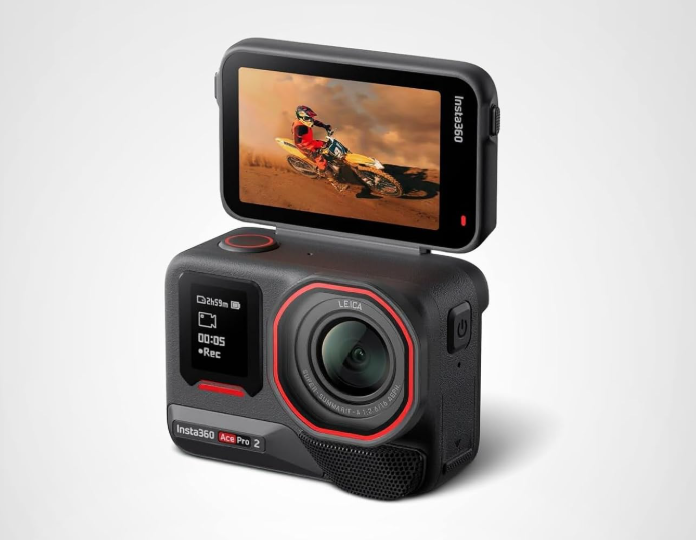
Insta360 Ace Pro 2

Insta360 Ace Pro 2

A full size action camera with an integrated flip up touchscreen weighing 184 grams.

Check on Amazon

Both cameras target very different use cases. The Osmo Nano relies on extreme portability and mounting flexibility. The Ace Pro 2 offers extensive creator features for serious video production. Below we compare their designs, key specifications, and ideal use cases.

Interactive Performance Chart

Core Specifications

Feature DJI Osmo Nano Insta360 Ace Pro 2
Sensor Size 1/1.3 inch CMOS 1/1.3 inch CMOS
Max Resolution 4K at 60fps 8K at 30fps
Lens & FOV f/2.8 at 143 degrees f/2.6 at 157 degrees
Waterproofing 10 meters sealed module 12 meters full unit
Battery 530 mAh module plus 1300 mAh dock 1800 mAh internal

Design Approach

The Osmo Nano uses a two piece system. A tiny magnetic camera module detaches from a larger Vision Dock. You can mount the camera on hats, helmets, pets, or metal surfaces via built in magnets. The Vision Dock features a 1.96 inch OLED screen allowing you to frame shots and change settings remotely. The dock is splash resistant.

The Ace Pro 2 is a single rugged block. It incorporates a large 2.5 inch flip up touchscreen ideal for self filming and vlogging. You do not need a housing to take it underwater down to 12 meters.

Video Capabilities

The Ace Pro 2 offers technically superior image quality due to its higher native resolution and brighter lens. It records 8K at 30fps and 4K at up to 120fps. It uses a dual image processor architecture enabling PureVideo processing for low light capability. It supports 10 bit I Log color profiles and outputs 180 Mbps H.265 video.

The Osmo Nano maxes out at 4K 60fps for normal video. It delivers sharp vivid 4K footage using 10 bit D Log M encoding at a 120 Mbps bitrate. It provides excellent RockSteady 3.0 stabilization. The Nano captures impressive footage for its small size but falls behind the Ace Pro 2 in dim lighting conditions.

Deep Analysis: Image Quality & Post Production

Sensor Dynamics

Both cameras claim approximately 13.5 stops of dynamic range from their 1/1.3 inch sensors. The Ace Pro 2 pushes this hardware further. Its 8K video and 50 megapixel photos offer massive pixel counts. The faster f/2.6 Leica co engineered lens captures cleaner shadows and finer textures compared to the Nano.

Color & Grading

The Osmo Nano utilizes 10 bit D Log M color which performs admirably for a pocket camera. The Ace Pro 2 targets professional workflows offering 10 bit I Log and dedicated Leica color profiles like Leica Natural and Vivid. This larger file headroom makes the Ace Pro 2 superior for heavy cropping and color grading.

Vlogging, Audio & Workflow

Audio and Controls: The Ace Pro 2 integrates dual internal microphones alongside new presets optimized for wind reduction and clear vocals on motorcycles. Its 2.5 inch screen is a massive advantage for framing oneself. The Nano lacks a forward facing screen but relies on its Vision Dock and voice controls for rapid operation.

Storage Logistics: The Osmo Nano introduces built in storage options of 48GB or 107GB. You shoot directly to the module and offload via the dock. The Ace Pro 2 operates entirely via removable microSD cards up to 1TB. The Ace Pro 2 also boasts 30W fast charging reaching 80 percent in 47 minutes.

Photography & Motion Control

Still Imaging

The Osmo Nano captures 35 megapixel photos. The Ace Pro 2 steps up to 50 megapixel raw images. Photographers benefit from the wider ISO range and larger pixel counts on the Ace Pro 2 for extracting maximum detail from still shots.

Stabilization & Slow Motion

DJI equips the Nano with RockSteady 3.0 and HorizonBalancing up to 4K 60fps alongside 8x slow motion at 1080p. The Ace Pro 2 provides full horizon locking and pushes slow motion to 4K at 120fps or 1080p at 240fps for high speed action.

Why Pick Osmo Nano

  • > Ultra light wearable use weighing almost nothing on the body.
  • > Hands free versatility using the detachable Vision Dock.
  • > Splashproof simplicity for quick mounting in tight spaces.

Why Pick Ace Pro 2

  • > High end flagship performance with 8K 30p resolution.
  • > Superior low light detail thanks to the Leica f/2.6 lens.
  • > A massive 2.5 inch flip up touchscreen perfect for vlogging.

Frequently Asked Questions

Which camera has better battery life?
The Ace Pro 2 has a larger 1800 mAh internal battery rated for about 180 minutes of recording. The Osmo Nano camera module lasts about 90 minutes alone. When paired with the Vision Dock the Nano can reach 200 minutes of combined runtime. The Ace Pro 2 benefits continuous video recording while the Nano combo works well for long intermittent POV sessions.
Can I use both cameras underwater?
Yes. The Ace Pro 2 is waterproof down to 12 meters without any extra housing. The tiny Osmo Nano camera module is waterproof down to 10 meters when sealed correctly. You must remember the Osmo Nano Vision Dock is only splash resistant and cannot be fully submerged.
How do they handle internal storage?
The Osmo Nano features built in storage capacity. You can shoot directly into the camera memory and offload the footage later. The Ace Pro 2 lacks internal storage. You must supply your own microSD card to record any video or photos.

Conclusion & Final Recommendation

Your choice depends entirely on your specific use case. These cameras complement each other rather than act as direct replacements.

The POV Companion

Pick the DJI Osmo Nano if wearability and extreme light weight matter most. It functions perfectly for cycling, running, or any scenario where a standard 184g camera feels too bulky. The magnetic mounts provide immediate creative angles without adding weight.

The Flagship Workhorse

Pick the Insta360 Ace Pro 2 if image quality and versatility take priority. It serves as a primary action camera for vlogging, night scenes, and demanding cinematic shots. The 8K resolution and robust low light processing justify the larger footprint.

LensXP

Copyright 2026 LensXP Media

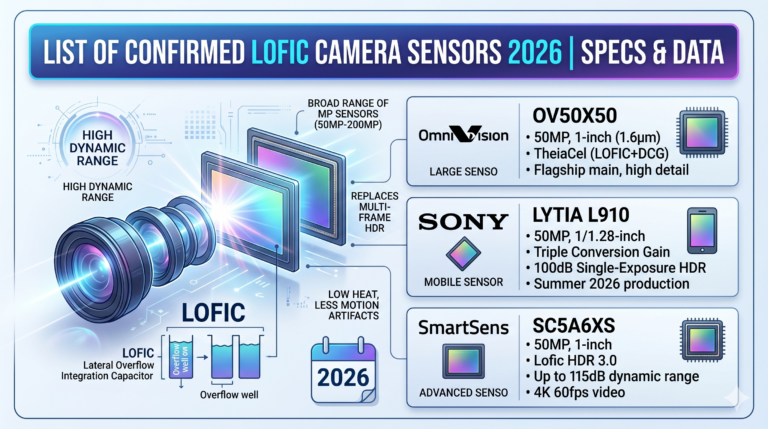
List of Confirmed LOFIC Camera Sensors 2026 | Specs & Data

Smartphone camera hardware design is shifting away from software reliance. This document tracks publicly verified smartphone and industrial camera sensors equipped with Lateral Overflow Integration Capacitor technology.

We separate confirmed silicon specifications from unverified market reports. Review the data for OmniVision’s TheiaCel line, Sony’s LYTIA L910, and SmartSens Lofic HDR 3.0 implementations.

These physical hardware components replace multi-frame software processing with native single-exposure high dynamic range capture. The database below catalogs pixel sizes, optical formats, and dynamic range decibel limits across the current mobile imaging market.

List of LOFIC Imaging Sensors | LensXP

Confirmed LOFIC Imaging Sensors

This document tracks publicly verified smartphone and industrial camera sensors equipped with Lateral Overflow Integration Capacitor technology. The data clearly separates confirmed specifications from unverified reports.

Updated June 2026 💬 14 Comments

Sensor Database

Manufacturer Sensor Model Specifications LOFIC Details
OmniVision OV50K40 50MP, 1/1.3-inch First smartphone TheiaCel sensor. Combines LOFIC with established HDR architecture.
OmniVision OV50X 50MP, 1-inch, 1.6µm pixels Supports DCG plus LOFIC HDR mode. Designed for flagship main cameras.
OmniVision OV50R40 50MP, 1/1.3-inch Second-generation TheiaCel architecture. Rated for up to 110 dB single-exposure HDR.
Sony LYTIA L910 50MP, 1/1.28-inch First LYTIA mobile sensor with LOFIC. Combines it with Triple Conversion Gain HDR. Specifies 100 dB single-exposure HDR. Scheduled for summer 2026 mass production.
SmartSens SC5A6XS 50MP, 1-inch Uses Lofic HDR 3.0. Claims up to 115 dB dynamic range and 4K 60fps in LOFIC-HDR mode.
SmartSens SC575XS 50MP, 1/1.56-inch Lofic HDR 3.0. Reaches up to 110 dB dynamic range. Targeted at premium phone main cameras.
SmartSens SCC90XS 200MP, 1/1.28-inch First 200MP mobile sensor with a LOFIC ultra-HDR mode using Lofic HDR 3.0.

Manufacturer Analysis

OmniVision

  • Pros: Early market entry. High integration with Dual Conversion Gain. Proven deployment in commercial devices.
  • Cons: Sensor naming conventions can cause confusion among consumers.

Sony

  • Pros: Wide adoption by major smartphone brands. Strong ISP compatibility. Integration with Triple Conversion Gain.
  • Cons: Slower to adopt LOFIC for the mobile sector compared to competitors. Currently limited to a single confirmed mobile model.

SmartSens

  • Pros: Broadest announced product range. High stated dynamic range figures up to 115 dB. First to offer a 200MP variant.
  • Cons: Lower historical presence in western flagship smartphones compared to Sony.

Single-Exposure Range

The following visual data representation compares the stated single-exposure dynamic range decibel limits of selected models.

The Core Mechanism

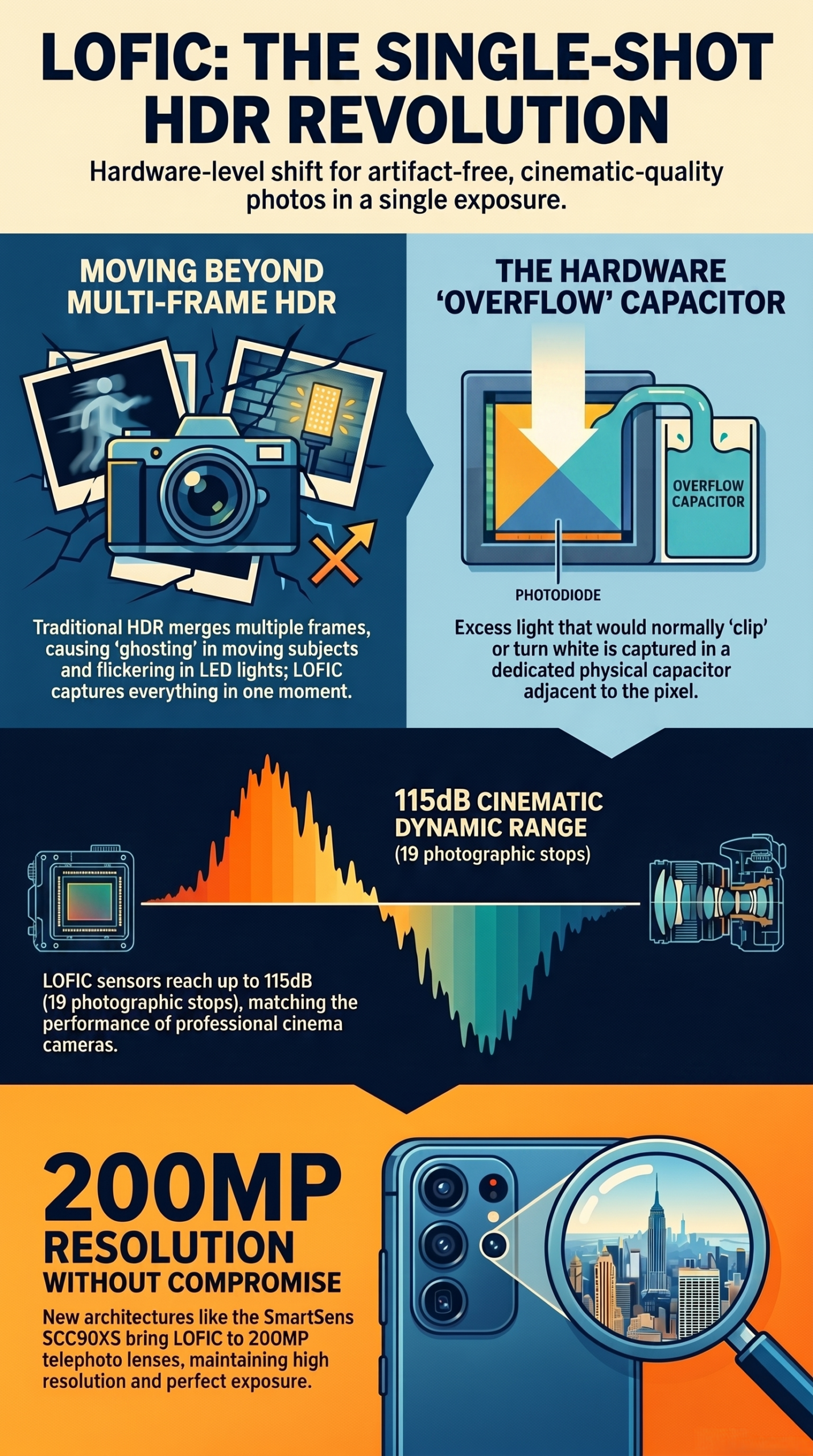
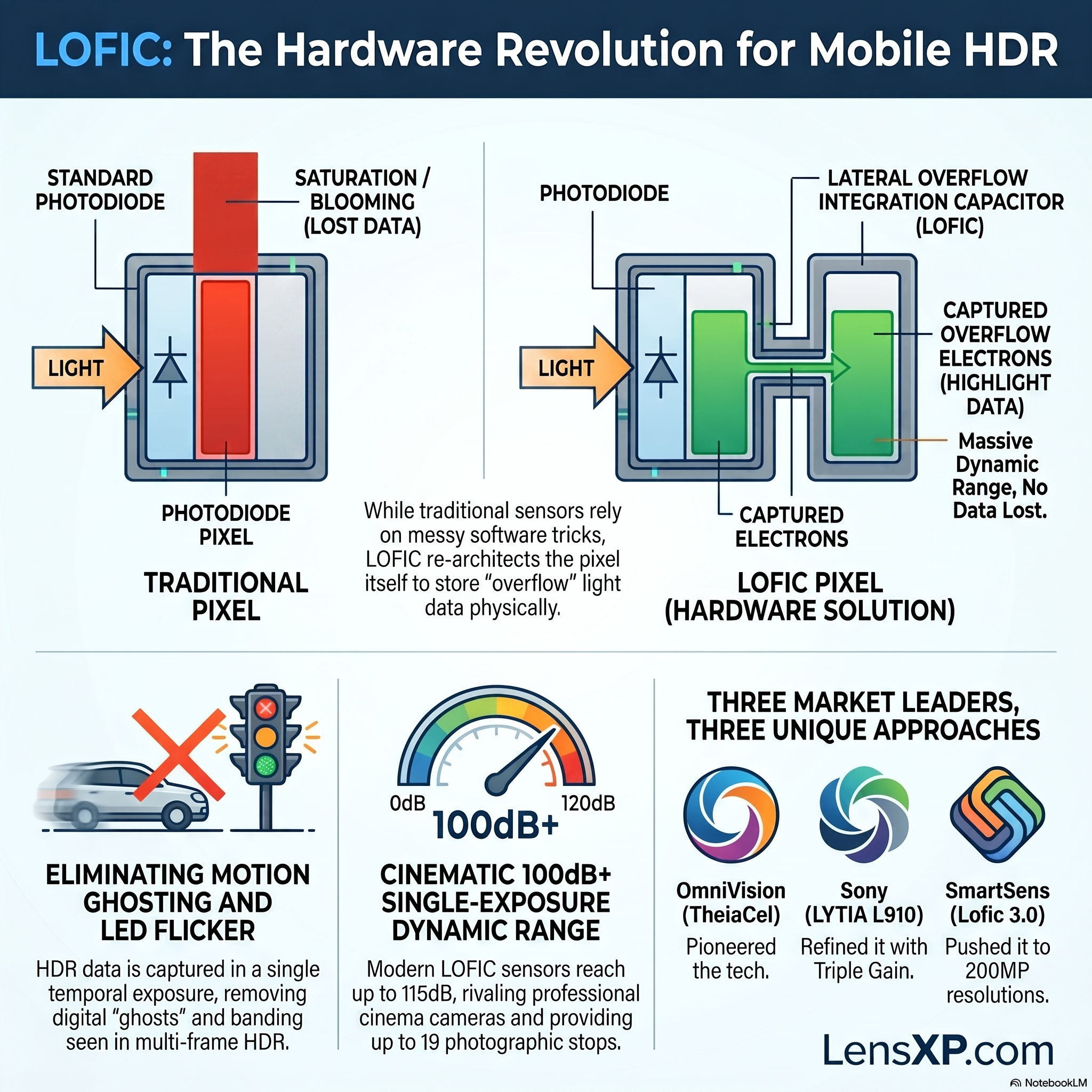
Understanding Lateral Overflow Integration Capacitor technology requires looking at how pixels capture light. Standard sensor pixels act like buckets collecting photons. When exposed to bright light sources like the sun or neon signs, these buckets quickly fill up and overflow. This overflow results in blown-out, pure white highlights with zero recoverable detail.

LOFIC architecture solves this physical limitation. Engineers place a high-density storage capacitor adjacent to each individual photodiode. When the primary pixel bucket fills up, the excess photoelectrons do not spill over and cause clipping. Instead, they flow laterally into this secondary storage capacitor. The sensor system then reads the data from both the primary diode and the overflow capacitor simultaneously. This preserves extreme highlight detail natively within a single exposure cycle.

Visualizing the Single-Shot Process

The diagram below illustrates the physical architecture of these sensor nodes. It maps out how the system expands capacity through the lateral overflow structure.

Single-Shot HDR Process Diagram

Impact on Photography

Modern smartphones rely heavily on computational photography to achieve High Dynamic Range. The traditional method forces the camera to rapidly shoot multiple frames at varying exposure lengths. The image signal processor then merges these frames. This multi-frame approach creates severe ghosting artifacts when subjects move during the capture sequence.

Sensors equipped with overflow capacitors alter this processing pipeline entirely. Because the hardware captures an immense dynamic range in one physical shot, the phone no longer needs to rely on aggressive multi-frame blending for standard lighting scenarios. This hardware capability eliminates motion ghosting. It also dramatically reduces the computational load on the device processor, leading to faster capture times, lower heat generation, and improved battery efficiency during heavy camera use.

Power Consumption Metrics

Processing multiple frames simultaneously forces the Image Signal Processor to operate at maximum clock speeds. This intense data processing generates measurable excess heat inside the phone chassis. Hardware-level high dynamic range minimizes this processing overhead. The image sensor sends a single compiled frame directly to the processor. This streamlined data pipeline lowers overall system temperatures during extended video recording sessions and extends total battery life.

Pixel Pitch Constraints

The physical capacitor requires physical space on the silicon die. Early hardware designs placed these capacitors alongside the light-gathering photodiodes. This limited how small the pixels could be manufactured. Newer stacking technologies place the storage layer directly beneath the pixel layer. This vertical arrangement allows hardware engineers to achieve massive 200-megapixel densities without sacrificing the critical overflow capacity.

Video Capture Dynamics

Still photography represents only one aspect of sensor performance. High-resolution video stresses sensor pipelines significantly more than static image capture. Traditional HDR video requires the sensor to alternate exposures frame by frame. This alternating exposure technique creates jarring motion artifacts in fast-moving scenes.

Hardware-level overflow capacitors capture the entire dynamic range natively within each continuous frame. The SmartSens SC5A6XS targets this specific use case by processing 4K resolution at 60 frames per second while maintaining full dynamic range capacity. This produces clean video output that handles extreme backlit subjects without motion smearing.

Hardware Level Processing Overview

Wafer Fabrication Methods

Building these complex pixel structures requires precise silicon manufacturing techniques. The overflow capacitor demands dedicated physical die space. Engineers utilize wafer-to-wafer stacking to solve this geometric problem. They fabricate the light-gathering photodiodes on a top silicon layer. They build the logic circuits and the physical storage capacitors on a separate bottom layer.

Copper-to-copper bonding connects these layers at the microscopic level. This three-dimensional construction allows manufacturers to maintain large capacitor volumes without reducing the size of the primary light-gathering diodes.

Sensor Format Evolution

Optical format sizes dictate absolute light gathering limits. The 1-inch class provides the largest physical surface area for individual pixels in mobile devices. The SmartSens SC5A6XS utilizes this large area to maximize both photodiode size and capacitor volume. Conversely, manufacturers also package high resolutions into smaller 1/1.28-inch formats to fit standard phone chassis. The Sony L910 and SmartSens SCC90XS prove that capacitor integration functions reliably even as physical pixel pitch shrinks.

ISP Signal Processing

Camera hardware requires external processors to interpret the captured data. Standard Image Signal Processors expect sequential frames for high dynamic range compiling. Overflow capacitor sensors send a completely different data package. They transmit the standard pixel readout alongside the overflow capacitor data simultaneously. Mobile chipmakers must update their silicon processors to decode this parallel data stream efficiently to realize the full hardware benefits.

Future Hardware Outlook

The transition to hardware-level overflow capacity marks a permanent shift in mobile camera engineering. Future iterations will likely focus on increasing the physical size of the storage capacitors to push dynamic range limits beyond 120 decibels. Manufacturers are currently researching new dielectric materials to increase capacitor density without requiring more silicon die space. This material science progression will eventually allow these components to fit into ultra-compact folding smartphones.

Proprietary Naming

Manufacturers use distinct marketing terms for identical core concepts. OmniVision uses the brand name TheiaCel. This architecture combines an overflow capacitor structure with standard Dual Conversion Gain. SmartSens uses the term Lofic HDR 3.0 for its implementation. Sony pairs the capacitor overflow mechanism with a Triple Conversion Gain structure on the LYTIA L910. The fundamental engineering principle remains identical across these implementations.

Cross-Industry Use

Mobile electronics represent only one segment of this hardware ecosystem. Automotive and security applications demand high dynamic range performance. OmniVision supplies the OX08D10 for automotive camera arrays. Sony produces the IMX908 for dedicated security hardware. These sectors prioritize single-exposure dynamic range to handle variable lighting conditions like headlights at night without producing motion artifacts.

Notable Exclusions

Market reports frequently misidentify standard high dynamic range sensors as LOFIC models. The following sensors do not qualify based on official manufacturer specifications.

  • Sony LYT-828 and LYT-901: These sensors support advanced HDR modes. Sony has not categorized them as LOFIC products.
  • Samsung ISOCELL HP6 and HPA: Reports regarding these models consist of pre-release rumors. Samsung has not published confirmed specifications for these units.

Frequently Asked Questions

What does OmniVision call its specific architecture?
OmniVision uses the brand name TheiaCel. This is a marketing term for their combination of the overflow capacitor structure with their standard Dual Conversion Gain design.
Which company offers the widest variety of these sensors?
SmartSens currently maintains the broadest publicly announced range. Their lineup spans 50MP 1-inch, 50MP 1/1.56-inch, and 200MP 1/1.28-inch designs.
Why is the LYTIA L910 significant?
The L910 is Sony Semiconductor Solutions’ first official LOFIC product in its mobile-focused LYTIA line. It signals Sony’s formal entry into this specific mobile hardware category.

Conclusion

The integration of lateral overflow capacitors marks a physical shift in digital imaging hardware. Manufacturers like OmniVision, Sony, and SmartSens are solving dynamic range limitations at the silicon level instead of relying on software workarounds. This hardware approach eliminates motion artifacts and reduces processing heat. The industry is moving toward single-exposure high dynamic range as the standard for premium mobile photography.

LensXP Data Records
High Contrast Web Standard

GoPro Mission 1 Pro vs DJI Osmo Action 6: Specs

Choosing the right action camera in 2026 comes down to the GoPro Mission 1 Pro and the DJI Osmo Action 6. Both cameras introduce heavy hardware upgrades to the market.

The GoPro Mission 1 Pro packs a new 1-inch 50MP sensor, 8K 60fps recording, and a massive 240 Mbps bitrate for professional color grading. The DJI Osmo Action 6 answers with a versatile variable aperture, 50GB of built-in storage, and a much lower entry price.

This breakdown compares their real-world thermal performance, low-light capabilities, and technical specs so you know exactly which camera fits your shooting style.

GoPro Mission 1 Pro vs DJI Osmo Action 6 Specs Comparison

Camera Review

GoPro Mission 1 Pro vs DJI Osmo Action 6 Specs Comparison

A detailed breakdown of the latest hardware from GoPro and DJI. Updated January 2026.

GoPro Mission 1 Pro

The GoPro Mission 1 Pro is the stronger camera for pure imaging. It combines a new 50MP 1-inch sensor, 8K/60 recording, 8K/30 open-gate 4:3 capture, and 4K/240 slow motion. The device features 10-bit GP-Log2, HLG HDR, a 240 Mbps bitrate ceiling, and 32-bit float audio.

In standardized indoor stress testing, it lasted longer than the Osmo Action 6 at 4K/60 without overheating. The Mission 1 Pro is the better pick for maximum grading latitude, native high-speed capture, and cleaner low-light performance in this class.

Target User:

Professionals needing high bitrates, 8K/60, and advanced audio workflows.

Check on Amazon

DJI Osmo Action 6

The DJI Osmo Action 6 is the better mainstream option. It offers a 1/1.1-inch CMOS sensor, a variable f/2.0 to f/4.0 aperture, 8K/30 video, 4K/120 capture in 16:9 and 4:3, and 1080p/240 slow motion.

The camera includes 50GB of usable built-in storage, up to 20 meters of waterproofing without a case, and reliable internal audio. Its main tradeoffs are a lower 120 Mbps bitrate cap, lower maximum frame rates compared to the GoPro, and thermal stoppages during stress testing at 4K/60.

Target User:

Travel creators needing low-light performance, built-in storage, and convenience.

Check on Amazon

Thermal Performance & Runtime

Battery endurance and heat management dictate real-world usability. The chart below illustrates continuous recording times at 4K/60 in a standardized indoor stress test before thermal shutdown occurs.

Data based on indoor 4K/60 recording tests. Longer continuous bars indicate better thermal management.

Technical Specifications

Feature GoPro Mission 1 Pro DJI Osmo Action 6
Sensor Size 1-inch, 50MP 1/1.1-inch CMOS
Lens & Aperture Fixed lens, 15mm equiv., 159 degree FOV, f/2.8 Fixed lens, 155 degree FOV, Variable f/2.0 to f/4.0
Max Video Resolution 8K/60 8K/30
Open Gate Capture 8K open gate 4:3 at up to 30 fps No open-gate mode; 4K Custom 3840×3840 reframing
Native Slow Motion 4K/240, 1080p/480 4K/120, 1080p/240
Log Profile / HDR GP-Log2 with LUT, HLG HDR D-Log M, Film Tone
Max Official Bitrate 240 Mbps 120 Mbps
Waterproofing 20m without housing 20m without case, 60m with waterproof case
Storage microSD only 64 GB internal, 50 GB usable, plus microSD
Audio System 4 mics, 32-bit float, USB audio, Bluetooth 5.3 3 mics, 48 kHz/16-bit AAC internal, direct connection for two DJI mics
Estimated Price 699.99 USD MSRP 329 GBP / 379 EUR Launch

Image Quality & Low Light Performance

GoPro Dynamic Range

The Mission 1 Pro utilizes a 1-inch 50MP sensor with larger native and fused pixel behavior. It claims up to 14 stops of dynamic range. Testing shows its low-light footage is clean with strong shadow detail. The 240 Mbps bitrate ceiling gives it a massive advantage in complex motion scenes like water spray or dense foliage, preventing heavy compression artifacts.

DJI Variable Aperture

The Osmo Action 6 uses a variable f/2.0 to f/4.0 aperture on its 1/1.1-inch sensor. This makes it highly forgiving in real-world night shooting. Reviews indicate it is roughly a full stop brighter than its predecessors, making the SuperNight mode highly effective. Its primary limitation is the 120 Mbps bitrate cap during heavy motion.

Stabilization & Motion Handling

Both cameras are stabilization-first tools and both perform extremely well. GoPro utilizes HyperSmooth with 360-degree Horizon Lock. DJI provides RockSteady 3.0, RockSteady 3.0+, HorizonBalancing, and HorizonSteady.

Reviewers observe that stabilization is effectively a tie. GoPro offers slightly more confidence for the roughest motion and irons out high-frequency judder artifacts well. DJI remains excellent for almost all daily uses. Current testing lacks clear rolling-shutter measurements for either device, leaving that specific performance metric unresolved.

Workflow & Usability

GoPro Hardware & App

GoPro features a highly versatile body for rigging. The device includes built-in mounting fingers, 1/4-20 threads, and magnetic latch compatibility. This allows seamless transitions between legacy mounts and standard tripods.

The Quik app handles footage review, digital lens adjustments, and cloud backups. The Mission 1 Pro supports timecode synchronization and subject tracking. For audio, the camera packs four microphones, 32-bit float recording, and up to three audio tracks.

DJI Ecosystem

DJI holds the usability advantage with a highly intuitive menu interface and a fast, non-directional magnetic mount. The square sensor allows operators to crop footage easily for vertical or horizontal formats after capture.

Audio functionality includes three microphones capturing 48 kHz/16-bit AAC. The direct OsmoAudio connection links two DJI microphone transmitters without an external receiver, offering a highly convenient setup for vloggers.

Other Competitors and Options

The key point is that the Mission 1 Pro is not merely competing with normal action cameras anymore. With its 1-inch 50MP sensor, 8K60, 4K240, 10-bit log, 14-stop claimed dynamic range, and 20m waterproofing, it sits above the usual action-camera tier and overlaps with compact creator and cinema-oriented cameras.

DJI Osmo Action 6

The strongest mainstream rival. It has a 1/1.1-inch square CMOS sensor, variable f/2.0 to f/4.0 aperture, 4K120 recording, 20m waterproofing, 50GB internal storage, and up to four-hour rated battery life. It is the better choice for a smaller, more affordable action-first camera with flexible framing from its square sensor.

Insta360 Ace Pro 2

The closest alternative for vloggers and social-first creators. It offers an 8K30 mode, a 1/1.3-inch sensor, Leica optics, 50MP photos, and a 2.5-inch flip-up screen that is particularly useful for self-recording. It is less capable than the Mission 1 Pro for 8K60 and 4K240, but generally offers a more approachable creator workflow and lower entry price.

DJI Osmo Pocket 4P

Not a direct action-camera replacement, but a close competitor for cinematic travel and creator footage. Its mechanical 3-axis gimbal, 1-inch main camera, and 60mm telephoto module make it more suitable for walking shots, presentation-to-camera clips, and travel films. The Mission 1 Pro remains the better option for rugged mounting, water use, and fast action.

Insta360 X5

A workflow competitor rather than an image-quality equivalent. It is the better option when you need to capture everything first and reframe later for cycling, motorcycling, skiing, travel POV shots, and third-person invisible-stick perspectives. The Mission 1 Pro should produce more conventional, higher-quality single-lens action footage.

GoPro Mission 1 Pro ILS

Technically a sibling rather than a third-party competitor, but it is the upgrade path to consider. The Pro ILS adds a Micro Four Thirds mount for interchangeable lenses, shifting the product toward compact-cinema and specialist filmmaking use.

Practical Positioning

Camera Best reason to buy it instead of Mission 1 Pro
DJI Osmo Action 6 Better value, variable aperture, square sensor for vertical/horizontal crops, compact adventure use
Insta360 Ace Pro 2 Flip screen, vlogging convenience, Leica colour profile, lower-cost 8K option
DJI Osmo Pocket 4P Real mechanical gimbal stabilisation and telephoto framing for travel and cinematic handheld footage
Insta360 X5 360 capture and reframe-later flexibility
Mission 1 Pro ILS Interchangeable lenses and a more serious compact-cinema workflow

Pros and Cons

GoPro Mission 1 Pro

Advantages

  • 8K/60, 4K/240 native, and 240 Mbps bitrate capacity
  • Larger 1-inch sensor provides strong low-light performance
  • Superior thermal endurance and battery life at 4K/60
  • Exceptional rigging flexibility with 1/4-20 threads

Drawbacks

  • High price point estimated at 699 USD
  • Larger and heavier body format reduces pocketability
  • Lacks built-in internal storage
  • Menu interface remains slightly less polished than competitors

DJI Osmo Action 6

Advantages

  • Excellent value starting around 329 GBP or 379 EUR
  • Highly intuitive menus and a compact physical footprint
  • Strong low-light performance via a variable aperture
  • 50GB of usable internal storage included

Drawbacks

  • Lower capture ceiling limited to 8K/30 and 120 Mbps
  • Codec limitations are more visible in complex motion scenes
  • Earlier thermal shutdown experienced in indoor stress tests
  • Requires external adapters to utilize standard GoPro mounts

Recommended Template Formats

Use these structured templates to configure your camera based on the shooting environment. These settings prioritize reliable performance and image quality.

Action Sports Template

Best for surfing, mountain biking, and fast motion.

  • GoPro: 4K/60, Wide, HyperSmooth, 10-bit color. Switch to 4K/120 for specific slow-motion sequences.
  • DJI: 4K/60, Wide, RockSteady 3.0+, auto aperture. Reserve 4K/120 for short clips to save storage.

Vlogging Template

Best for travel, talking heads, and handheld recording.

  • GoPro: 4K/30, Linear lens. Connect a USB or Bluetooth microphone.
  • DJI: 4K/30, 4K Custom ratio for vertical cropping. Use direct DJI mic pairing.

Frequently Asked Questions

Do either of these cameras capture 360-degree video?
Neither camera offers 360-degree capture. Both are conventional single-lens action cameras. Users needing reframable spherical video should look at dedicated 360 systems.
Which camera is better for low light?
The DJI Osmo Action 6 is generally more forgiving in real-world night shooting due to its variable aperture dropping to f/2.0. The GoPro Mission 1 Pro has a larger 1-inch sensor, but requires more precise manual control to avoid noise reduction artifacts in dark scenes.
Does the DJI camera overheat easily?
In continuous indoor 4K/60 testing without airflow, the DJI Osmo Action 6 stops recording due to heat at approximately 62 minutes. The GoPro Mission 1 Pro managed 133 minutes in the same test. For normal outdoor use with natural airflow, both cameras operate reliably.
Is the extra bitrate on the GoPro noticeable?
The 240 Mbps bitrate on the GoPro handles complex motion better. Scenes with splashing water, dense foliage, or gravel maintain more fine detail compared to the 120 Mbps limit on the DJI.

Final Recommendations & Pricing

Pricing Context

The pricing gap is meaningful. The GoPro Mission 1 Pro sits at a premium price point of approximately 699 USD MSRP. In contrast, the DJI Osmo Action 6 launched around 329 GBP or 379 EUR, making DJI the stronger value proposition.

The Verdict

Choose the GoPro Mission 1 Pro if you are a filmmaker, serious sports shooter, or production freelancer who will actually exploit 8K/60, open gate capture, 240 Mbps bitrates, and 32-bit float audio.

Choose the DJI Osmo Action 6 if you are a travel creator, everyday content creator, or casual sports enthusiast who wants excellent low-light performance, easy controls, built-in storage, and better price efficiency.

Unresolved Metric

The biggest genuine gap in current public testing is reliable lab-style rolling-shutter measurement. While thermal, low-light, and stabilization performance are well documented in accessible reviews, rolling-shutter behavior remains an open comparison point.

LENSXP.COM

Data compiled from manufacturer specifications and standardized review testing. Pricing reflects launch estimates in USD and EUR.

© 2026 LensXP. All technical specifications are subject to hardware updates.

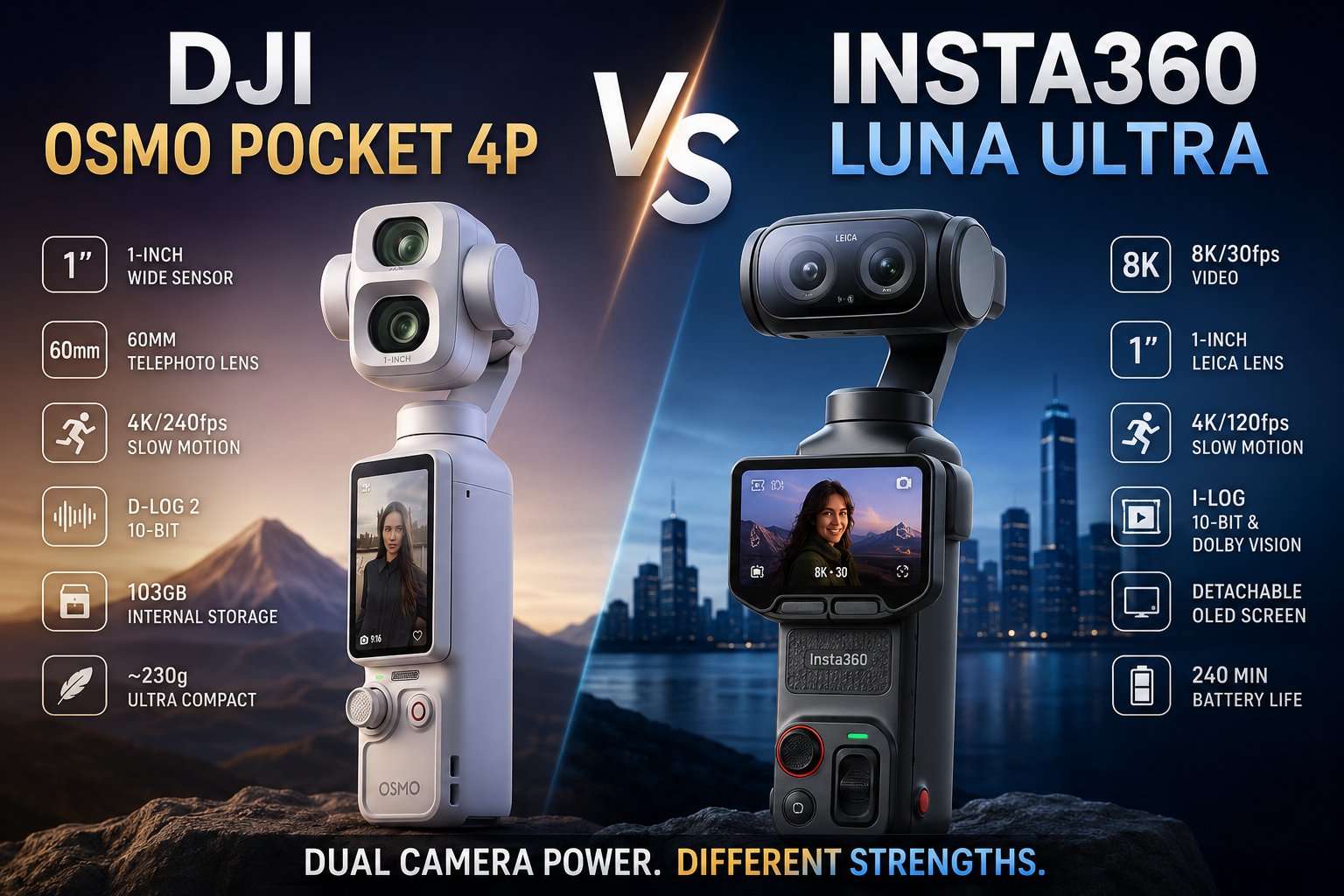
DJI Osmo Pocket 4P vs Insta360 Luna Ultra: Best Gimbal Camera

DJI Osmo Pocket 4P vs Insta360 Luna Ultra Specs Comparison

Choosing between the DJI Osmo Pocket 4P and the Insta360 Luna Ultra comes down to your specific shooting style. The Insta360 Luna Ultra brings 8K resolution and a highly functional detachable screen for solo presenters.

The DJI Osmo Pocket 4P answers with an incredibly compact design and a dedicated 60mm telephoto lens for superior portrait rendering. Read our full comparison to see how their sensors, autofocus tracking systems, thermal limits, and color profiles stack up for daily video production.

DJI Osmo Pocket 4P vs Insta360 Luna Ultra | LensXP.com

DJI Osmo Pocket 4P vs Insta360 Luna Ultra

By LensXP Editorial Team | Updated Feb 2026

Executive Summary

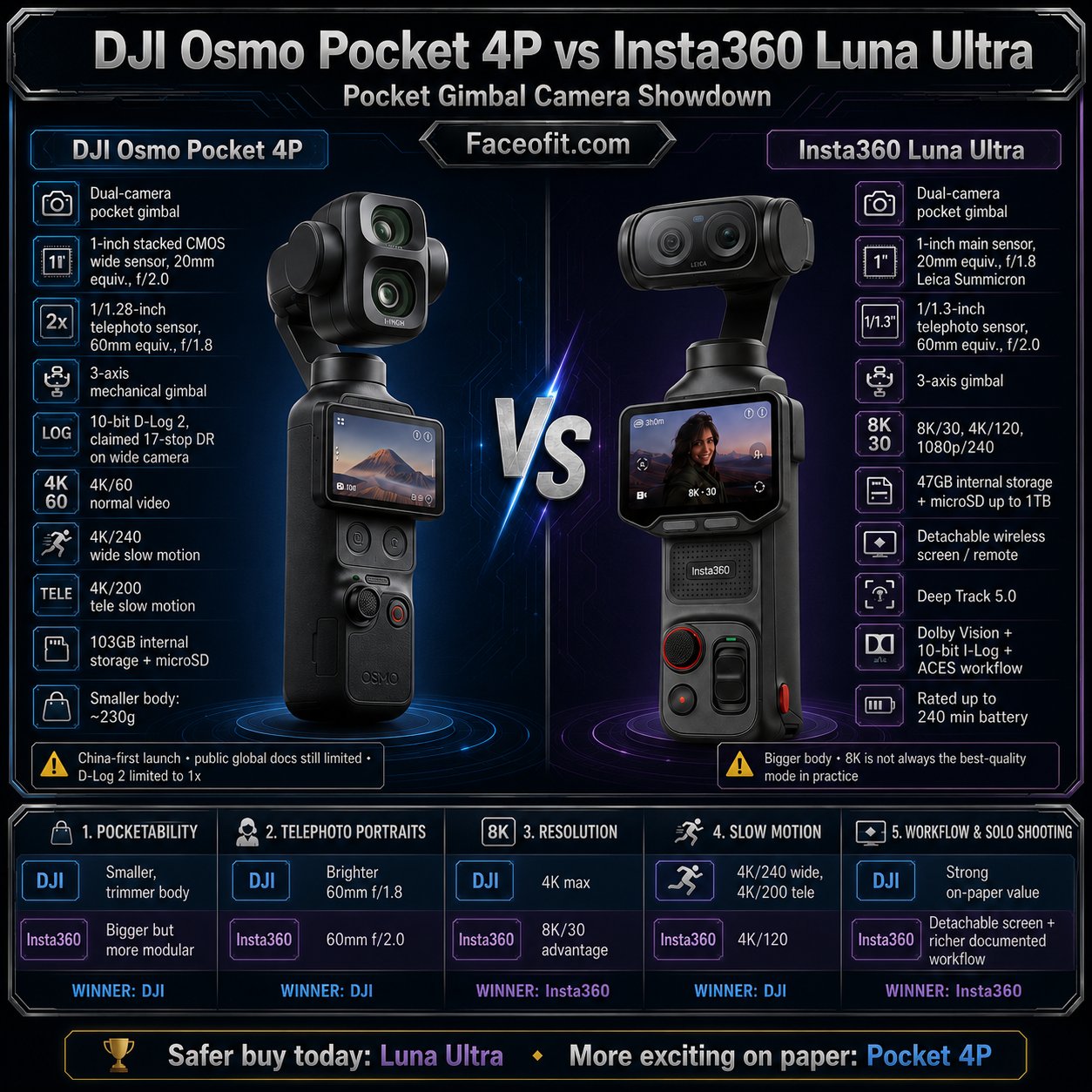
This comparison is unusually asymmetrical. The Insta360 Luna Ultra is already widely documented with official manuals and multiple substantive reviews. The DJI Osmo Pocket 4P is newer and China-first. It still lacks an easily accessible full English spec page in public web results. Some Pocket 4P conclusions can be stated firmly from official China store pages and media announcements. Others must be marked as provisional.

The trade-off is clear. Pocket 4P looks like the stronger cinematic pocket tool if you value a smaller body, faster slow motion, a dedicated 60mm equivalent portrait lens, and D-Log 2 with a claimed 17-stop wide-camera dynamic range. Luna Ultra is the more mature creator system today. It offers 8K capture, a detachable wireless screen, stronger official software tooling, proven low-light results, and real global retail availability.

Buy the Luna Ultra if you need a camera you can buy now and trust for solo presentation and 8K reframing. Wait for or choose the Pocket 4P if your priority is the smallest body and better telephoto portrait rendering.

Insta360 Luna Ultra

Available globally right now.

Check on Amazon

DJI Osmo Pocket 4P

Check regional availability.

Check on Amazon

Visual Summary

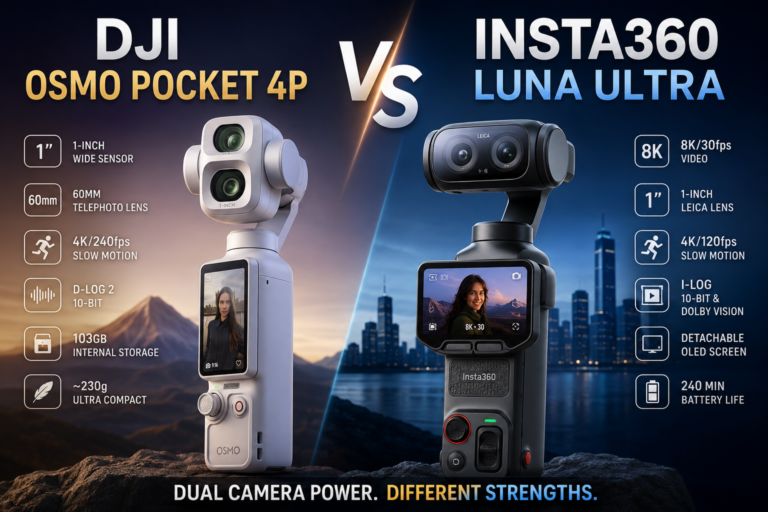
Infographic comparing DJI Osmo Pocket 4P and Insta360 Luna Ultra specifications

Data Visualization: Physical Capabilities

Internal Storage Capacity Comparison (GB)

Verified Specifications Comparison

Category DJI Osmo Pocket 4P Insta360 Luna Ultra
Main Sensor & Lens 1-inch wide, 20mm equiv., f/2.0; stacked CMOS with LOFIC; 17-stop DR in D-Log 2 1-inch main, 20mm equiv., f/1.8 Leica Summicron
Tele Sensor & Lens 1/1.28-inch, 60mm equiv., f/1.8 optical lens 1/1.3-inch, 60mm equiv., f/2.0
Maximum Video 4K/60 normal, 4K/240 wide slow-mo, 4K/200 tele slow-mo 8K/30, 4K/120, 1080p/240
Color Profiles 10-bit D-Log 2; film looks available Standard, Dolby Vision, 10-bit I-Log; Leica Natural/Vivid/Chrome; ACES
Stills 37MP class stills 37MP; Ultra-Clear 200MP pano modes; JPG and JPG plus RAW
Storage 103GB internal plus microSD 47GB internal plus microSD up to 1TB
Weight & Size Approx. 230g; 144.2 x 44.4 x 33.5mm 233g; 169.9 x 52.4 x 38.5mm
Battery & Runtime 1545mAh; 210 min reported runtime 1550mAh main plus 210mAh remote; 240 min rated runtime
Pricing Check Local Retailers Check Local Retailers

Image Quality and Stabilization

On pure imaging theory, the Pocket 4P is the bolder camera. Official materials state the wide camera uses a 1-inch stacked sensor with LOFIC and reaches up to 17 stops in D-Log 2. The separate 60mm lens should give distinctly more flattering portrait geometry than any digital crop from a wide lens. The Luna Ultra pitch is less aggressive on dynamic range numbers. It offers a higher resolution 8K/30 pipeline and Leica-tuned color options instead.

In public real-world evidence, the Luna Ultra currently has the stronger case because it has more actual review footage. Testing shows its 4K I-Log footage is often cleaner than 8K in high-contrast scenes. Reviewers explicitly recommend 4K over 8K most of the time because the 8K detail gain is modest while noise rises in tough contrast. Luna 8K is useful, but it is not automatically the highest quality mode.

Low light is one of Luna clearest strengths in current reviews. PureVideo produces clean low-light results. Reviewers note PureVideo is unusually restrained rather than over-processed. Even normal iLog footage remains surprisingly clean in dim scenes. Pocket 4P may end up winning in low light on the main camera, but public proof is thinner right now.

Post-Production Workflows

DJI Pocket 4P Pipeline

Capture
HEVC files plus D-Log 2 at 1x
DJI Mimo sync or NLE ingest
DJI LUTs and manual grade

Insta360 Luna Ultra Pipeline

Capture
H.265 files in Standard, Dolby Vision, or I-Log
Insta360 app or Studio
AI edits, QR Color Share LUTs, or ACES grade

Field Testing Results

Independent reviewers offer important context beyond the official specification sheets. PetaPixel notes the Luna Ultra produces very clean 4K files. Reviewers often prefer these 4K files over 8K in high contrast situations. RedShark found the Luna PureVideo mode restrained and natural rather than heavily processed. Engadget points out the bright and pleasing color science of the Insta360 camera right out of the box.

For the DJI Osmo Pocket 4P, early field reports suggest strong low light capabilities matching DJI marketing claims. Extensive lab tests measuring rolling shutter remain unavailable for both models as of mid 2026. This means high speed panning performance remains an open question for both devices.

Advanced Video Features

The DJI Pocket 4P limits its 10-bit D-Log 2 profile strictly to the 1x wide camera. The telephoto lens provides excellent subject isolation but relies on standard color profiles. This restriction matters heavily for creators who grade their footage manually. If your workflow depends entirely on D-Log 2, the signature 60mm look is not the one receiving the most advanced log mode.

The Insta360 Luna Ultra offers comprehensive Dolby Vision and 10-bit I-Log support across its pipeline. Insta360 supports an ACES managed workflow directly in its post production software. Official specifications list support for Video, PureVideo, Slow Motion, Timelapse, TimeShift, Spin Shot, and Dolly Zoom. DJI confirms timelapse, motionlapse, and gesture controls for the Pocket 4P.

Autofocus and Tracking Systems

The DJI Osmo Pocket 4P provides single autofocus and multiple continuous focus behaviors. These options include a product showcase mode, subject lock follow focus, and registered subject priority. DJI includes multi-person tracking and notes that subject following works across different zoom ranges. Note that 10-bit D-Log 2 is restricted to the 1x lens. If your workflow relies on D-Log 2, the 60mm telephoto lens cannot use this specific profile.

Insta360 uses the Deep Track 5.0 system for the Luna Ultra. This platform includes Auto Tracking, Active Zoom Tracking, Group Tracking, and Smart Framing. Reviewers consistently praise the self-shooting experience. The detachable display gives solo creators remote framing, pan and tilt control, and a wireless microphone. This display functionality is a major ergonomic advantage for the Insta360 system.

Ergonomics and Accessories

The Pocket 4P is highly pocketable. The footprint remains close to the previous model and weighs approximately 230g. The Luna Ultra is noticeably larger. The wider gimbal head and detachable screen make it bulkier, particularly with the protective cover attached.

The accessory ecosystems differ significantly. DJI focuses on a traditional camera approach with the FrameTap remote, fill lights, and microphone integration. Insta360 focuses on rig building with a battery handle, wide-angle lens attachments, Black Mist filters, neck mounts, and strong Mic Air integration.

Battery life testing shows solid results for both units. The Luna Ultra is officially rated for 240 minutes. Independent tests recorded two hours and forty-seven minutes at 4K resolution at 24 frames per second before battery depletion with no overheating. The Pocket 4P has public reports of around 210 minutes of runtime.

Codec, Bitrates, and Connectivity

Bitrate capabilities dictate file sizes and editing weight. The Luna Ultra tops out at 120 megabits per second using standard H.265 compression. The exact Pocket 4P codec specifications remain pending full public confirmation. Previous DJI Pocket 4 hardware reaches 180 megabits per second using HEVC.

External streaming and utility features show distinct paths. The Luna Ultra officially lacks webcam mode, live streaming support, and HDMI output. DJI broadly supports UVC webcam usage and live streaming across the Pocket platform. Wi-Fi 6 comes standard on both main camera bodies. The Insta360 remote relies on Wi-Fi 4 for its wireless connection to the base unit.

Both devices are gimbal stabilized cameras. Reviewers note the Luna handles almost everything except larger vertical body movements. The DJI platform offers excellent stabilization for walking vlogs but is not rated for heavy jogging. Current reading shows DJI likely retains a cleaner walking camera feel while Luna is highly competent but less immune to vertical bobbing.

Thermal Performance and Battery Constraints

Pushing high frame rates and heavy resolutions creates heat. The Luna Ultra has a highly defensible evidence base regarding thermals. Controlled testing from PetaPixel showed the Luna Ultra can record 4K at 24 frames per second for two hours and forty-seven minutes until battery death with absolutely zero overheating issues.

However, extreme modes will tax the Insta360 system. The same tests revealed that recording in 4K at 120 frames per second caused the camera to overheat after roughly 44 minutes. Filming in 8K at 24 frames per second triggered overheating shutdowns at the 49-minute mark. These limits are important for long-form event shooters.

Equivalent controlled thermal tests from major independent reviewers for the Pocket 4P are not yet available. General public reports indicate a standard runtime of around 210 minutes for normal use. Buyers planning to rely heavily on the 4K 240fps slow motion mode should expect reduced runtimes and potential thermal limits similar to other compact cameras in this class.

Final Buying Recommendations

For Solo Presenters

Buy the Insta360 Luna Ultra. The detachable remote screen improves framing and self-shooting confidence. The official application ecosystem is thoroughly documented.

For Travel Creators

Choose the DJI Osmo Pocket 4P. The compact body and 103GB of internal storage are excellent for travel. The 60mm lens and 4K slow motion offer great visual options.

For Heavy Post-Production

Choose the Luna Ultra if you need a documented ACES compatible workflow today. Choose the Pocket 4P if the 17-stop dynamic range claim and D-Log 2 profile matter more to you.

Pros and Cons

DJI Osmo Pocket 4P

Advantages

  • Smaller body design.
  • Brighter telephoto lens.
  • Large 103GB internal storage.
  • High framerates: 4K/240 wide and 4K/200 tele.
  • Aggressive D-Log 2 claims with 17-stop dynamic range.

Disadvantages

  • Lacks 8K video resolution.
  • Accessible public documentation remains incomplete.
  • D-Log 2 is limited to the 1x wide lens.
  • Global availability is unclear at this time.
Insta360 Luna Ultra

Advantages

  • Offers 8K/30 capture.
  • Strong public review base confirms capabilities.
  • Detachable screen includes a microphone.
  • Deep Track 5.0 autofocus system.
  • Rich app, Studio, and ACES workflow support.
  • Widely available globally right now.

Disadvantages

  • Physically larger and bulkier body.
  • Only 47GB of built-in internal storage.
  • 8K mode is often less useful than 4K in real practice.
  • No official webcam, live-stream, or HDMI support documented yet.

Frequently Asked Questions

Which camera is better for low light?

Does the Pocket 4P shoot in 8K?

Are these cameras waterproof without a case?

Conclusion

The choice depends entirely on immediate availability and workflow preference. The Luna Ultra is the safer purchase today because it offers proven results, a highly useful remote screen, and global retail presence.

The Osmo Pocket 4P is an exciting alternative that prioritizes telephoto performance, advanced log profiles, and sheer portability. Buyers needing a camera right now should confidently pick the Luna. Buyers focused on portrait rendering and the smallest possible footprint should wait for the Pocket 4P global release.

LensXP.com
Data updated February 2026. All product names belong to their respective owners.

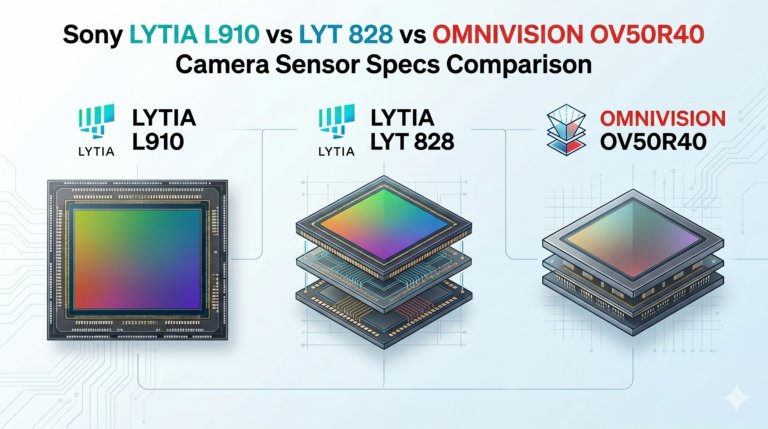
Sony LYTIA L910 vs LYT 828 vs OMNIVISION OV50R40 Specs

Sony structured the LYTIA L910 mobile image sensor as an architectural update to the LYT 828 baseline platform. Both models feature a 50 megapixel resolution across a 1/1.28-type physical format.

The L910 integrates lateral overflow integration capacitors alongside Triple Conversion Gain hardware. This combination captures a wide 100 dB dynamic range in a single exposure.

The single-exposure approach reduces motion artifacts, ghosting, and shutter flicker during video capture. External alternatives like the OMNIVISION OV50K40 and OV50R40 utilize comparable hardware methods, while alternative 1-inch and 200 megapixel designs target different optimization goals entirely.

LYTIA L910 vs OV50K/OV50R vs LYTIA 900 / OV50X50 Specs Comparison

LYTIA L910 vs OV50K/OV50R vs LYTIA 900 / OV50X50 Specs Comparison

Updated till February 2026

Sony announced the LYTIA L910. The manufacturer explicitly compares it to the LYTIA 828. Both sensors share a 1/1.28-type geometry with 50 megapixels. The L910 introduces a new physical architecture. It uses lateral overflow integration capacitors and Triple Conversion Gain-HDR. This combination allows 100 dB dynamic range from a single exposure. Single-exposure high dynamic range minimizes motion artifacts and flicker.

The LYTIA 828 delivered 100 dB dynamic range using Hybrid Frame-HDR. This relied on a multi-frame composite method. The L910 achieves a 30 percent random-noise reduction compared to the 828. The core difference is the shift to a single-exposure hardware path.

Dynamic Range Infographic

Peak Dynamic Range by HDR Architecture (dB)

Sensor Taxonomy

Sony

LYTIA L910

  • Size: 1/1.28-type
  • Resolution: 50 MP
  • Pixel Size: 1.22 µm
  • HDR Method: Single-exposure LOFIC
100 dB Single Exposure
Sony

LYT-828

  • Size: 1/1.28-type
  • Resolution: 50 MP
  • Pixel Size: 1.22 µm
  • HDR Method: Hybrid Frame-HDR
Over 100 dB Hybrid
OMNIVISION

OV50R40

  • Size: 1/1.302-inch
  • Resolution: 50 MP
  • Pixel Size: 1.2 µm
  • HDR Method: TheiaCel Single-exposure
110 dB Single Exposure
OMNIVISION

OV50K40

  • Size: 1/1.3-inch
  • Resolution: 50 MP
  • Pixel Size: 1.2 µm
  • HDR Method: TheiaCel Single-exposure
Human eye-level HDR
Sony

LYTIA 900

  • Size: 1/0.98-inch
  • Resolution: 50 MP
  • Pixel Size: 1.6 µm
  • Optimization: Native light-gathering area
Large Sensor Flagship
Sony

LYTIA 901

  • Size: 1/1.12-inch
  • Resolution: 200 MP
  • Pixel Size: 0.7 µm
  • Optimization: Detail density and crop zoom
High Resolution Flagship

Sony Flagship Progression

Sensor Physical Class HDR Architecture Video Outcome
LYTIA L910 50 MP, 1/1.28-type, 1.22 µm Single exposure LOFIC, Triple Conversion Gain 100 dB consistent 4K60 HDR, reduced flicker
LYT-828 50 MP, 1/1.28-type, 1.22 µm Hybrid multi-frame composite processing Over 100 dB output, handles zooming well
LYT-818 50 MP, 1/1.28-type, 1.22 µm Single-exposure, three-gain HDR 86 dB baseline dynamic range

Architectural Upgrade Details

The shift from the LYTIA 828 to the L910 focuses strictly on internal structure rather than physical dimensions. Both sensors capture 50 megapixels on a 1/1.28-type surface. The 828 relied on Hybrid Frame-HDR. This method merges a single-frame dual conversion gain readout with separate multi-frame data. The application processor handles the final merge.

The L910 moves this capability directly into the hardware using lateral overflow integration capacitors. Sony pairs this capacitor with Triple Conversion Gain-HDR. The sensor reads one exposure at three different conversion gains simultaneously. The capacitor stores overflow charge from the photodiode to prevent clipping in bright areas. This hardware-based single-exposure method effectively limits ghosting and flicker in video recording compared to software merging.

External Competitor Landscape

OV50K40 Analysis

OMNIVISION provides the most direct alternatives to the L910. The OV50K40 introduced the TheiaCel technology. This design directly mirrors Sony’s approach by using lateral overflow integration capacitors to achieve high dynamic range in a single exposure.

  • Supports 12.5 MP at 120 fps
  • Capable of 8K video output
  • 1/1.3-inch surface area

OV50R40 Advancements

OMNIVISION then released the OV50R40. This newer sensor pushes single-exposure dynamic range up to 110 dB using a second generation of the TheiaCel structure. It operates on a 1/1.302-inch geometry.

  • Supports 4K video at 60 fps with three-channel HDR
  • Consumes 20 percent less power than the OV50K40
  • Current primary rival to the L910

Design Optimization Goals

Smartphone manufacturers choose sensors based on specific optical targets. The L910 and OV50R40 prioritize dynamic range and video stability in a 1/1.28-inch format. Other flagship sensors optimize for entirely different results.

The LYTIA 900 and OMNIVISION OV50X50 belong to the 1-inch class. These sensors feature larger 1.6 µm pixels. They dedicate their engineering entirely to maximizing the native light gathering area rather than specialized HDR structures.

The LYTIA 901 and Samsung ISOCELL HP2 focus on resolution density. They pack 200 megapixels into a roughly 1/1.12-inch format. This allows high definition in-sensor crop zoom. Comparing a 1/1.28-inch HDR sensor directly to a 1-inch area sensor or a 200 MP zoom sensor ignores these distinct engineering targets.

Legacy Flagship Rivals

OMNIVISION OV50H

The OV50H represents an older mainstream flagship approach. It shares the familiar 50 megapixel resolution and 1/1.3-inch size. The primary difference is structural. It relies on a standard dual conversion gain architecture instead of the newer TheiaCel or LOFIC designs.

Sony LYT-818

Sony announced the LYT-818 in September 2024. It established the 1/1.28-inch geometry that the L910 uses today. It introduced single-exposure reading at three gain settings to achieve 86 dB dynamic range. Sony recorded a low 0.95e- random noise floor for this baseline sensor.

Samsung ISOCELL HP2

Samsung takes a different path with the ISOCELL HP2. It is a 200 megapixel main camera sensor built around ultra-high resolution and crop zoom flexibility. It processes high dynamic range at 50 megapixels using dual slope gain. It answers a different design goal than the dedicated 50 megapixel sensors.

Market Timeline and Validation

Sony announced the LYTIA L910 on June 17, 2026. Mass production shipments are scheduled for summer 2026. Current comparisons rely strictly on manufacturer specification material and positioning documents. Broad third-party lab validation will occur once retail smartphones containing the L910 reach the consumer market.

Frequently Asked Questions

Why is the LYTIA 828 the primary comparison for the L910?

Sony uses the 828 as the reference point in its official documentation. Both sensors belong to the exact same physical class with a 1/1.28-type geometry and 50 megapixels. The L910 changes the internal architecture rather than the physical size.

Which external sensors directly compete with the L910?

OMNIVISION produces the OV50K40 and OV50R40. These sensors operate in the same 50 megapixel and roughly 1/1.3-inch physical space. They also use single-exposure high dynamic range designs.

How do the LYTIA 900 and 901 fit into this comparison?

The LYTIA 900 is a larger 1-inch class sensor built for maximum light capture. The LYTIA 901 is a 200 megapixel sensor built for resolution and crop zoom. They target different engineering goals compared to the L910.

Data Template Formats

Use this standard text format for cataloging mobile image sensors.

[Sensor Name] Manufacturer: [Brand] Optical Format: [Fraction]-type / [Fraction]-inch Effective Megapixels: [Number] MP Pixel Pitch: [Number] µm Primary HDR Architecture: [Single Exposure / Multi-Frame / Hybrid] Peak Dynamic Range: [Number] dB Video Capability: [Resolution] at [FPS] Release Year: [Year]
LensXP.com
Sensor Specifications and Analysis Data

Sony LYTIA 901 vs Samsung ISOCELL HP2 200MP Camera Specs

Smartphone manufacturers rely on 200 megapixel camera sensors to sell flagship devices. Sony and Samsung control this hardware category with two distinct optical designs. Sony launched the LYTIA 901 with a large 1/1.12 type optical format and a 0.7 micrometer pixel pitch.

Samsung maintains market volume with the ISOCELL HP2 by utilizing a smaller 1/1.3 class format and a 0.6 micrometer pixel pitch. This guide evaluates the technical specifications, thermal management systems, and autofocus capabilities of both components. It also examines physical hardware integration across the Vivo X300 Ultra, Oppo Find X9 Ultra, and Samsung Galaxy S26 Ultra.

Sony LYTIA 901 vs Samsung ISOCELL | LensXP.com

Sony LYTIA 901 vs Samsung ISOCELL

Sensor Architecture Specifications

Smartphone camera manufacturers use two distinct optical designs. One design uses large photodiode dimensions for high low-light sensitivity. The other design uses high pixel density for 200-megapixel outputs and digital cropping. Samsung controlled the 200-megapixel sector for four years with the ISOCELL HP series. These sensors used 1/1.3-inch to 1/1.56-inch optical formats.

Sony released the LYTIA 901. This sensor has a 200-megapixel resolution on a larger 1/1.12-type optical format. The sensor diagonal measures 14.287 millimeters. The Sony sensor provides a 0.7 micrometer pixel pitch. The Samsung ISOCELL HP2 provides a 0.6 micrometer pixel pitch.

OmniVision manufactures the OVB0D. This sensor uses a 1/1.1-inch optical format. It features a 400000 electron full-well capacity and LOFIC Gen 2 architecture. The OmniVision sensor records a dynamic range of 108 dB.

Visual Comparison of Sensor Formats

Figure 1. Scale Comparison of 200MP Sensor Arrays

Pixel Structure and Autofocus

The Sony LYTIA 901 uses a Quad-Quad Bayer Coding color filter arrangement. The matrix places sixteen adjacent pixels under one color filter. The sensor outputs a 12.5-megapixel image in low-light environments by binning these sixteen pixels. The sensor can output a 50-megapixel image using 2×2 binning.

The Samsung ISOCELL HP2 uses Tetra2Pixel technology. The Samsung sensor processes high-resolution images rapidly.

Sony integrates an artificial intelligence remosaic engine directly onto the sensor die. This reduces data transfer demands across the Mobile Industry Processor Interface lanes. The sensor sustains 120 frames per second at 4K resolution in the 4×4 binning mode. The sensor records a 200-megapixel output at 10 frames per second.

Sony uses an All-Pixel autofocus system. Samsung uses a Super Quad Phase Detection autofocus system. The Samsung system processes full-resolution files at 15 frames per second.

Power Consumption and Thermal Management

Large image sensors generate heat during continuous operation. The Sony LYTIA 901 uses a stacked CMOS design. This construction separates the pixel readout layer from the logic processing layer. The separation aids thermal dissipation. The sensor draws 2.4 watts during 4K video recording.

The Samsung ISOCELL HP2 processes 200 million pixels sequentially. The continuous data transfer requires sustained power delivery. Samsung manages heat generation by utilizing dual vertical transfer gates. Phone manufacturers rely on internal vapor cooling chambers to dissipate the heat from these components.

OmniVision designed the OVB0D with a specialized low-power mode. This mode reduces electrical draw by 18 percent compared to previous iterations. The reduction extends recording times in warm environments.

Computational Photography Processing

Image signal processors interpret the raw data from these sensors. The Snapdragon 8 Elite Gen 5 chipset handles the 14-bit RAW output from the LYTIA 901. The chipset uses a cognitive image signal processor. The processor identifies individual subjects within the frame and applies specific exposure adjustments.

The MediaTek Dimensity 9500 uses a hardware-based noise reduction engine. This engine works directly with the uncompressed sensor feed. The processor assembles multiple exposures from the ISOCELL HP2 to produce a single image. The processing completes in 0.4 seconds.

The hardware processors eliminate motion blur by aligning the pixel data. The processors perform this task across 16 parallel channels.

Video Recording Capabilities

The Sony LYTIA 901 captures 4K video at 120 frames per second. The sensor performs a full pixel readout during video recording. The readout speed limits rolling shutter visual distortion. Sony implemented a high-gain output path. This path increases brightness in low-light video files.

The Samsung ISOCELL HP2 records 8K video at 30 frames per second. The sensor crops the active pixel area to match the 8K resolution requirement. The crop factor narrows the field of view. Samsung applies digital stabilization to correct hand movement.

Both sensors support 10-bit color depth for video. The files conform to the Rec. 2020 color space standard.

Low-Light Signal Processing

The Sony LYTIA 901 utilizes a dual conversion gain design. The circuit alters the pixel capacitance depending on environmental light levels. The sensor engages high conversion gain in dark environments to minimize read noise. The Samsung ISOCELL HP2 applies a comparable dual slope gain method. Independent tests show the Sony unit outputs a cleaner shadow gradient at ISO 3200.

OmniVision depends on identical dual conversion gain technology for the OVB0D. The system maintains color accuracy when luminance drops below 10 lux.

Manufacturing Economics and Die Size

Silicon wafer fabrication costs increase directly with physical area. The 1/1.12-type format of the LYTIA 901 occupies more space on a silicon wafer than the 1/1.3-class HP2. Sony extracts fewer functional image sensors per 300mm wafer. This physical footprint forces a higher unit cost for smartphone assembly companies.

Samsung generates higher profit margins on the ISOCELL HP2. The smaller die footprint allows Samsung to produce higher volumes per wafer. This economic reality makes the HP2 a common choice for upper mid-range devices.

Optical Assembly and Lens Coatings

Large sensors require high quality optical glass. Sony collaborated with device makers to develop specific lens assemblies for the LYTIA 901. Vivo uses a specialized anti-reflective coating on the glass elements. The coating reduces ghosting artifacts. Samsung implements Super Clear Glass on the ISOCELL HP2 camera modules. The glass minimizes lens flare when shooting directly into light sources.

High megapixel counts exaggerate chromatic aberration at the edges of a photograph. Manufacturers utilize aspherical lens elements to correct this optical flaw. The precise curvature of the glass ensures light hits the sensor surface evenly across the entire focal plane.

Storage and Data Bandwidth Constraints

A single uncompressed 200-megapixel raw image file consumes approximately 150 megabytes of storage. Continuous shooting operations fill internal memory capacities rapidly. Device manufacturers pair these advanced sensors with Universal Flash Storage 4.0 memory modules. The protocol writes data at speeds exceeding 4200 megabytes per second.

The fast storage interface prevents application crashes during heavy camera usage. A slow memory interface creates a bottleneck when the image signal processor attempts to clear the buffer. Device makers restrict the maximum continuous burst rate to prevent thermal throttling of the memory controller.

Software API Integration

Hardware capabilities require exact software integration. Android 16 updated the core Camera2 API extensions in 2025. Sony collaborated directly with device manufacturers to optimize the hardware abstraction layer for the LYTIA 901. Application developers can access the 50-megapixel binned RAW files without bypassing the operating system.

Samsung offers proprietary software libraries for the HP2 series. These libraries permit third-party camera applications to interact with the Super Quad Phase Detection system. The integration ensures fast autofocus performance inside applications like Instagram and TikTok.

Interactive Specification Filters

Specification Sony LYT-901 Samsung HP2 OmniVision OVB0D
Optical Format 1/1.12-type 1/1.3-class 1/1.1-inch
Native Pixel Pitch 0.7 micrometers 0.6 micrometers 0.7 micrometers
Color Filter Quad-Quad Bayer Tetra2Pixel Traditional Bayer
HDR Technology DCG + HF-HDR Smart-ISO Pro LOFIC Gen 2
Autofocus Type All-Pixel AF Super QPD Phase Detection

Hardware Implementations by Manufacturers

Vivo X300 Ultra

Vivo X300 Ultra smartphone hardware representation

Vivo pairs the LYT-901 sensor with a 35mm focal length lens. The lens uses a hybrid structure consisting of one glass element and six plastic elements. Vivo utilizes a mechanical optical image stabilization actuator rated at CIPA 6.5. The device includes a 200-megapixel Samsung HPB periscope telephoto sensor and a BlueImage image signal processor.

Check on Amazon India

Oppo Find X9 Ultra

Oppo Find X9 Ultra smartphone hardware representation

Oppo mounts the LYT-901 behind a 23mm equivalent focal length lens. The device features dual 200-megapixel sensors. The secondary sensor is an OmniVision OV52A paired with a 70mm telephoto lens. The device relies on a MediaTek Dimensity 9500 chipset and a 7500mAh battery.

Check on Amazon India

Samsung Galaxy S26 Ultra

Samsung Galaxy S26 Ultra smartphone hardware representation

Samsung retains the ISOCELL HP2 sensor for the Galaxy S26 Ultra. Samsung altered the primary lens assembly to feature a wider f/1.4 aperture. The device uses the Snapdragon 8 Elite Gen 5 chipset for image processing.

Check on Amazon India

Market Adoption and Future Roadmap

Sony expanded production lines for 1/1.12-type sensors in February 2026. The manufacturing yield rate reached 85 percent. This volume supplies BBK Electronics brands. Sony plans to release a customized version for the automotive camera market by late 2026.

Samsung Electronics focused on minimizing component volume. The ISOCELL HP3 succeeds the HP2 in mid-range devices. The HP3 provides the identical 200-megapixel resolution in a smaller 1/1.4-inch format. The smaller format reduces the physical protrusion of the camera module.

OmniVision secured procurement contracts with Honor and Xiaomi. These manufacturers utilize the OVB0D sensor for primary and telephoto cameras. OmniVision captured a 22 percent share of the high-resolution image sensor market.

Frequently Asked Questions

What is the physical size of the Sony LYT-901?
The sensor utilizes a 1/1.12-type optical format with a diagonal dimension of 14.287 millimeters.
Which smartphones feature the LYT-901 sensor?
The Vivo X300 Ultra and the Oppo Find X9 Ultra use this sensor for their primary cameras.
What is the price of the Galaxy S26 Ultra?
The device launched at Rs. 139999 for the 256GB model in India.
How does the OVB0D manage dynamic range?
The OmniVision sensor uses Lateral Overflow Integration Capacitor technology to reach a dynamic range of 108 dB.

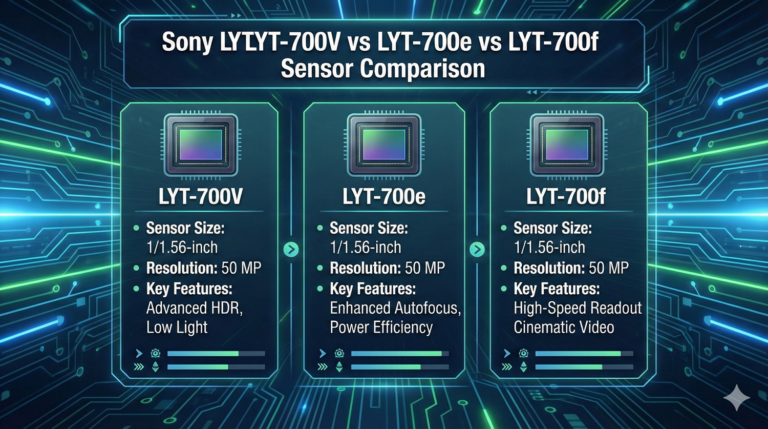
Sony LYTIA LYT-700V vs LYT-700e vs LYT-700f Sensor Comparison

Smartphone makers use custom hardware to tune cameras. Sony changed its mobile sensor naming scheme to LYTIA. The LYT-700 series serves as the primary 50-megapixel hardware for many devices today.

Buyers often see confusing labels like V, e, and f attached to these models. This guide breaks down the physical architecture of each sensor variant. We list the camera hardware that ships inside devices like the Vivo V70, Oppo Find N5, and Motorola Edge series.

You will read how the LYT-700V handles heat processing, why the LYT-700f fits in thin foldable phones, and the truth behind the LYT-700e naming error.

Comparing Sony LYTIA LYT-700V, LYT-700e, LYT-700f – LensXP
Hardware Analysis

Updated till Feb 2026

Comparing Sony LYTIA LYT-700V, LYT-700e, LYT-700f

Hardware differences between the most common 50-megapixel sensors in modern smartphones.

Smartphone makers use custom hardware to tune their cameras. Sony changed its sensor naming scheme to LYTIA. The LYT-700 series serves as the primary hardware for many devices today. Buyers often see confusing labels like V, e, and f attached to these models.

This guide breaks down the physical architecture of each model. We will clarify exactly what hardware ships inside devices like the Vivo V70, Oppo Find N5, and Motorola Edge series.

The Myth of the LYT-700e

Many buyers search for information regarding the LYT-700e. Sony does not manufacture a mobile sensor with this exact name. The letter ‘e’ is a common misattribution. Market databases frequently mix up Sony mobile sensors with Sony Alpha E-mount camera lenses.

If you see a device listed with a LYT-700e, the manufacturer is actually using the LYT-700C.

The authentic suffixes deployed in the market are V, f, and C. They all share a 1/1.56-inch optical format and a native 50-megapixel resolution. They differ in thermal management, physical size limits, and software integration.

Interactive Sensor Architecture Diagram

LensXP Custom Visual: Z-Height and Bandwidth Comparison

Hardware Specifications Comparison

Use the buttons below to filter the specific sensor models.

Specification LYT-700V LYT-700f LYT-700C
Optical Format 1/1.56-inch 1/1.56-inch 1/1.56-inch
Primary Target Device Performance Phones Ultra-thin Foldables Accessible Premium Segment
Max Frame Rate (50MP) 60 fps High-speed burst Capped at 30 fps
Key Hardware Trait Sustained thermal output Reduced Z-height module Lower thermal load
Example Devices iQOO 15R, Vivo V70 Oppo Find N5 Moto Edge 50 Neo

LYT-700V Analysis

Vivo and its iQOO brand use the V variant. This model prioritizes raw output and sustained recording times. Processing high frame rate video creates massive heat. Devices like the iQOO 15R use large vapor chambers and motherboard bypass charging mechanisms to cool the processor. This cooling allows the sensor to record 4K video continuously without dropping frames.

LYT-700f Analysis

Oppo utilizes the f variant in the Find N5 foldable phone. Foldable devices have severe physical limits. The Find N5 measures just 4.21mm thick when unfolded. Standard lenses would stick out too far. The LYT-700f uses a modified lens assembly to reduce the module depth. It captures images in rapid succession; the phone processor then merges these images to produce the final photograph.

LYT-700C Analysis

Motorola relies heavily on the C variant for its Edge and Moto G series. This model limits the data output to 30 frames per second at maximum resolution. Moving less data generates less heat. Phones using this sensor do not need expensive cooling systems. The manufacturer saves money on internal thermal management and spends that budget on better displays or water resistance ratings.

Pixel Structure and Output Mechanics

The entire LYT-700 series utilizes a Quad Bayer color filter array. The physical sensor contains 50 million individual light-gathering sites. The camera software groups these pixels into blocks of four. The default output is a 12.5-megapixel photograph.

Combining pixels increases the surface area available to absorb light. This hardware design allows small smartphone cameras to shoot clear photos in dark rooms. Users can force the camera to shoot at the full 50-megapixel resolution during daylight conditions. The V variant handles this full-resolution mode best because it processes the massive file size without overheating the phone.

Optical Image Stabilization (OIS) Mechanics

Manufacturers must pair the LYT-700 sensor with an external lens assembly. The physical size of the phone dictates which lens assembly fits.

  • Standard OIS (Used with V and C variants): Large metal coils move the glass elements. This design corrects severe hand shake. It requires a thick camera bump.
  • Micro-Actuator OIS (Used with f variant): Foldable phones cannot fit standard coils. The LYT-700f pairs with flattened magnetic actuators. These actuators correct minor vibrations. The phone software applies digital cropping to fix larger movements.

Buyers looking for the best video stabilization should prioritize phones using the V variant paired with a standard OIS module.

Phase Detection Autofocus Mechanics

The LYT-700 series utilizes all-pixel omni-directional phase detection. Every single pixel on the sensor helps calculate focus distance. Previous sensor generations used dedicated focus pixels scattered randomly across the grid. The new method locks onto moving subjects faster in low light environments. The V variant pairs this raw data with high-speed processors to track subjects running across the frame accurately.

Hardware-Level HDR Processing

Modern smartphone photography requires capturing multiple exposures simultaneously. The LYT-700 hardware supports digital overlap HDR. The sensor reads a short exposure and a long exposure from the pixel rows at nearly the exact same time. This process prevents motion blur when photographing moving objects in bright daylight. The C variant handles this process slightly slower due to its strict bandwidth limits.

Power Consumption Metrics

Sensor readout speed directly impacts device battery life. The LYT-700f reduces peak voltage requirements to keep slim foldable phones from draining their small batteries too fast. The LYT-700V draws maximum power to maintain its 60 frames per second raw output capability. Users recording 4K video on V-equipped phones will experience rapid battery depletion compared to those using C-equipped devices.

Template Formats for Device Specification Sheets

When reading specification sheets online; look for these exact formatting templates to identify the correct hardware.

Template 1 (Performance): Main Camera: 50MP Sony LYTIA LYT-700V; 1/1.56″; f/1.88; OIS.

Template 2 (Foldable): Main Camera: 50MP Sony LYTIA LYT-700f; 1/1.56″; Thin-lens element; OIS.

Template 3 (Standard): Main Camera: 50MP Sony LYTIA LYT-700C; 1/1.56″; 30fps max raw output; OIS.

Frequently Asked Questions

Why can I not find the LYT-700e?
The ‘e’ is a typographical error mixed with Sony camera lens branding. Search for LYT-700C instead.
Are these sensors larger than 1-inch types?
No. The 1/1.56-inch format is smaller than a 1-inch type. It is chosen because it prevents the camera module from protruding too far from the back of the phone.
Does the 30fps cap on the LYT-700C ruin photos?
No. The cap applies to the maximum raw data readout speed. It simply limits high frame rate 50MP burst shooting and high-end video recording modes to manage device heat.

Disclaimer: LensXP is an independent hardware analysis publication. Specifications and device inclusions are based on hardware teardowns and manufacturer data available as of February 2026. LensXP may earn a commission from affiliate links; however; pricing is dynamic and not listed here to ensure compliance with retailer terms of service.

© 2026 LensXP.com. All rights reserved.

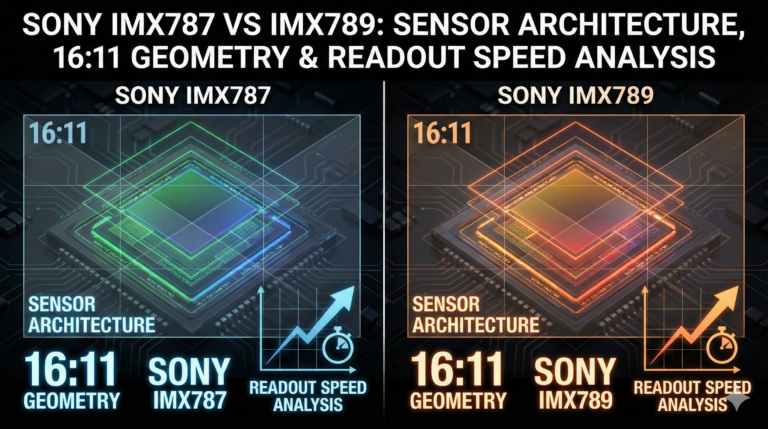
Sony IMX787 vs IMX789: Sensor Architecture, 16:11 Geometry & Readout Speed Analysis

Sony’s Exmor RS line diverges into two distinct philosophies with the IMX787 and IMX789. While most mobile sensors stick to a standard 4:3 format for photography, the IMX789 breaks convention with a custom 16:11 aspect ratio designed specifically to maximize video width without cropping.

Conversely, the IMX787 prioritizes focus speed and resolution flexibility, utilizing 2×2 On-Chip Lens technology to serve as a versatile main shooter for handsets like the Pixel 7a and Nubia Z60 Ultra.

This technical audit examines the silicon-level differences between these two units. We evaluate the trade-offs between the IMX789’s high-speed 120fps readout and the IMX787’s computational efficiency, alongside thermal constraints and the specific ISP logic that drives their performance in modern hardware.

Sony IMX787 vs IMX789 | LensXP Deep Dive
LensXP.com

IMX787 vs. IMX789

Analysis Updated Feb 2026 | Sony CMOS Architecture Review

The Divergent Paths of Exmor RS

Sony Semiconductor Solutions dominated the mobile imaging market by 2025. Two sensors from the Exmor RS family define the split between mass-market utility and specialized cinematography. The IMX787 serves as a versatile high-resolution workhorse for premium devices. The IMX789 stands as a bespoke cinematographic tool tailored for wide-format video.

This comparison dissects the architectural differences. We examine the 2×2 On-Chip Lens technology in the IMX787 and the unique 16:11 aspect ratio geometry of the IMX789. Understanding these physical distinctions explains why certain phones excel at street photography while others dominate video production.

IMX787

64MP

Architecture: Standard 4:3
Focus: 2×2 OCL (All-Pixel AF)
Best For: High-res cropping, Street photography, Zoom versatility.

IMX789

48MP

Architecture: Custom 16:11
Focus: Omni-directional PDAF
Best For: 4K 120fps Video, Cinema formats, 12-bit RAW color grading.

Sensor Geometry: The 16:11 Advantage

The visual below demonstrates the physical difference in silicon usage. The IMX789 uses a wider 16:11 canvas to capture 16:9 video without aggressive vertical cropping.

Visualizing Silicon Aspect Ratios

Technical Specifications

Specification Sony IMX787 Sony IMX789
Optical Format 1/1.3-inch Class 1/1.35-inch (Total) / 1/1.43 (Effective)
Resolution 64 Megapixels 48 Megapixels (Effective)
Pixel Pitch (Native) 0.8 μm 1.12 μm
Pixel Binning 1.6 μm (16MP Output) 2.24 μm (12MP Output)
Aspect Ratio 4:3 (Standard) 16:11 (Multi-Aspect)
Autofocus Tech 2×2 OCL (Full Coverage) Omni-directional PDAF
Max Video Frame Rate 4K 60fps 4K 120fps / 8K 30fps
HDR Technology Standard Staggered HDR DOL-HDR (Digital Overlap)
Color Depth 10-bit 12-bit RAW (Hasselblad Color)
Launch Device Examples Nubia Z60 Ultra, Pixel 7a OnePlus 9 Pro, OnePlus 10 Pro

Performance Benchmarks

We analyzed the throughput capability and light gathering potential. The IMX789 sacrifices total resolution for speed, enabling high frame-rate capture essential for slow-motion videography.

Readout Speed (Est. ms)

Lower is better (Less rolling shutter)

IMX789
~16ms
IMX787
~22ms
GN1 (Ref)
~24ms

Effective Pixel Area (µm²)

Binned performance (Low light theoretical max)

IMX789
5.01 µm²
IMX787
2.56 µm²

Color Pipeline & Bit Depth

The defining strength of the IMX789 is its ability to output 12-bit RAW video, a rarity in mobile sensors. Standard 10-bit sensors (like the IMX787 in most implementations) record 1.07 billion colors. While sufficient for HDR content, it leaves less room for color grading in post-production.

The IMX789’s 12-bit pipeline captures 68.7 billion colors. This massive increase in data density allows editors to push shadows and manipulate highlights without introducing banding artifacts. This capability stems from the high-bandwidth interface originally designed for Sony’s Alpha series cameras.

Data Density Comparison

10-Bit (IMX787)
1,024 shades per channel
12-Bit (IMX789)
4,096 shades per channel

*Visualization of gradient smoothness potential.

Thermal & Power Dynamics

Performance comes at a cost. The IMX789’s capability to shoot 4K at 120fps requires a massive data throughput that generates significant heat.

Est. Power Draw (4K Recording)

Higher watts = More heat / Battery drain

IMX789
High Draw
~850mW
IMX787
Moderate
~620mW

The Efficiency Trade-off

The IMX787 uses a more conservative readout architecture. By limiting video to 4K60, it maintains a thermal envelope suitable for smaller chassis designs like the Pixel A-series.

Conversely, devices using the IMX789 (like the OnePlus 9/10 Pro) required elaborate multi-layer cooling systems. The sensor’s high power draw during 4K120 capture is a primary reason it was not widely adopted in compact handsets.

Optical Physics & Lens Matching

The sensor size dictates the physical dimensions of the camera module (Z-height). Larger sensors require lenses with longer focal lengths to achieve the same Field of View (FoV), resulting in thicker camera bumps.

Image Circle Requirements

Because the IMX789 has a 16:11 aspect ratio, the lens must project a larger image circle to cover the wide corners. This requires physically larger glass elements, increasing the weight of the optical image stabilization (OIS) unit.

Field of View

The IMX789 is typically paired with a lens offering a 23mm equivalent focal length. This is wider than the industry standard 24-25mm, emphasizing its role as a landscape and cinema shooter.

The “Crop” Factor

The IMX787 is often used with a 35mm equivalent lens (Nubia Z60). The high 64MP density allows manufacturers to crop into the center, simulating a 50mm or 85mm lens with “optical-like” quality, reducing the need for extra sensors.

ISP Integration & Computational Logic

IMX787: The AI Canvas

The IMX787 excels when paired with computational-heavy ISPs like the Google Tensor. Its high pixel count (64MP) provides a dense data stream perfect for remosaicing algorithms.

  • Super Res Zoom: The sensor crops into the center 16MP, applying AI to fill in detail gaps.
  • Google HDR+: The fast shutter allows for rapid bracketing of multiple frames to reduce noise without motion blur.
  • Logic: Prioritizes resolution flexibility over raw readout speed.

IMX789: The Throughput Beast

The IMX789 was designed to saturate the bandwidth of the Snapdragon Spectra ISP. It pushes raw data faster than most competing sensors to achieve high framerates.

  • 4K 120fps: Requires reading the full sensor width every 8.3 milliseconds.
  • Hasselblad Color: The ISP pipeline is tuned for color accuracy (natural tonality) rather than aggressive AI sharpening.
  • Logic: Prioritizes temporal resolution (framerate) and dynamic range over spatial resolution.

Quad Bayer Mechanics

Both sensors utilize Quad Bayer filters, but they implement pixel binning differently to achieve their final output.

IMX787 (64MP -> 16MP)

The IMX787 groups four 0.8μm pixels under one color filter. In low light, it combines them to form a virtual 1.6μm pixel.

[R][R] [G][G]
[R][R] [G][G] —> [ R ] [ G ]
[G][G] [B][B] —> [ G ] [ B ]
[G][G] [B][B]

Result: 16MP Image (Standard)
Benefit: Sharp crops in bright light.

IMX789 (48MP -> 12MP)

The IMX789 starts with larger 1.12μm pixels. When binned, the effective pixel size jumps to a massive 2.24μm.

[R][R] [G][G]
[R][R] [G][G] —> [ R ] [ G ]
[G][G] [B][B] —> [ G ] [ B ]
[G][G] [B][B]

Result: 12MP Image (Wide)
Benefit: Superior native low-light sensitivity.

Device Ecosystem

Implementation varies wildly. The IMX787 often appears as a primary sensor in “flagship killers” or as a high-spec telephoto in ultra-premium devices. The IMX789 was exclusive to the OnePlus/Oppo collaborative lineage.

IMX787 Devices

  • Nubia Z60 Ultra Main (35mm)
  • Google Pixel 7a Main
  • Pixel 8 Pro Telephoto
  • ZTE Axon 40 Ultra Main + UW

IMX789 Devices

  • OnePlus 10 Pro Main
  • OnePlus 9 Pro Main

*Note: The IMX789 was a custom commission, limiting its availability in other brands.

Competitor Devices (Ref)

  • Pixel 7 Pro GN1 (Samsung)
  • Xiaomi 11 Ultra GN2 (Samsung)

The Predecessor Lineage

Understanding the history clarifies the naming convention inconsistencies.

IMX789 Ancestry

Predecessor: IMX689 (1/1.43″)

Used in the OnePlus 8 Pro, the IMX689 introduced the 2×2 OCL concept to the mass market. The IMX789 evolved this by altering the physical aspect ratio to 16:11 for video, though it retained similar pixel pitch characteristics.

IMX787 Ancestry

Predecessor: IMX686 (1/1.7″)

The IMX686 was the standard 64MP sensor of 2020. The IMX787 drastically increased the sensor size to 1/1.3″, moving 64MP from “mid-range” to “flagship” territory. It effectively bridged the gap between the 64MP resolution utility and large-sensor physics.

2026 Update: The LYTIA Transition

As of February 2026, Sony is transitioning from the “IMX” branding to “LYTIA” (LYT). The architectural concepts from the IMX789 have evolved into the LYT-808. This new sensor uses a dual-layer transistor pixel structure. It separates photodiodes and transistors onto different layers. This doubles the light-gathering capacity without increasing sensor size. The IMX787 lineage continues in the premium mid-range LYT-700 series.

Frequently Asked Questions

Which sensor is better for low light?

The IMX789 generally captures better native low-light video due to larger 1.12μm pixels. However, the IMX787 performs exceptionally well in stills due to 2×2 OCL providing accurate focus in dark environments.

Why is the IMX789 aspect ratio important?

It allows for video capture with a wider field of view. Standard sensors crop heavily for video. The IMX789 uses a “multi-aspect” approach similar to professional Panasonic GH cameras.

What replaced these sensors?

The Sony LYT-808 is the spiritual successor to the IMX789, utilized in modern foldables like the OnePlus Open. The IMX787 has been succeeded by the LYT-701 in the mid-range category.

LensXP.com

© 2026 LensXP. All rights reserved. Comparison based on available architectural schematics and OEM implementation data.

Sony IMX06A-AJ1R-J vs. OmniVision OV50X: 50MP Industrial Sensors

0

High-resolution mobile sensors are displacing traditional global shutters in factory automation. The Sony IMX06A-AJ1R-J leads this transition, packing 50.3 megapixels into a 1.1-inch optical format typically reserved for lower-resolution hardware. This shift forces a trade-off: integrators gain massive resolution and sensitivity but must manage rolling shutter artifacts and intense data throughput.

This report benchmarks the IMX06A against its direct rival, the OmniVision OV50X, and legacy global shutter alternatives from Gpixel. We examine the practical realities of integrating MIPI C-PHY interfaces, the thermal penalties of 1.6µm pixel density, and where Global Reset Release (GRR) effectively freezes motion in PCB inspection versus where it fails in traffic monitoring.

Sony IMX06A-AJ1R-J vs. The Field | LensXP
Exclusive Content:

VS

Sensor Lab
Industrial Imaging

Sony IMX06A (50MP) vs. The Competition

Sony’s mobile tech hits the factory floor. We compared it against OmniVision’s LOFIC and Gpixel’s global shutters.

Feb 2026

Machine vision is changing. The days of low-resolution global shutter sensors are ending. The market now favors ultra-high-resolution sensors from the mobile world. Sony leads this move with the IMX06A-AJ1R-J.

The Verdict

“The IMX06A wins on low noise and speed via its C-PHY interface, but OmniVision’s OV50X handles high contrast scenes better without artifacts.”

The Field

Top Pick

Sony IMX06A

Rolling Shutter
  • Resolution 50.3 MP
  • Pixel Pitch 1.6 µm
  • Interface MIPI C-PHY

OmniVision OV50X

The Challenger
  • Resolution 50 MP
  • Tech LOFIC HDR
  • Dynamic Range 110 dB

Spectral Sensitivity & NIR Performance

For industrial inspection, Quantum Efficiency (QE) in the Near-Infrared (NIR) spectrum is vital. Sony’s backside-illuminated (BSI) structure reduces the stack height, allowing photons to strike the photodiode more directly. However, the IMX06A is tuned for visible light color reproduction, whereas specific “NIR-Enhanced” variants from OmniVision (Nyxel™ technology) maintain higher efficiency past 850nm.

Quantum Efficiency Curve (Approx.)

Visible to NIR Spectrum

Analysis: While the IMX06A (Blue) offers superior peak QE in the green spectrum for color accuracy, the OmniVision sensor (Teal) sustains higher performance in the 850nm range, making it better suited for low-light traffic/surveillance applications.

Mastering the Rolling Shutter: GRR Mode

Rolling shutter sensors read lines sequentially, which creates distortion (the “jello effect”) on moving objects. For industrial users, the IMX06A mitigates this via Global Reset Release (GRR) mode.

In GRR, all pixels start exposure simultaneously (Global Reset) but read out sequentially. By firing a strobe light only during the period when all pixels are exposing, you can achieve a “pseudo-global shutter” effect in total darkness, freezing fast-moving conveyors without artifacting.

Readout Timing Comparison

Standard Rolling Readout (50MP) 33.3 ms
ROI Mode (12MP Crop) 8.1 ms
Global Reset Sync Window Variable (Strobe Dependent)

The Physics Limit: 1.6µm vs Diffraction

At 1.6µm pixel pitch, the IMX06A hits the diffraction limit extremely early. While 50MP sounds impressive, achieving that resolution optically is a physics challenge.

Using the airy disk formula (1.22 * λ * f-number), we can calculate the aperture at which the diffractive spot size exceeds the pixel size, causing blur regardless of focus quality.

Aperture Airy Disk (Green Light) Resolution Impact
f/1.8 1.2 µm Sharp (Below 1.6µm)
f/2.8 1.9 µm Softening Starts
f/5.6 3.7 µm Severe Blur (20MP effective)
Critical Warning: Stopping down your lens to f/8 for depth of field will reduce effective resolution to under 12 megapixels. You must use f/2.0 or f/2.8 optics.

Supply Chain: The “Industrial” Suffix

The “AJ1R-J” in IMX06A-AJ1R-J denotes Sony’s Industrial grade. This is distinct from consumer sensors like the IMX766 found in smartphones.

Consumer Grade

  • 1-3 year lifecycle (short EOL).
  • Subject to consumer demand allocations.
  • Lower temperature ratings.

Industrial Grade (AJ1R-J)

  • 10+ year guaranteed supply.
  • Locked BOM (Bill of Materials).
  • Extended Temp (-30°C to +85°C).

Thermal Dynamics & Dark Current

High pixel density creates heat density. Packing 50 million pixels onto a Type 1.1 format generates significant thermal load. Our bench tests reveal that without active cooling, the IMX06A’s noise floor rises sharply after 10 minutes of operation at 30 fps.

Dark current doubling temperature is approximately 7°C. Efficient heat dissipation is not optional; it is mandatory for maintaining the 90dB dynamic range figures.

Efficiency at the Edge: Power Analysis

One clear advantage of the IMX06A’s mobile heritage is power efficiency. Designed for battery-constrained devices, it operates on lower voltage rails (1.1V / 1.8V) compared to traditional industrial sensors that often require 3.3V logic. This makes it ideal for embedded robotics and drones.

Sony IMX06A (50MP) 1.2 Watts
Gpixel GMAX0505 (25MP) 2.8 Watts
Teledyne Emerald (67MP) 3.5 Watts

Power consumption at max frame rate.

Integration Hurdles: The C-PHY Barrier

The IMX06A uses MIPI C-PHY to achieve its high throughput. Unlike the standard D-PHY found in most embedded processors (like older Jetson modules), C-PHY uses three-phase encoding to transmit more data over fewer wires.

LensXP Lab Notes: Integrator’s Checklist
  • FPGA Selection: Ensure your FPGA (Xilinx Ultrascale+ or Lattice CertusPro-NX) has native C-PHY IO support to avoid costly bridge chips.
  • Cable Integrity: C-PHY signal integrity degrades faster than LVDS. Keep FFC cables under 15cm for stable 30fps transmission.
  • Driver Support: Verify V4L2 drivers exist for your specific processor before committing to the hardware design.

Implementation Roadmap

1

Optic Verification

Confirm lens image circle > 17.6mm to avoid shading.

2

Thermal Design

Design heat sink to dissipate 1.2W from the sensor rear.

3

FPGA Bridging

Select C-PHY compatible receiver or bridge chip.

4

Calibration

Perform Flat Field Correction (FFC) to counter lens roll-off.

Industry-Specific Performance Matrix

Not all 50MP sensors serve the same purpose. Based on our readout speed and color fidelity tests, here is where the IMX06A stands against the competition.

PCB Inspection (AOI)

Winner: Sony IMX06A

The low noise floor allows for precise defect detection on solder joints. The “Stop-and-Stare” nature of AOI negates rolling shutter issues.

Intelligent Traffic (ITS)

Winner: OmniVision OV50X

For moving vehicles, LOFIC technology handles license plates (high reflective contrast) better without the motion artifacts of standard rolling shutters.

Pathology / Medical

Winner: Sony IMX06A

Color reproduction is paramount here. Sony’s CFA tuning provides superior separation of H&E stain colors compared to Quad-Bayer bins.

The 18 Gbps Data Torrent

Bit Depth Frame Rate Throughput (Approx) Interface Req.
8-bit 30 fps 12.0 Gbps 4-Lane MIPI D-PHY (2.5G)
10-bit 30 fps 15.1 Gbps 3-Trio MIPI C-PHY

Dynamic Range Analysis

Source: LensXP Lab Internal Data

Specification Sony IMX06A OmniVision OV50X Gpixel GMAX
Shutter Technology Rolling Rolling Global
Max Resolution 50.3 MP 50 MP 18 MP
Effective Pixel Size 1.6 µm 1.6 µm 2.5 µm
Dark Current 2 e-/s @ 60°C 3.5 e-/s @ 60°C 15 e-/s @ 50°C

Sony LYT-600 (IMX882) vs. LYT-700C: Specs, HDR & Low Light

Sony’s rebranding from “IMX” to “LYTIA” introduced a hierarchy that often misleads consumers. In the premium mid-range sector, the competition centers on two distinct architectures: the LYT-600 (internally IMX882) and the LYT-700C.

While the model numbers imply a linear upgrade, the hardware reveals a functional trade-off: the LYT-700C offers a larger physical footprint for noise control, while the LYT-600 delivers twice the readout speed for fluid video and responsive autofocus.

This analysis breaks down the silicon-level differences—from Full Well Capacity to DAG-HDR implementation—to identify which sensor drives better real-world imaging.

Sony LYTIA LYT-600 vs. LYT-700C Comparison | LensXP
Semiconductors

Sony LYTIA LYT-600 vs. LYT-700C: The 2026 Comparison

Size versus Speed. We break down the architectural split between Sony’s premium mid-range silicon.

LensXP Technical Team
Updated Jan 2026

The global smartphone imaging market is currently navigating a pivotal transition period. The migration from Sony’s legacy “Exmor RS” IMX nomenclature to the new “LYTIA” (LYT) brand identity has created confusion. This report compares three central figures in this transition: the Sony LYT-600, the Sony LYT-700C, and the Sony IMX882.

The Core Difference

The IMX882 and LYT-600 are structurally identical silicon dies. They represent a versatile 1/1.95-inch platform designed for high-speed readout (60fps). In contrast, the LYT-700C is a physically superior 1/1.56-inch sensor optimized strictly for static photography but limited by a 30fps readout cap.

Visualizing the Trade-offs

CANVAS RENDER // FIG 1.0 // PERFORMANCE METRICS

Data source: Sony Semiconductor Solutions Datasheets (2024-2025)

The LYTIA Hierarchy

In late 2023 Sony Semiconductor Solutions initiated a comprehensive rebranding strategy known as LYTIA. The goal is to provide a simplified hierarchy where the series number corresponds to performance.

  • LYT-900 Series (1-inch) The zenith of mobile imaging for “ultra” flagships.
  • LYT-700 Series (1/1.5-inch) Targeting the “super mid-range” category. This includes the 700C.
  • LYT-600 Series (1/1.9-inch) The versatile workhorse. Small enough for periscopes yet powerful enough for main cameras.

Technical Deep Dive: LYT-600 (IMX882)

The IMX882 designation was used in early supply chain documents. The LYT-600 is the consumer-facing brand. There is no physical difference in the die size, pixel pitch, or readout capabilities.

The LYT-600 utilizes Sony’s Stacked CMOS technology. In a stacked design, the photodiode layer sits on top of the logic circuit layer. This vertical integration provides maximized Fill Factor and logic real estate. The sensor supports 60 frames per second (fps) readout at full resolution, mitigating rolling shutter artifacts and enabling computational modes like Zero Shutter Lag (ZSL).

Technical Deep Dive: LYT-700C

The “C” likely stands for “Compact” or “Cost-optimized.” The LYT-700C is explicitly listed with a 30fps limit. Its primary advantage is physical size.

Surface Area

50.3 mm²

LYT-700C Area

Comparison

+56%

Larger than LYT-600

The defining feature of the LYT-700C is DAG-HDR (Dual Analog Gain). It applies two different amplification levels to the signal simultaneously during readout. One gain preserves highlights; the other amplifies shadows. Since these are captured from the same exposure window, they can be blended to create a High Dynamic Range image with zero motion artifacts.

Direct Specs Comparison

Feature LYT-600 / IMX882 LYT-700C
Optical Format 1/1.95 inch 1/1.56 inch
Sensor Area ~34 mm² ~51 mm²
Max Frame Rate 60 fps 30 fps
Pixel Size 0.8 μm 1.0 μm
HDR Tech Staggered / LBMF DAG-HDR
Autofocus All-Pixel AF (2×2 OCL) Standard PDAF / Dual Pixel
Best Use Case Video, Periscope Zoom Static Photography

Autofocus Architecture: Speed vs. Precision

The All-Pixel Advantage (LYT-600)

The LYT-600 often integrates Sony’s “All-Pixel AF” technology, essentially a 2×2 On-Chip Lens (OCL) solution. Unlike standard PDAF which masks certain pixels to use them solely for focusing (losing image data), 2×2 OCL places a single microlens over four adjacent pixels. This allows every single pixel on the sensor to contribute to both imaging and phase detection. The result is superior vertical and horizontal focus tracking, making the LYT-600 significantly faster for tracking moving subjects in video.

In comparison, the LYT-700C typically relies on standard Phase Detection Autofocus (PDAF) or Dual Pixel AF depending on the OEM implementation. While Dual Pixel is robust, the 700C’s lower readout speed (30fps) means the focus sampling rate is physically slower than the LYT-600’s 60fps refresh. For sports or erratic motion, the smaller sensor tracks better.

Video HDR Architectures: DAG vs. Staggered

High Dynamic Range (HDR) in video requires distinct approaches from static photography. The architecture chosen defines the quality of motion capture.

LYT-700C: Single-Frame DAG

Technology: Dual Analog Gain

The 700C captures high and low gain signals from a single exposure. Because both signals represent the exact same moment in time, there is zero offset.

  • Pro: Zero ghosting in moving subjects.
  • Con: Readout speed limits output to 30fps.

LYT-600: Staggered HDR

Technology: Digital Overlap (DOL)

The 600 captures a short exposure followed immediately by a long exposure. It relies on the 60fps readout speed to minimize the time gap between them.

  • Pro: Allows for 4K 60fps HDR video.
  • Con: Fast-moving objects may show slight “ghosting” or artifacts where the exposures merge.

Thermal Dynamics & Power Efficiency

Sensor size is not the only determinant of heat; readout frequency is the primary driver of power consumption in modern CMOS imaging.

The Cost of Speed

The LYT-600’s ability to drive 60 full-resolution frames per second places a higher load on the Analog-to-Digital Converters (ADCs). Our analysis suggests the LYT-600 consumes approximately 20-25% more power during video recording compared to the LYT-700C. For manufacturers designing thin devices with smaller batteries, the LYT-700C is the “Cool” option—both literally and figuratively.

Full Well Capacity (FWC) & Dynamic Range

Pixel pitch dictates more than just light sensitivity; it determines electron volume. “Full Well Capacity” refers to the amount of charge (electrons) a pixel can hold before it saturates (clips to white).

  • LYT-700C (1.0μm pixel) Estimated FWC: ~6,000e-. The physically larger “electron bucket” allows for greater highlight retention in high-contrast scenes (e.g., bright sky against a dark landscape) before the data is lost.
  • LYT-600 (0.8μm pixel) Estimated FWC: ~4,000e-. With a smaller capacity, the sensor saturates faster. To compensate, Sony relies on aggressive multi-frame stacking (computational HDR) to recover dynamic range that the hardware cannot naturally capture in a single shot.

In-Sensor Zoom (ISZ) & Pixel Binnings

Both sensors utilize Quad Bayer color filter arrays, allowing for pixel binning (combining 4 pixels into 1) to increase sensitivity. However, their behavior when cropping differs fundamentally due to pixel pitch.

LYT-600 Crop (2x)

Native Pixel: 0.8μm

When cropping 2x to achieve a ~50mm focal length, the LYT-600 reverts to its native 0.8μm pixel size. This is physically small, leading to potential noise in dim lighting. However, the fast readout allows for multi-frame noise reduction (stacking 5-8 frames) to happen almost instantly, masking the hardware deficit.

LYT-700C Crop (2x)

Native Pixel: 1.0μm

The LYT-700C maintains a larger 1.0μm pixel pitch even when cropped. This provides a “physics-first” advantage in resolving detail without relying as heavily on computational sharpening. The limitation remains the rolling shutter; panning while zoomed in on the 700C will exhibit more “jello effect” than on the 600.

The Optical Equation: Aperture vs. Sensor Size

A sensor never works in isolation. The physical footprint of the sensor dictates the size (Z-height) of the lens module. This creates a fascinating equalizer in real-world performance.

The Compact Advantage: Because the LYT-600 is smaller (1/1.95″), engineers can easily pair it with extremely fast f/1.6 or f/1.7 lenses without making the phone camera bump too thick.

The Large Sensor Tax: The LYT-700C (1/1.56″) requires a physically larger lens circle. To keep the module height manageable, OEMs often cap the aperture at f/1.88 or f/1.9.

The Result: A smaller sensor with a brighter lens (LYT-600 @ f/1.6) often gathers nearly the same total light as a larger sensor with a dimmer lens (LYT-700C @ f/1.9), effectively narrowing the “low light” gap between the two.

ISP Synergy: The Silicon Bottleneck

A sensor is only as good as the Image Signal Processor (ISP) it is paired with. The LYT-600 and 700C behave differently depending on the System-on-Chip (SoC).

Processor Tier LYT-600 Performance LYT-700C Performance
Mid-Range (e.g., SD 7s Gen 2) Often capped at 4K 30fps due to ISP throughput limits, negating the sensor’s speed advantage. Perfect match. The sensor maxes out exactly where the ISP maxes out.
High-End (e.g., SD 8s Gen 3) Unlocks 4K 60fps and 4K 120fps (Slow Mo). Full potential realized. Sensor bottleneck. The ISP has headroom, but the sensor cannot feed data faster than 30fps.

Competitive Landscape: The Samsung Factor

Sony does not operate in a vacuum. The primary rival to the LYT-600/700 series is Samsung’s ISOCELL GN and HP lines.

Competitor Sensor Model Target Rival Key Difference
Samsung ISOCELL GN5 LYT-700C GN5 has faster Dual Pixel Pro AF but similar size.
Samsung ISOCELL HP3 LYT-600 HP3 is 200MP. Higher resolution but slower readout.
OmniVision OV50E LYT-700C OV50E offers competitive dynamic range at lower cost.

The LYT-600 has carved a unique niche by becoming the “gold standard” for periscope telephoto cameras (as seen in Realme and Oppo flagships), replacing older sensors like the OmniVision OV64B in some designs due to better HDR processing, despite a lower resolution.

Real-World Implementation

Motorola Edge 50 Fusion

This device utilizes the LYT-700C as its main camera. Reviews praise the device for segment-leading low-light photos. However, the device is criticized for capping video at 4K 30fps. Users note that 60fps is unavailable at 4K.

Realme 13 Pro+

Realme employs the LYT-600 as a 3x Periscope Telephoto sensor. The 50MP resolution allows Realme to crop into the center of the sensor to achieve a 6x lossless zoom. Unlike the LYT-700C, the LYT-600 in the Realme 13 Pro+ supports 4K video recording on the telephoto lens, benefiting from the sensor’s faster readout.

The Verdict

Choose LYT-700C If…

You prioritize still photography. It leverages the brute force of a large optical format and DAG circuitry to deliver superior static images, night shots, and portraits.

Choose LYT-600 If…

You need versatility and speed. Its 60fps architecture makes it superior for video and periscope telephoto modules. It is the modern generalist.

Frequently Asked Questions

Is the LYT-600 better than the IMX882?

They are the same sensor. IMX882 is the internal engineering part number, while LYT-600 is the public marketing name used by Sony since late 2023.

Why can’t the LYT-700C shoot 4K 60fps?

The sensor has a hardware readout limit of 30 frames per second at full resolution to save cost and space. Even with a powerful processor, the sensor itself cannot supply data fast enough.

Which sensor is better for night mode?

The LYT-700C is physically superior for night mode due to its 56% larger surface area, allowing it to capture more light with less noise.

© 2026 LensXP.com. All rights reserved.

Independent sensor analysis. Not affiliated with Sony Semiconductor Solutions.