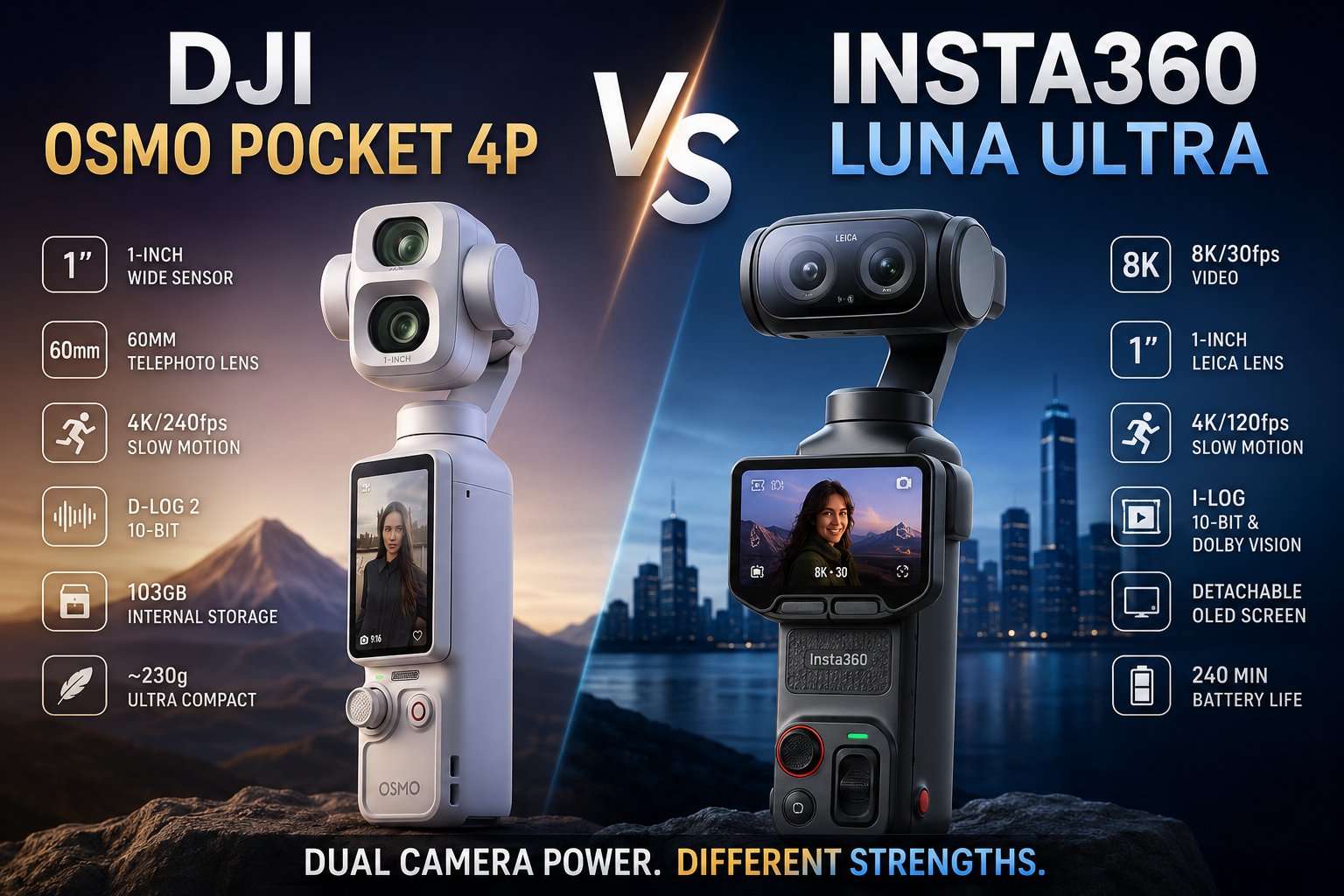
Choosing between the DJI Osmo Pocket 4P and the Insta360 Luna Ultra comes down to your specific shooting style. The Insta360 Luna Ultra brings 8K resolution and a highly functional detachable screen for solo presenters.
The DJI Osmo Pocket 4P answers with an incredibly compact design and a dedicated 60mm telephoto lens for superior portrait rendering. Read our full comparison to see how their sensors, autofocus tracking systems, thermal limits, and color profiles stack up for daily video production.
DJI Osmo Pocket 4P vs Insta360 Luna Ultra
Executive Summary
This comparison is unusually asymmetrical. The Insta360 Luna Ultra is already widely documented with official manuals and multiple substantive reviews. The DJI Osmo Pocket 4P is newer and China-first. It still lacks an easily accessible full English spec page in public web results. Some Pocket 4P conclusions can be stated firmly from official China store pages and media announcements. Others must be marked as provisional.
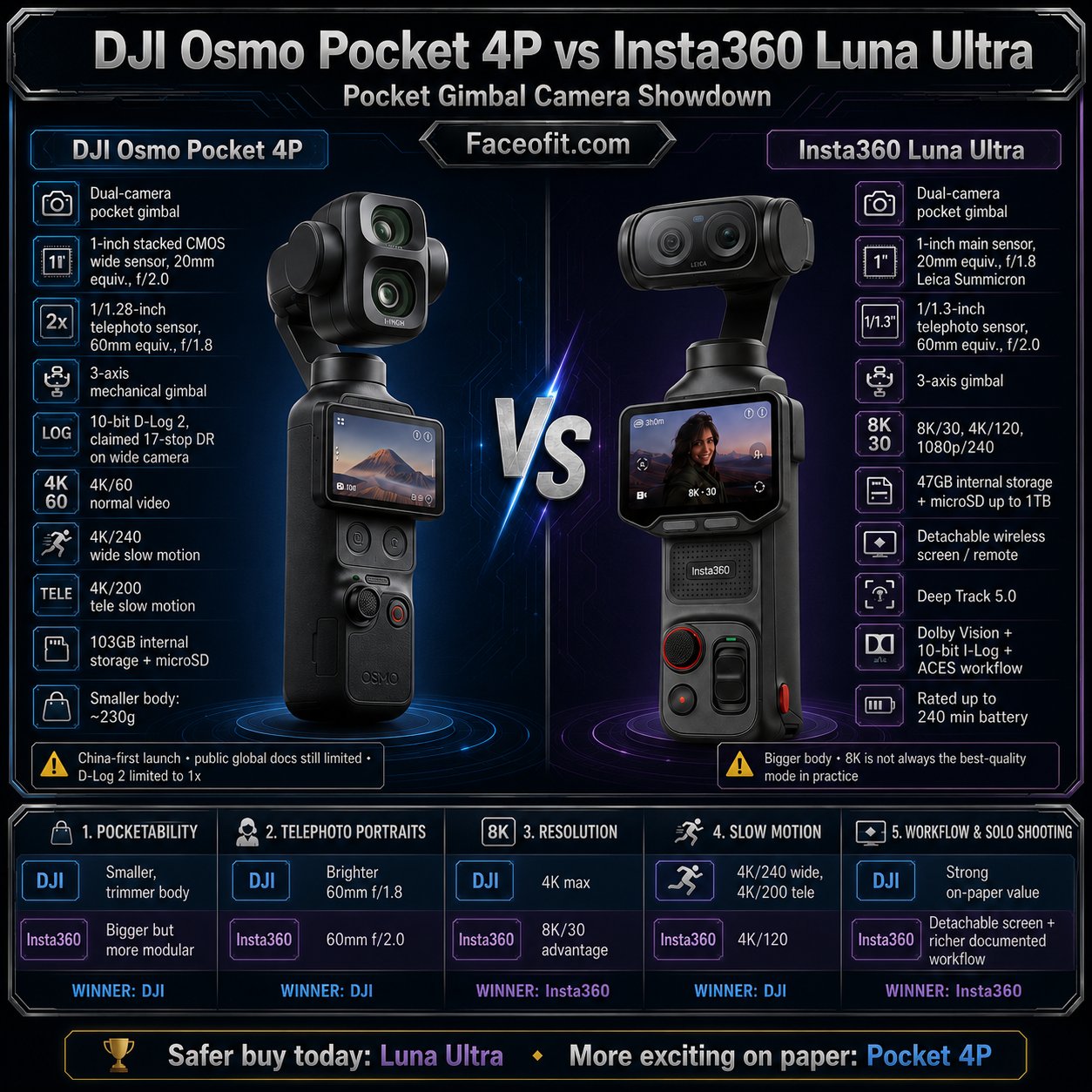
The trade-off is clear. Pocket 4P looks like the stronger cinematic pocket tool if you value a smaller body, faster slow motion, a dedicated 60mm equivalent portrait lens, and D-Log 2 with a claimed 17-stop wide-camera dynamic range. Luna Ultra is the more mature creator system today. It offers 8K capture, a detachable wireless screen, stronger official software tooling, proven low-light results, and real global retail availability.
Visual Summary
Data Visualization: Physical Capabilities
Internal Storage Capacity Comparison (GB)
Verified Specifications Comparison
| Category | DJI Osmo Pocket 4P | Insta360 Luna Ultra |
|---|---|---|
| Main Sensor & Lens | 1-inch wide, 20mm equiv., f/2.0; stacked CMOS with LOFIC; 17-stop DR in D-Log 2 | 1-inch main, 20mm equiv., f/1.8 Leica Summicron |
| Tele Sensor & Lens | 1/1.28-inch, 60mm equiv., f/1.8 optical lens | 1/1.3-inch, 60mm equiv., f/2.0 |
| Maximum Video | 4K/60 normal, 4K/240 wide slow-mo, 4K/200 tele slow-mo | 8K/30, 4K/120, 1080p/240 |
| Color Profiles | 10-bit D-Log 2; film looks available | Standard, Dolby Vision, 10-bit I-Log; Leica Natural/Vivid/Chrome; ACES |
| Stills | 37MP class stills | 37MP; Ultra-Clear 200MP pano modes; JPG and JPG plus RAW |
| Storage | 103GB internal plus microSD | 47GB internal plus microSD up to 1TB |
| Weight & Size | Approx. 230g; 144.2 x 44.4 x 33.5mm | 233g; 169.9 x 52.4 x 38.5mm |
| Battery & Runtime | 1545mAh; 210 min reported runtime | 1550mAh main plus 210mAh remote; 240 min rated runtime |
| Pricing | Check Local Retailers | Check Local Retailers |
Image Quality and Stabilization
On pure imaging theory, the Pocket 4P is the bolder camera. Official materials state the wide camera uses a 1-inch stacked sensor with LOFIC and reaches up to 17 stops in D-Log 2. The separate 60mm lens should give distinctly more flattering portrait geometry than any digital crop from a wide lens. The Luna Ultra pitch is less aggressive on dynamic range numbers. It offers a higher resolution 8K/30 pipeline and Leica-tuned color options instead.
In public real-world evidence, the Luna Ultra currently has the stronger case because it has more actual review footage. Testing shows its 4K I-Log footage is often cleaner than 8K in high-contrast scenes. Reviewers explicitly recommend 4K over 8K most of the time because the 8K detail gain is modest while noise rises in tough contrast. Luna 8K is useful, but it is not automatically the highest quality mode.
Low light is one of Luna clearest strengths in current reviews. PureVideo produces clean low-light results. Reviewers note PureVideo is unusually restrained rather than over-processed. Even normal iLog footage remains surprisingly clean in dim scenes. Pocket 4P may end up winning in low light on the main camera, but public proof is thinner right now.
Post-Production Workflows
DJI Pocket 4P Pipeline
Insta360 Luna Ultra Pipeline
Field Testing Results
Independent reviewers offer important context beyond the official specification sheets. PetaPixel notes the Luna Ultra produces very clean 4K files. Reviewers often prefer these 4K files over 8K in high contrast situations. RedShark found the Luna PureVideo mode restrained and natural rather than heavily processed. Engadget points out the bright and pleasing color science of the Insta360 camera right out of the box.
For the DJI Osmo Pocket 4P, early field reports suggest strong low light capabilities matching DJI marketing claims. Extensive lab tests measuring rolling shutter remain unavailable for both models as of mid 2026. This means high speed panning performance remains an open question for both devices.
Advanced Video Features
The DJI Pocket 4P limits its 10-bit D-Log 2 profile strictly to the 1x wide camera. The telephoto lens provides excellent subject isolation but relies on standard color profiles. This restriction matters heavily for creators who grade their footage manually. If your workflow depends entirely on D-Log 2, the signature 60mm look is not the one receiving the most advanced log mode.
The Insta360 Luna Ultra offers comprehensive Dolby Vision and 10-bit I-Log support across its pipeline. Insta360 supports an ACES managed workflow directly in its post production software. Official specifications list support for Video, PureVideo, Slow Motion, Timelapse, TimeShift, Spin Shot, and Dolly Zoom. DJI confirms timelapse, motionlapse, and gesture controls for the Pocket 4P.
Autofocus and Tracking Systems
The DJI Osmo Pocket 4P provides single autofocus and multiple continuous focus behaviors. These options include a product showcase mode, subject lock follow focus, and registered subject priority. DJI includes multi-person tracking and notes that subject following works across different zoom ranges. Note that 10-bit D-Log 2 is restricted to the 1x lens. If your workflow relies on D-Log 2, the 60mm telephoto lens cannot use this specific profile.
Insta360 uses the Deep Track 5.0 system for the Luna Ultra. This platform includes Auto Tracking, Active Zoom Tracking, Group Tracking, and Smart Framing. Reviewers consistently praise the self-shooting experience. The detachable display gives solo creators remote framing, pan and tilt control, and a wireless microphone. This display functionality is a major ergonomic advantage for the Insta360 system.
Ergonomics and Accessories
The Pocket 4P is highly pocketable. The footprint remains close to the previous model and weighs approximately 230g. The Luna Ultra is noticeably larger. The wider gimbal head and detachable screen make it bulkier, particularly with the protective cover attached.
The accessory ecosystems differ significantly. DJI focuses on a traditional camera approach with the FrameTap remote, fill lights, and microphone integration. Insta360 focuses on rig building with a battery handle, wide-angle lens attachments, Black Mist filters, neck mounts, and strong Mic Air integration.
Battery life testing shows solid results for both units. The Luna Ultra is officially rated for 240 minutes. Independent tests recorded two hours and forty-seven minutes at 4K resolution at 24 frames per second before battery depletion with no overheating. The Pocket 4P has public reports of around 210 minutes of runtime.
Codec, Bitrates, and Connectivity
Bitrate capabilities dictate file sizes and editing weight. The Luna Ultra tops out at 120 megabits per second using standard H.265 compression. The exact Pocket 4P codec specifications remain pending full public confirmation. Previous DJI Pocket 4 hardware reaches 180 megabits per second using HEVC.
External streaming and utility features show distinct paths. The Luna Ultra officially lacks webcam mode, live streaming support, and HDMI output. DJI broadly supports UVC webcam usage and live streaming across the Pocket platform. Wi-Fi 6 comes standard on both main camera bodies. The Insta360 remote relies on Wi-Fi 4 for its wireless connection to the base unit.
Both devices are gimbal stabilized cameras. Reviewers note the Luna handles almost everything except larger vertical body movements. The DJI platform offers excellent stabilization for walking vlogs but is not rated for heavy jogging. Current reading shows DJI likely retains a cleaner walking camera feel while Luna is highly competent but less immune to vertical bobbing.
Thermal Performance and Battery Constraints
Pushing high frame rates and heavy resolutions creates heat. The Luna Ultra has a highly defensible evidence base regarding thermals. Controlled testing from PetaPixel showed the Luna Ultra can record 4K at 24 frames per second for two hours and forty-seven minutes until battery death with absolutely zero overheating issues.
However, extreme modes will tax the Insta360 system. The same tests revealed that recording in 4K at 120 frames per second caused the camera to overheat after roughly 44 minutes. Filming in 8K at 24 frames per second triggered overheating shutdowns at the 49-minute mark. These limits are important for long-form event shooters.
Equivalent controlled thermal tests from major independent reviewers for the Pocket 4P are not yet available. General public reports indicate a standard runtime of around 210 minutes for normal use. Buyers planning to rely heavily on the 4K 240fps slow motion mode should expect reduced runtimes and potential thermal limits similar to other compact cameras in this class.
Final Buying Recommendations
For Solo Presenters
Buy the Insta360 Luna Ultra. The detachable remote screen improves framing and self-shooting confidence. The official application ecosystem is thoroughly documented.
For Travel Creators
Choose the DJI Osmo Pocket 4P. The compact body and 103GB of internal storage are excellent for travel. The 60mm lens and 4K slow motion offer great visual options.
For Heavy Post-Production
Choose the Luna Ultra if you need a documented ACES compatible workflow today. Choose the Pocket 4P if the 17-stop dynamic range claim and D-Log 2 profile matter more to you.
Pros and Cons
Advantages
- Smaller body design.
- Brighter telephoto lens.
- Large 103GB internal storage.
- High framerates: 4K/240 wide and 4K/200 tele.
- Aggressive D-Log 2 claims with 17-stop dynamic range.
Disadvantages
- Lacks 8K video resolution.
- Accessible public documentation remains incomplete.
- D-Log 2 is limited to the 1x wide lens.
- Global availability is unclear at this time.
Advantages
- Offers 8K/30 capture.
- Strong public review base confirms capabilities.
- Detachable screen includes a microphone.
- Deep Track 5.0 autofocus system.
- Rich app, Studio, and ACES workflow support.
- Widely available globally right now.
Disadvantages
- Physically larger and bulkier body.
- Only 47GB of built-in internal storage.
- 8K mode is often less useful than 4K in real practice.
- No official webcam, live-stream, or HDMI support documented yet.
Frequently Asked Questions
Which camera is better for low light?
Does the Pocket 4P shoot in 8K?
Are these cameras waterproof without a case?
Conclusion
The choice depends entirely on immediate availability and workflow preference. The Luna Ultra is the safer purchase today because it offers proven results, a highly useful remote screen, and global retail presence.
The Osmo Pocket 4P is an exciting alternative that prioritizes telephoto performance, advanced log profiles, and sheer portability. Buyers needing a camera right now should confidently pick the Luna. Buyers focused on portrait rendering and the smallest possible footprint should wait for the Pocket 4P global release.