

In this post, we objectively compare the Omnivision OV64A vs OV64B vs OV64C smartphone camera sensors, which are expected soon.
Also Read: Samsung ISOCELL HM3 vs HM2 vs Sony IMX686
The world’s third-largest mobile phone image sensor company is OmniVision. This company announced three image sensors based on the PureCel®Plus chip stacking technology and electronic image stabilization (EIS) technology to equip high-end smartphones with superior quality image capture as well as 4K (& 8K) video performance. Names of these image sensors are OV64A, OV64B, and OV64C. Now let’s get into the details of each of these sensors and then look at their comparison:
Omnivision OV64A:
 Lenovo Legion 2 Pro
This first 64MP mobile phone sensor comes with a 1.0 µm pixel size. Due to the huge pixel size, there is an enhancement in the low-light performance of smartphones. What makes it so exceptional is that it supports 8K resolution @ 30 fps. OV64A comes with a class-leading optical format i.e.,1/1.34″.
When compared with the 0.8 µm 64MP image sensor, the 1.0 µm pixel size of OV64A offers 60% more sensitivity. Such large optics and high resolution offer the greatest possible performance in low-light conditions. So, this sensor is suitable for wide and ultra-wide main cameras equipped in high-end smartphones.
Features:
- Implemented with OmniVision’s PureCel®Plus-S stacked die technology, this sensor incorporates an on-chip, hardware remosaic, and 4-cell (4C) color filter array. So, this sensor offers superior quality, 64 MP Bayer output, or 8K video output in real-time.
- During low light conditions, the OV64A sensor can use near-pixel binning to deliver an output of 16 MP image for the 4K2K video along with four times the sensitivity. So, it yields 2.0 µm equivalent low-light performance for video and preview.
- Features like 3-exposure control, 4-cell HDR with an on-chip combination and tone mapping, and extremely fast frame rate work collectively to remove motion artifacts. These features help the sensor to produce the best 64 MP signal-to-noise ratio (SNR).
- OV64A provides a 2- and 3-exposure staggered HDR timing option. So, smartphone designers obtain great flexibility to choose the finest HDR method for a particular scene.
- Additional features are 4C half-shield phase-detection for fast autofocus support, and CPHY and DPHY interfaces.
Omnivision OV64B:
 Redmi Note 10S – Check on Amazon
This 64 MP image sensor comes with a 0.7 µm pixel size as well as a 1/2″ optical format. These key features enable high-end mobile designers to design the thinnest possible smartphones with high-resolution cameras i.e. 64 MP.
Implemented with OmniVision’s PureCel®Plus stacked die technology, the OV64B sensor generates leading-edge still image captures as well as outstanding 4K video recordings with electronic image stabilization (EIS). Due to these features, OV64B is a perfect sensor for the wide, ultra-wide, main, or telephoto rear-facing camera present in multicamera configurations.
Features:
- There is support for 3 stage exposure, staggered HDR timing for up to 16 MP video modes.
- The integration of on-chip hardware re-mosaic and a 4-cell color filter array generates superior quality, 64MP quad Bayer output in real-time.
- During low light conditions, OV64A sensor use near-pixel binning to deliver 16 MP image output with four times sensitivity. Consequently, it offers 1.4 µm equivalent performance for previews as well as still captures.
- When capturing the best quality images, the sensor enables 2x digital crop zoom with the 16 MP resolution as well as a fast mode switch.
- Type-2, 2×2 microlens phase detection autofocus (ML-PDAF) boosts autofocus accuracy, chiefly in low light. Also, it offers a CPHY interface for high throughput through fewer pins.
- There is support for slow motion video for 1080p @ 240 fps and 720p @ 480 fps.
Omnivision OV64C:
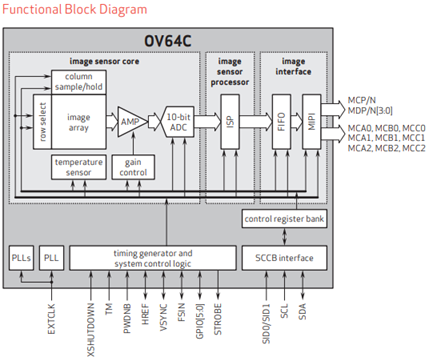 Image Source: Omnivision
This high-performance 64 MP image sensor features a 0.8 µm pixel size to power high-resolution smartphone cameras with an optical format of 1/1.7″.
Designed on OmniVision’s PureCel®Plus stacked die technology, OV64C offers leading-edge still image capture as well as outstanding 4K video performance with electronic image stabilization (EIS) suitable for high-end smartphones.
4-cell remosaic facilitates full resolution Bayer output. The CPHY interface offers high throughput by utilizing fewer pins. This interface makes this sensor ideal for the main rear-facing camera present in multicamera configurations.
Features:
- The integration of hardware re-mosaic and an on-chip 4-cell color filter array offers high-quality, 64MP Bayer output in real-tons; OV64C uses near-pixel binning to deliver 16 MP image output four times sensitive during low-light conditionality. It provides 1.6 µm equivalent performance for still and preview captures.
- 2x digital crop zoom feature is supported with a fast mode switch and 16MP resolution.
- Type-2, 2×2 microlens phase detection autofocus (ML-PDAF) boosts autofocus accuracy, chiefly in low light conditions.
- There is support for 3-exposure, staggered HDR timing for up to 16 MP video modes.
Comparison of Omnivision OV64A vs OV64B vs OV64C:
| Features |
OmniVision
|
OmniVision
|
OmniVision |
| Technology | PureCel®Plus-S | PureCel®Plus-S HDR |
PureCel®Plus-S HDR |
| Resolution | 64 MP | 64 MP | 64 MP |
| Pixel size | 1.008 µm | 0.702 µm | 0.801 µm |
| Image Area | 9354.24 x 7031.808 μm | 6514.56 x 4897.152 μm | 7433.28 x 5587.776 µm |
| Color filter | 4-cell (4C) color filter array | 4-cell color filter array | 4-cell color filter array |
| Optical format | 1/1.32″ | 1/2″ | 1/1.7″ |
| Normal frame rate | Full @ 15 fps | Full @ 15 fps | Full @ 15 fps |
| Video frame rate | 16 MP with 4C binning @ 60 fps, 4K2K video @ 120 fps, 8K video @ 30 fps, 1080p @ 240 fps and 720p @ 480 fps | 1080p @ 240 fps, 720p @ 480 fps, 8K @ 30 fps, 16 MP captures with 4-cell binning @ 30 fps, 4K@ 60 fps and 4K video with EIS @ 30 fps | 8K video @ 30 fps, 16MP captures with 4-cell binning @ 30 fps, 4K video @ 60 fps and 4K video with EIS @ 30 fps |
| Shutter type | Rolling Shutter | Rolling Shutter | Rolling Shutter |
| ADC accuracy | 10 bits | 10 bits | 10 bits |
| Interface | MIPI | SCCB MIPI |
MIPI |
| Autofocus | Fast autofocus | Microlens phase detection autofocus (ML-PDAF) | Microlens phase detection autofocus (ML-PDAF) |
| Output formats | 10-bit HDR RGB RAW | RAW | RAW |
| Chroma | Color | Color 4-Cell |
RGB Bayer 4-Cell |
| Operating temperature | -30°C to +85°C | -30°C to +85°C | -30°C to +85°C |
| Power requirement | Standby: <10 µW Active: ~765 mV (64MP @ 15 fps) |
Standby: <10 µA Active: 647 mW (64MP @ 15 fps) |
Standby: <12 µA Active: 790 mW (64MP @ 16 fps) |

Concluding Note:
The large pixel size of 1.0 µm in OV64A offers great sensitivity and superior low-light performance. It is an ideal choice for high-end smartphones. OV64B and OV64C offer excellent autofocus accuracy in low-light conditions.
OV64B offers 1.4 µm equivalent performance for still and previews capture whereas OV64C offers 1.6 µm equivalent performance for still and previews capture.
