

In this post, we are comparing Samsung’s ISOCELL Plus vs EXMOR-RS CMOS sensor by Sony semiconductor. Both imaging sensors are built for entirely different camera form factors. The Sony sensors are for their flagship range of mirrorless cameras, whereas ISOCELL+ is for smartphones.
ISOCELL Plus and EXMOR-RS CMOS sensors improve image quality in the latest camera models. Let’s go through the details of each of them:
ISOCELL Plus sensor:
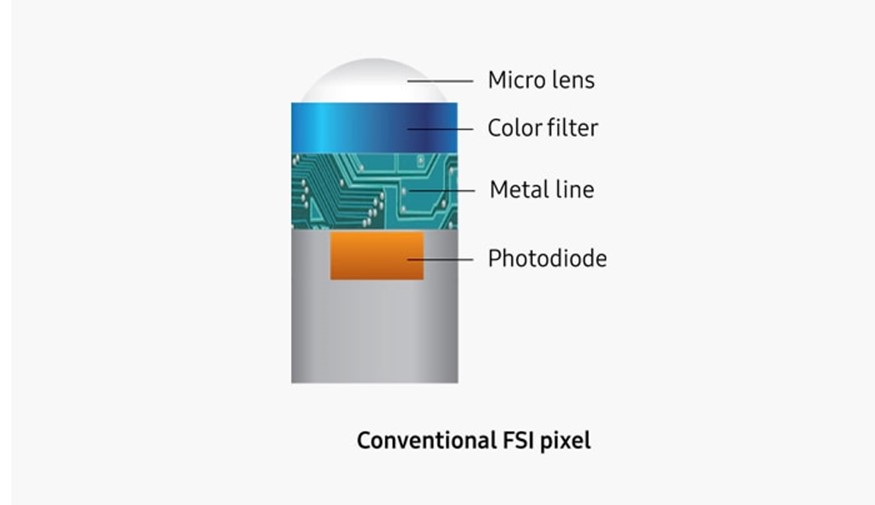 The latest ISOCELL Plus sensor technology from Samsung powers the top-notch cameras seen on the brand’s flagship devices. Samsung tackled the engineering challenges of smartphone cameras and built the ISOCELL Plus technology, which pushes the boundaries of the image sensor to convey color-accurate, crystal-clear photos even in challenging lighting conditions.
ISOCELL technology enables a broader chief ray angle (CRA) by capturing more diagonal light. This eventually allows a brighter lens with a wider aperture that produces clear and more luminous pictures even in low light conditions.
Because of their design, ISOCELL image sensors can also decrease the height of the camera module irrespective of the resolution. Hence, these sensors adopt the sleek form factor of contemporary smartphones.
Five years after the inception of ISOCELL, Samsung has elevated the image sensing technology further with the ISOCELL Plus.
In the traditional ISOCELL technology, the metal grids that isolate the color filter decreases interference between pixels. Also, they lead to some optical loss because they absorb reflected light or incoming light from the neighboring pixels.
On the other hand, the ISOCELL Plus sensor substitutes that metal barrier with an advanced new material developed by Fujifilm. So, it minimizes light reflection and optical loss. The latest ISOCELL Plus technology indicates more accurate and sharper photos, although challenging light environments exist.
The ISOCELL Plus sensor features higher color fidelity and 15% more light sensitivity. Moreover, this sensor is compatible with super-resolution cameras with more than 20 MP resolutions. The technology also allows the image sensor to equip pixel-sized 0.8 µm or smaller without any performance loss. Hence, this sensor is an optimal solution for high-resolution cameras.
ISOCELL Plus sensor not only facilitates the development of ultra-high-resolution sensors with its small pixels but will also provide a performance boost for sensors with more significant pixel designs. The pixels are separated through a unique coating material, leading to a rise in density by 30%.
Samsung launched ISOCELL Plus in July 2018, and since then, it has progressively extended its image sensor lineup built on the technology.
Exmor-RS CMOS sensor:
 Sony developed Exmor-RS, the world’s foremost stacked CMOS image sensor that conveys superior picture quality in a compact size. It is designed for use in tablets and smartphones. It includes a unique, advanced ‘stacked structure.’
Sony built this 35 mm full-frame stacked CMOS image sensor with the built-in memory for the high-performance α9. It leads to a lighter and smaller professional camera.
In addition to offering outstanding imaging performance, it entails multiple functions that help reduce components to trim the weight and size of the α9. The idea behind the development is to use natural resources. The structure layers the pixel section that shows results of back-illuminated pixels on the chip attached with mounted circuits for signal processing.
This α9 sensor significantly boosts image quality and performance through powerful AF; vibration-free, silent, constant shooting up to 20 fps, and a blackout-free viewfinder. Note that this sensor packs all the features of a conventional digital SLR mirror, AF sensor, mechanical shutter, and optical finder.
Along with these, it reduces the physical size and weight of the camera. Compared to a conventional full-frame DSLR, for example, Sony’s first full-frame model α900, the α9 is approx. 20% smaller. So, it is easier to carry anywhere. Moreover, this sensor offers performance and speeds beyond the capabilities of other sensor models while using fewer resources.
Sony will also unveil three corresponding imaging modules equipped with these sensors. Of these three modules, two Exmor-RS models that Sony will launch are IMX135 (type 1/3.06 model with 13.13 effective megapixels) and IMX1344 (type 1/4 model with 8.08 effective megapixels). They feature the ‘HDR (High Dynamic Range) movie’ function and the ‘RGBW coding’ function.
HDR movie function allows the configuration of two unique exposure conditions on a single screen when shooting. It flawlessly performs image processing to produce optimal images with brilliant colors and a broad dynamic range, irrespective of the light conditions.
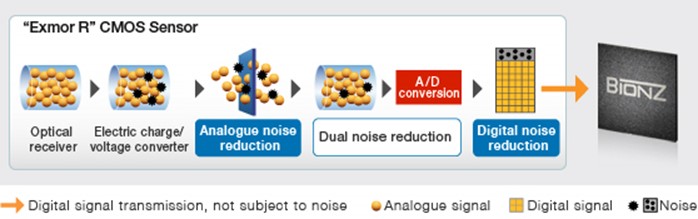
RGBW coding function can capture clear, sharp images even when captured in low light conditions. This function features W (white) pixels in addition to the conventional RGB (red-green-blue) pixel. It leverages Sony’s proprietary device technology and signal processing to enhance sensitivity without negotiating its high resolution.
The third Exmor RS imaging module is the ISX014 (type 1/4 model with 8.08 effective megapixels). It has an in-built camera signal processing function.
Critical features of Exmor RS stacked CMOS image sensor:
- Commercializing the latest, independently developed Exmor-RS, equipped with the world’s first unique stacked structure.
- The corresponding stacked structure offers superior image quality and a more compact size.
- Implemented with ‘HDR movie’ and ‘RGBW coding’ functions (“IMX135” and “IMX134”)
- It is implemented with a built-in camera signal processing function that provides compatibility with picture adjustment, automatic controls, and multiple image output formats (like YUV) (“ISX014”).
ISOCELL Plus vs. EXMOR-RS CMOS sensor:
| ISOCELL Plus sensor | Exmor-RS CMOS sensor |
| Compatible with cameras with a resolution of more than 20 MP | Compatible with cameras with resolution up to 13.3 MP |
| Equip pixels of size 0.8 µm or smaller without any performance loss | The corresponding camera models are 20% smaller than full-frame DSLR cameras |
| Improves the image quality using higher color fidelity and 15% more light sensitivity | Improves the image quality and performance using powerful AF; constant shooting up to 20 fps, and a blackout-free viewfinder |
| The output minimizes optical loss and light reflection | The optimal image output shows brilliant colors, sharpness, clarity, and a broad dynamic range, irrespective of the light conditions |
