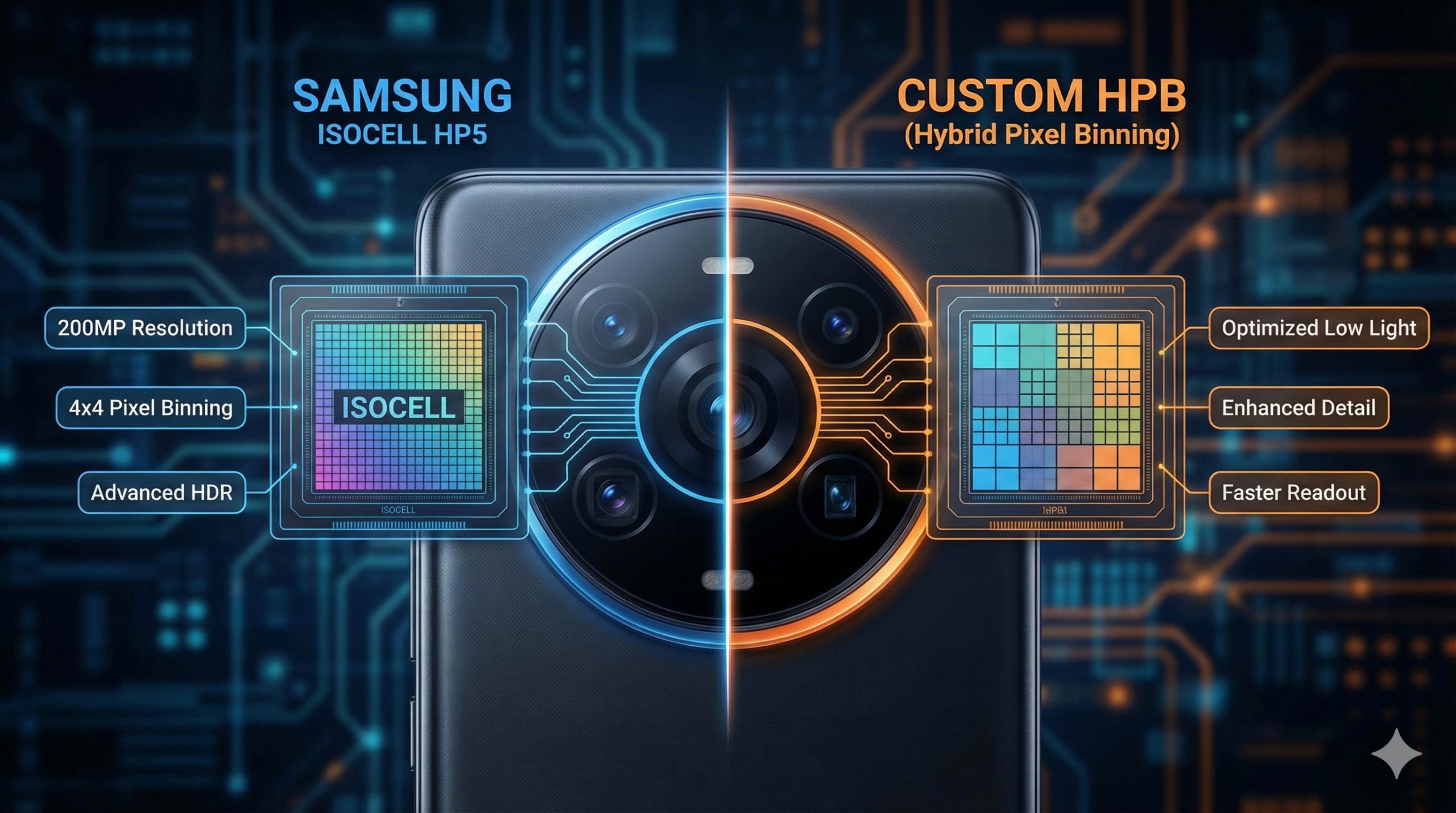
The move toward 200MP telephoto cameras has created two distinct engineering paths. Samsung Electronics currently manufactures two separate high-resolution sensors for periscope zoom lenses: the standard ISOCELL HP5 and the custom-tuned ISOCELL HPB.
Although both capture 200 million pixels, they solve different problems. The HP5 uses a 0.5µm pixel pitch to fit inside thin foldables, while the HPB employs a larger 1/1.4-inch optical format and proprietary Blue Glass filters to capture more light in “Ultra” tier devices like the Vivo X300 Pro.
This analysis examines the physical architecture, diffraction limits, and thermal performance differences between these two sensors.
Samsung ISOCELL HP5 vs. Custom HPB: The Battle for Telephoto Supremacy
Two 200MP sensors. Two different philosophies. One creates slim foldables; the other replaces your DSLR.
LensXP Sensor Lab
Analysis by Silicon & Optics Team
The semiconductor imaging market is undergoing a significant shift. Ultra-high-resolution sensors are migrating from primary cameras to telephoto periscope systems. This analysis focuses on Samsung Electronics’ two premier 200MP telephoto solutions: the ISOCELL HP5 and the custom-tuned ISOCELL HPB.
Both sensors use 200 million pixels to allow for digital cropping and zooming. However, they follow opposing engineering paths. The ISOCELL HP5 uses a 0.5µm pixel pitch and a 1/1.56-inch optical format. It is designed for volumetric efficiency. This fits high-performance telephotography into slim flagships and foldables.
In contrast, the ISOCELL HPB (a custom version of the HP9 co-developed with Vivo) prioritizes optical quality. It features a larger 1/1.4-inch format, 0.56µm pixels, and a proprietary “Blue Glass” filter. It serves “Ultra” tier systems where size is secondary to image fidelity.
Visualizing the Scale
CANVAS RENDERER v2.1Data Source: Samsung Semiconductor Datasheets (Prelim 2025)
ISOCELL HP5
The Compact Performer
- 0.5µm Pixel Pitch: Extreme miniaturization allows 200MP in a 1/1.56″ format, critical for foldable thickness constraints (<10mm devices).
- D-VTG Technology: Dual Vertical Transfer Gates boost Full Well Capacity (FWC) by up to 66%, compensating for the small pixel area.
- Target Devices: Foldables like the Find N6, Mix Fold 5, and slim “Pro” models.
ISOCELL HPB
The Optical Giant
- 0.56µm Pixel Pitch: 25.6% larger pixel surface area. Native sensitivity is higher, reducing gain requirements in low light.
- Blue Glass Filter: A spin-coated absorptive layer that eliminates internal reflections (ghosting) common in night cityscapes.
- CIPA 5.5 Stabilization: Required due to the larger, heavier lens elements needed to cover the 1/1.4″ format.
The Aperture Bottleneck: Diffraction Limits
A critical, often overlooked limitation of the 0.5µm (HP5) and 0.56µm (HPB) pixels is diffraction. As periscope lenses typically operate between f/2.5 and f/4.3, the physical size of the light spot (Airy disk) begins to exceed the size of the individual pixel.
When the aperture narrows, the resolution is no longer limited by the sensor’s megapixel count, but by the physics of light itself. The HPB, having slightly larger pixels and usually paired with brighter f/2.6 optics (in Vivo implementations), hits this diffraction wall later than the HP5, which is often paired with slower f/3.0+ optics in foldables to save Z-height.
Diffraction & Pixel Pitch Simulator
Airy Disk Diameter: — µm
Calculating physics limit…
The Physics of Electron Wells (D-VTG)
The central challenge of the HP5 is the 0.5µm pixel. As pixels shrink, the “bucket” available to hold electrons (photons converted to charge) shrinks. This typically leads to “blown out” highlights (low full well capacity).
To counter this, the HP5 employs Dual Vertical Transfer Gates (D-VTG). Instead of one gate controlling electron flow, two gates act in tandem to deeper transfer capacity. This allows the HP5 to maintain dynamic range comparable to older 0.7µm sensors, despite the physical reduction.
Impact on HDR
Without D-VTG, the HP5 would clip highlights instantly in daylight. This tech is less critical on the HPB, which relies on sheer surface area, but is fundamental to the HP5’s existence.
In-Sensor Zoom Calculator
Estimate the effective focal length and resolution when cropping into these 200MP sensors.
*Note: HPB retains higher modulation transfer function (MTF) at 4x crop due to superior lens optics, whereas HP5 may show softness at edges.
The Processing Pipeline: 600MB/s Bandwidth
Moving 200 million pixels puts an enormous strain on the Image Signal Processor (ISP). The data stream for a single 14-bit RAW frame exceeds 300MB. Burst shooting or video recording saturates the MIPI bus instantly.
Vivo’s Approach (HPB): They utilize a dedicated imaging chip (V3+) to handle the debayering of the proprietary color filter array before the data even hits the main Snapdragon processor. This allows for real-time 4K cinematic previews.
Samsung’s Approach (HP5): To fit into foldables without dedicated imaging chips, the HP5 relies heavily on “Remosaic” algorithms running on the main SoC (Snapdragon 8 Gen 5). This can lead to slightly higher shutter lag compared to the hardware-accelerated HPB pipeline.
Battery Impact
Processing 200MP full-res shots consumes roughly:
- HPB (Dedicated Chip): ~450mA
- HP5 (SoC Software): ~520mA
Estimated peak draw during burst capture.
Vivo X300 Pro
The definitive showcase for the ISOCELL HPB. Featuring a 200MP Zeiss-tuned periscope lens, this device pushes the boundaries of mobile photography with the industry’s first “Blue Glass” stabilized sensor array.
Full Technical Specifications
| Feature | Samsung ISOCELL HP5 | Samsung ISOCELL HPB (Custom) |
|---|---|---|
| Resolution | 200 MP (16,320 x 12,240) | 200 MP (16,320 x 12,240) |
| Sensor Format | 1/1.56″ Type | 1/1.4″ Type (Larger) |
| Pixel Architecture | 0.5µm w/ D-VTG | 0.56µm w/ Floating Cell |
| Autofocus | Super QPD (Quad Phase Detection) | QPD + Laser AF Assist (OEM Dependent) |
| Filter Type | Standard IR Cut | Blue Glass (Spin-coated) |
| Video Max | 8K 30fps / 4K 120fps | 8K 30fps / 4K 120fps (High Bitrate) |
| Telemacro | Fixed Element (Usually >15cm focus) | Floating Element (Focus <8cm) |
| Readout Speed | Fast (Small thermal envelope) | Standard (Requires cooling chamber) |
| Zoom Fidelity | High (DSP Enhanced) | Ultra-High (Optical Clarity) |
The Competition: Sony IMX858 vs. Samsung 200MP
Sony IMX858 (50MP)
USED IN: XIAOMI ULTRA, OPPO FIND X ULTRA
Sony prioritizes dynamic range and consistency over raw resolution. The IMX858 is physically smaller (1/2.51″) but pairs with faster f/1.8 lenses in dual-periscope setups. It relies on “Optical reach” rather than “Digital Crop.”
Samsung HP5/HPB (200MP)
USED IN: VIVO X ULTRA, HONOR MAGIC
Samsung bets on versatility. A single 200MP sensor can act as a 3x, 6x, and 10x lens simultaneously via cropping. While the IMX858 offers cleaner raw files at native 5x, the HPB outperforms it at intermediate zoom steps (e.g., 7.5x) where the Sony must interpolate.
Video Implications: 4K120 and Thermal Throttling
While photography is the primary battleground, video performance differs. The HP5, often situated in thinner chassis (foldables), faces steeper thermal throttling curves. While capable of 4K at 120fps, sustained recording often drops to 60fps to preserve sensor integrity.
The HPB benefits from the larger chassis of “Ultra” phones. This allows for massive vapor chamber cooling solutions. Consequently, HPB implementations typically support sustained high-bitrate LOG recording and longer durations of 8K video capture without overheating.
Market Implications 2026
The HP5 enables the “Compact Super-Telephoto” era. Devices like the Find N6 use this to offer 10x-quality zoom in a foldable form factor. The HPB cements the status of “Camera Replacement” phones like the X200 Ultra, targeting users who accept ergonomic bulk for optical supremacy comparable to dedicated mirrorless cameras.